On this page
Your textbook says that any strong acid with any strong base releases about 57 kJ per mole of water. One of the first tables to show this was published in 1871 by Julius Thomsen of Copenhagen. Hydrochloric acid, nitric acid, soda, potash and lithia all landed near 13,700 calories. Acetic acid and ammonia fell short, and sulphuric acid overshot. We read Thomsen's table in its English abstract in the Journal of the Chemical Society, volume 24 (1871), pages 875–878, on the scanned pages at the Internet Archive. His life story is from Sir Edward Thorpe's Thomsen Memorial Lecture, delivered on 17 February 1910 and printed in the Journal of the Chemical Society, Transactions, volume 97.
Who was Julius Thomsen?
Thorpe gives his birth in Copenhagen on 16 February 1826. He entered the Polytechnic there in 1843. His first paper, in 1852, was titled "Bidrag til en Thermochemisk System" (contributions to a thermochemical system).
He also built an industry. In 1853 he patented a way to make soda from cryolite, a sodium aluminium fluoride found almost only in Greenland. Heating cryolite with chalk gave calcium fluoride and sodium aluminate. Carbon dioxide then precipitated alumina and left sodium carbonate in solution. The factory at Oeresund, near Copenhagen, made his fortune. He was a municipal councillor of Copenhagen "for more than a third of a century".
The science came in parallel. His thermochemical papers were collected as Thermochemische Untersuchungen, four volumes, 1882–1886. Thorpe says they "comprise more than 3500 calorimetrical estimations", all "made by Thomsen personally". In 1883 he and Marcellin Berthelot shared the Davy Medal of the Royal Society. Berthelot's own method is in how Marcellin Berthelot built the bomb calorimeter.
What did Thomsen's 1871 table measure?
The abstract states the conditions exactly. Each figure is the heat evolved "when one molecule of sulphuric hydrate or an equivalent quantity of another acid, diluted with 400 molecules of water, is neutralised with an equivalent quantity of base in the same state of dilution." So "800 molecules of water enter into the reaction for every molecule of salt formed".
The key detail for converting: every entry is for two equivalents, written as (2NaAq, 2HClAq). That forms 2 moles of water, so you divide by 2. The units are not named; gram-calories fit, as the conversion below shows. Selected values from Table I:
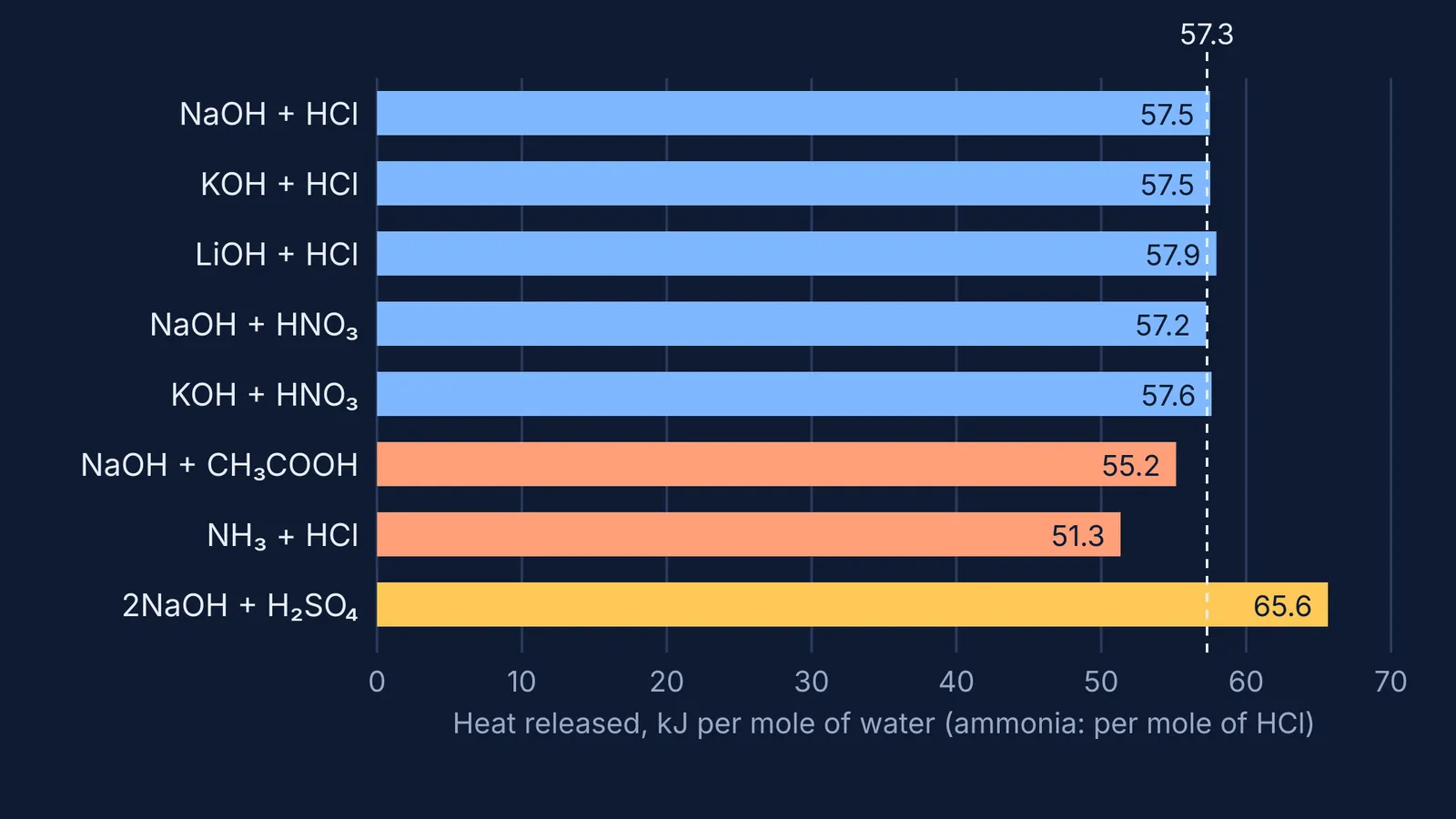
2NaOH + 2HCl: 27,490. 2KOH + 2HCl: 27,500. 2LiOH + 2HCl: 27,700.
2NaOH + 2HNO₃: 27,360. 2KOH + 2HNO₃: 27,540.
2NaOH + 2CH₃COOH: 26,370. 2KOH + 2CH₃COOH: 26,430.
2NH₃ + 2HCl: 24,540.
2NaOH + H₂SO₄: 31,380.
His Table III adds more acids with soda: HBr 27,500, HI 27,350 and HClO₃ 27,520.
Worked example: how do you convert Thomsen's numbers to kJ/mol?
Take NaOH with HCl.
Per mole of water. 27,490 ÷ 2 = 13,745 cal.
To joules. 13,745 × 4.184 = 57,509 J.
To kJ with a sign. ΔH = −57.5 kJ/mol. The reaction gives out heat, so the sign is negative.
Do the same for every strong pair and you get 13,680 to 13,850 cal, that is 57.2 to 57.9 kJ/mol, around the familiar textbook figure of 57.1 to 57.3.
Now acetic acid, a weak acid.
Per mole of water. 26,370 ÷ 2 = 13,185 cal, which is 55.2 kJ/mol.
Split by Hess's law. CH₃COOH(aq) → CH₃COO⁻(aq) + H⁺(aq), ΔH_ion. Then H⁺(aq) + OH⁻(aq) → H₂O(l), −57.5 kJ/mol. The sum is CH₃COOH(aq) + OH⁻(aq) → CH₃COO⁻(aq) + H₂O(l), −55.2 kJ/mol.
Subtract. ΔH_ion = −55.2 − (−57.5) = +2.3 kJ/mol. With KOH instead, 26,430 against 27,500 gives +2.2.
Treat this as Thomsen's number under his conditions, not a constant to memorise. His own Table III gives acetic acid with soda as 26,310, which makes the gap 2.4. The general method is in why the heat of neutralisation of a weak acid is less.
Ammonia is a weak base: 24,540 ÷ 2 gives 12,270 cal, or 51.3 kJ, a shortfall of 6.2 kJ. Here no water forms (NH₃ + H⁺ → NH₄⁺), so the value is per mole of HCl neutralised, not per mole of water.
Why is the heat the same for every strong acid?
Thorpe explained it in 1910 in the language of the time. Thomsen's "observation that the heat of neutralisation is the same for a long series of inorganic acids, such as hydrochloric acid, hydrobromic acid, hydriodic acid, chloric acid, nitric acid, etc., supports the theory of electrical dissociation". The reason: "the process of neutralisation for all of them is the combination of the ion of hydrogen in the acid with the ion of hydroxyl of the base to form water."
In modern symbols: Na⁺(aq) + OH⁻(aq) + H⁺(aq) + Cl⁻(aq) → Na⁺(aq) + Cl⁻(aq) + H₂O(l). Cancel the spectators and only H⁺ + OH⁻ → H₂O is left. Thomsen's data came in 1871. Arrhenius's ionic theory, which made sense of it, came only in 1887.
Thorpe draws a second lesson: the heat of neutralisation "cannot be considered as a measure of the strength of the acids". Table III shows why. Hydrocyanic acid with soda gives 5,530, only 11.6 kJ per mole. Hydrofluoric acid, also weak, gives 32,540, or 68.1 kJ, more than any strong acid. The reason is in why HF's enthalpy of neutralisation is higher than strong acids.
Why does sulphuric acid release more heat?
2NaOH + H₂SO₄ gave 31,380, which is 15,690 cal or 65.6 kJ per mole of water, 8.1 kJ above HCl. Thomsen did not treat it as an error. On page 878 he reports the sulphuric-minus-hydrochloric difference for soda by three independent methods: direct neutralisation 3,890, decomposing the sulphate with barium chloride 3,872, and partial decomposition 3,852. Their mean, 3,871, is 8.1 kJ per mole of water.
The abstract gives no explanation. Here is a modern one, which we have not checked against Thomsen's text. HSO₄⁻ is a much weaker acid than H₂SO₄, so at this dilution part of the second proton stays bound as HSO₄⁻. Neutralising HSO₄⁻ is therefore not just H⁺ + OH⁻, and that extra step releases more heat. Use it as a hint, not as Thomsen's view.
Does Thomsen's 57.5 disagree with the 25 °C value?
Not necessarily. The modern value at 25 °C and infinite dilution is −55.8 kJ/mol, and it becomes more negative as the temperature falls. The abstract does not state Thomsen's temperature or correct to infinite dilution, so his 57.2–57.9 should not be read as a correction to anyone's textbook. Thorpe also credits Thomsen with showing, through heats of neutralisation, solution and dilution, that reaction heats change with temperature as Kirchhoff's relation requires. The numbers are worked out in why the enthalpy of neutralisation changes with temperature.
If ionisation and spectator ions still feel abstract, the Concept Library gives each concept its own lesson. For exam practice, Fermi's AI tutor for JEE prep is part of Fermi Test Prep for JEE Main and Advanced.
Quick checklist
Thomsen's 1871 entries are for 2 moles of water: halve, then multiply by 4.184.
Strong acid with strong base: 13,680 to 13,850 cal, or 57.2 to 57.9 kJ/mol.
Weak acid shortfall = ionisation enthalpy: +2.3 kJ/mol for acetic acid in his data.
For ammonia the value is per mole of acid, since no water forms.
Sulphuric acid gives 8.1 kJ more per mole of water, confirmed three ways.
Heat of neutralisation is not a measure of acid strength: compare HCN and HF.