On this page
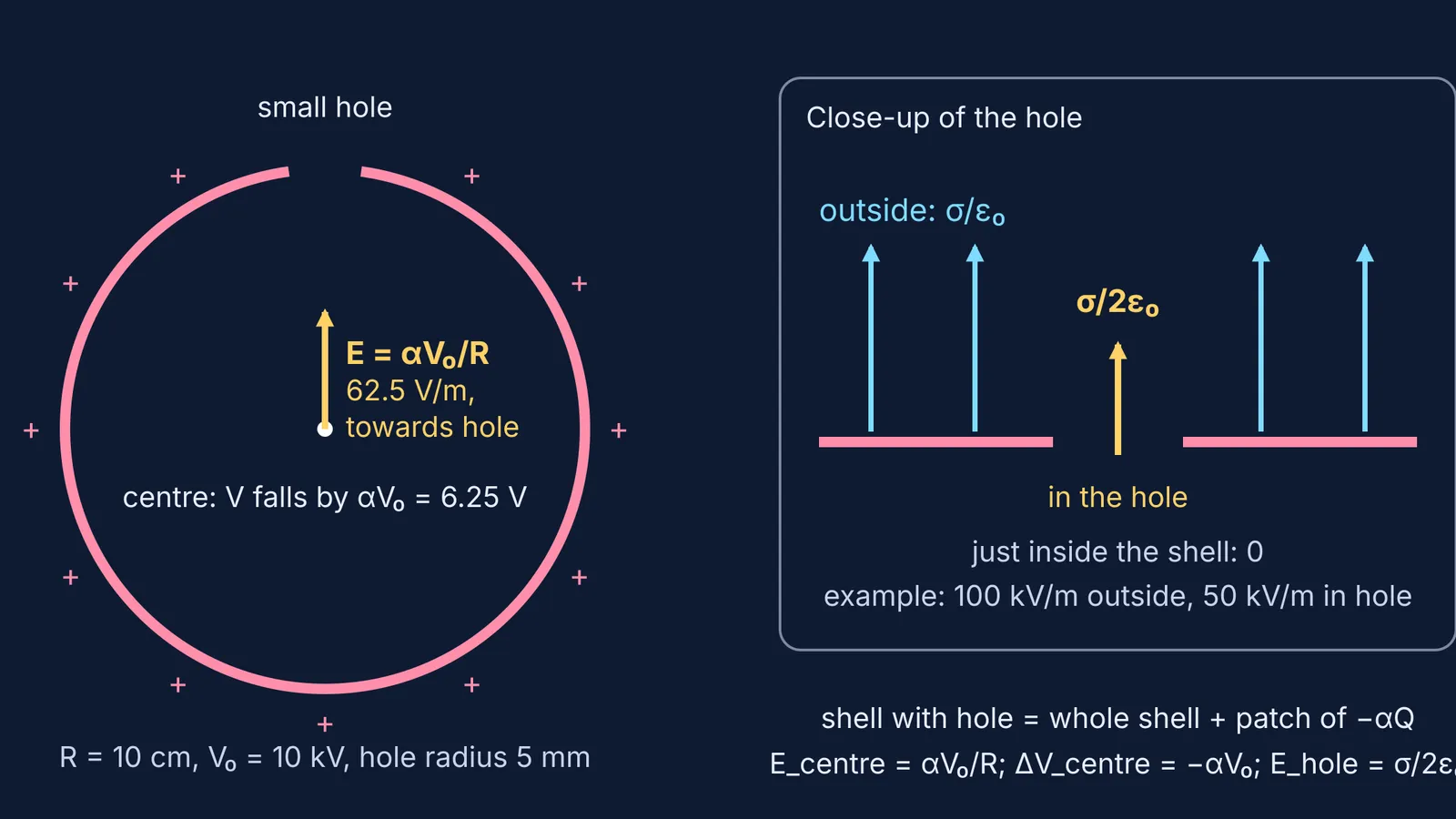
Inside a uniformly charged spherical shell the electric field is zero everywhere, and the potential is the same as on the surface. Now cut a tiny hole in the shell. The field at the centre is no longer zero, the potential inside drops slightly, and the field right in the hole turns out to be exactly half the field just outside the shell. One idea gives all three results: superposition. JEE Advanced used this setup in 2019, and this post works it with numbers.
How do you handle a shell with a hole in it?
Do not try to integrate over the shell with a piece missing. Instead, think of the shell with a hole as two things added together:
A complete shell with uniform surface charge density σ and total charge Q.
A small patch of charge density −σ sitting exactly where the hole is.
The −σ patch cancels the shell's charge over the hole, so the sum is the shell with a hole. Let the hole's area be a fraction α of the whole surface, so the patch carries charge −αQ. This trick is the same one used for a charged sheet with a circular hole.
The shell is a thin insulating shell, so its charge stays where it was put. That matters, as explained below.
What is the field at the centre now?
The complete shell gives zero field at the centre. So the whole field comes from the patch.
Seen from the centre, a small patch at distance R looks like a point charge −αQ. Its field has magnitude
E = αQ/(4πε₀R²) = αV₀/R, using V₀ = Q/(4πε₀R) for the potential of the shell.
The patch is negative, so its field points towards it. The field at the centre points towards the hole. That makes sense: the charge on the far side is no longer balanced by charge on the near side, and it pushes a positive test charge towards the gap.
You can check this against an exact result. A cap of half-angle β on a sphere produces a field (σ/4ε₀) sin²β at the centre. For β = 90°, a hemisphere, that is the σ/4ε₀ worked out in the field at the centre of a charged hemisphere. For a small cap it gives αV₀/R again.
How much does the potential inside change?
The complete shell gives V₀ everywhere inside. The patch adds −αQ/(4πε₀d), where d is the distance from the patch.
At the centre: d = R, so V = V₀ − αV₀ = V₀(1 − α).
At R/2 from the centre, towards the hole: d = R/2, so V = V₀ − 2αV₀ = V₀(1 − 2α).
The ratio: V(centre)/V(R/2) = (1 − α)/(1 − 2α).
This was Q.2 of JEE Advanced 2019 Paper 1. The ratio (1 − α)/(1 − 2α) is option C. The other options fail on the working above. The potential at the centre falls by αV₀, not 2αV₀. The field at the centre rises from zero to αV₀/R; it is not "reduced". At a distance 2R from the centre on the hole side, the patch is a distance R away, so the field falls by αV₀/R, not αV₀/(2R).
Why is the field in the hole half the field outside?
Now look right at the hole, where the patch is no longer a distant point. Very close to it, the small patch looks like a flat sheet, and a sheet of charge σ gives a field σ/2ε₀ on each side, pointing away from it on both sides.
Split the field just at the surface of the complete shell into two parts: the patch's own field, and the field of all the rest of the shell.
Just inside: the total is zero, so the rest of the shell must give σ/2ε₀ outwards, cancelling the patch's σ/2ε₀ inwards.
Just outside: the rest gives σ/2ε₀ outwards, and the patch adds another σ/2ε₀ outwards, total σ/ε₀. That is the familiar field just outside a charged surface.
In the hole: the patch is gone, and only the rest of the shell remains. E = σ/2ε₀, outwards, exactly half of σ/ε₀.
The factor of 2 between σ/ε₀ and σ/2ε₀ is the one compared in the field near a conductor versus a sheet. The same "rest of the surface gives σ/2ε₀" step is how Griffiths (Introduction to Electrodynamics, section 2.5.3) finds the force on a surface charge. Alan Guth's MIT 8.07 lecture notes on surface forces explain it as the charge feeling the average of the field outside and the zero field inside.
Worked example: a 10 cm shell at 10 kV with a 5 mm hole
Take a thin insulating shell of radius R = 0.10 m at potential V₀ = 10 kV, with a circular hole of radius a = 5 mm. These are illustrative numbers.
Charge. Q = 4πε₀RV₀ = 4π × 8.854 × 10⁻¹² × 0.10 × 10⁴ = 111 nC.
Surface density. σ = Q/(4πR²) = 0.885 µC/m².
Field just outside. σ/ε₀ = V₀/R = 100 kV/m.
Area fraction. α = πa²/(4πR²) = a²/(4R²) = 25/40,000 = 6.25 × 10⁻⁴.
Field at the centre. αV₀/R = 6.25 × 10⁻⁴ × 10⁵ = 62.5 V/m, towards the hole.
Potential at the centre. Falls by αV₀ = 6.25 V, to 9,993.75 V.
Field in the hole. σ/2ε₀ = 50 kV/m, outwards.
Potential at the middle of the hole. Near the hole the patch is a disc, and a uniform disc of radius a has potential σa/2ε₀ at its own centre. So the potential there falls by 0.885 × 10⁻⁶ × 0.005/(2 × 8.854 × 10⁻¹²) = 250 V, to 9,750 V.
The potential at the centre barely changes, but the potential in the hole drops by 40 times as much, because the missing charge is right there.
When does this result not hold?
On a conductor, charge is free to move. It would redistribute after the hole is cut, so the interior field would return to zero and the answers above would not apply.
For a large hole, α is no longer small, and you need the exact cap formula rather than a point charge.
The outward push on the shell's charge, σ²/2ε₀ per unit area, comes from the same σ/2ε₀ field, which is why a charged soap bubble expands.
The Fermi Problem Library has superposition problems with a step-by-step solver that explains the reasoning. If you are preparing for JEE Main & Advanced, Fermi Test Prep offers personalised preparation with an AI tutor, live classes, adaptive mocks, mentorship and a study plan that updates based on mastery.
Quick checklist
Shell with hole = complete shell + patch of charge −αQ.
Field at centre: αV₀/R, pointing towards the hole.
Potential: V₀(1 − α) at the centre, V₀(1 − 2α) at R/2 towards the hole.
Field in the hole: σ/2ε₀, half the σ/ε₀ just outside.
Point-charge patch for distant points; flat-sheet patch for points at the hole.
Insulating shell only: on a conductor the charge moves.