On this page
Pectin is what makes jam set. Chemically it is a long chain of galacturonic acid units, and some of their COOH groups carry a methyl ester. The fraction that is esterified is the degree of esterification (DE). The Bureau of Indian Standards measures it, and the galacturonic acid content, with two NaOH titrations in one flask. Each step is Class 11 and 12 chemistry: acid-base titration, ester hydrolysis and a back titration.
What is pectin, chemically?
IS 15929:2012, the Indian standard for food-grade pectin, says pectin "consists mainly of the partial methyl esters of polygalacturonic acid and their sodium, potassium, calcium and ammonium salts", extracted with water from "usually citrus fruits or apples". In some types, part of the esters are turned into amides with ammonia. The commercial product is normally diluted with sugar.
So each unit in the chain has its C-6 carbon in one of three forms:
–COOH (or a salt such as –COO⁻Na⁺): a free acid group.
–COOCH₃: a methyl ester.
–CONH₂: an amide, found only in amidated pectin.
Table 1 of the standard sets a minimum of 65% galacturonic acid, on an ash-free, dried basis, and a maximum degree of amidation of 25% of the carboxyl groups. Both are measured by the method in Annex H.
How does the first titration count the free COOH groups?
Annex H starts with a wash:
Weigh 5 g of pectin and stir it for 10 minutes with 5 mL of hydrochloric acid and 100 mL of 60% ethanol.
Filter. Wash with more of the HCl–60% ethanol mixture, then with 60% ethanol until the washings are free of chloride, then with ethanol.
Dry for 2.5 hours at 105 °C and weigh. Call this mass x, in mg.
The HCl turns every –COO⁻ salt into –COOH. The added sugar washes out while the pectin stays behind. Washing until no chloride is left removes free HCl, which would otherwise be titrated too.
One-tenth of x (standing for 0.5 g of the original pectin) is titrated with 0.1 M NaOH to phenolphthalein:
–COOH + NaOH → –COO⁻Na⁺ + H₂O
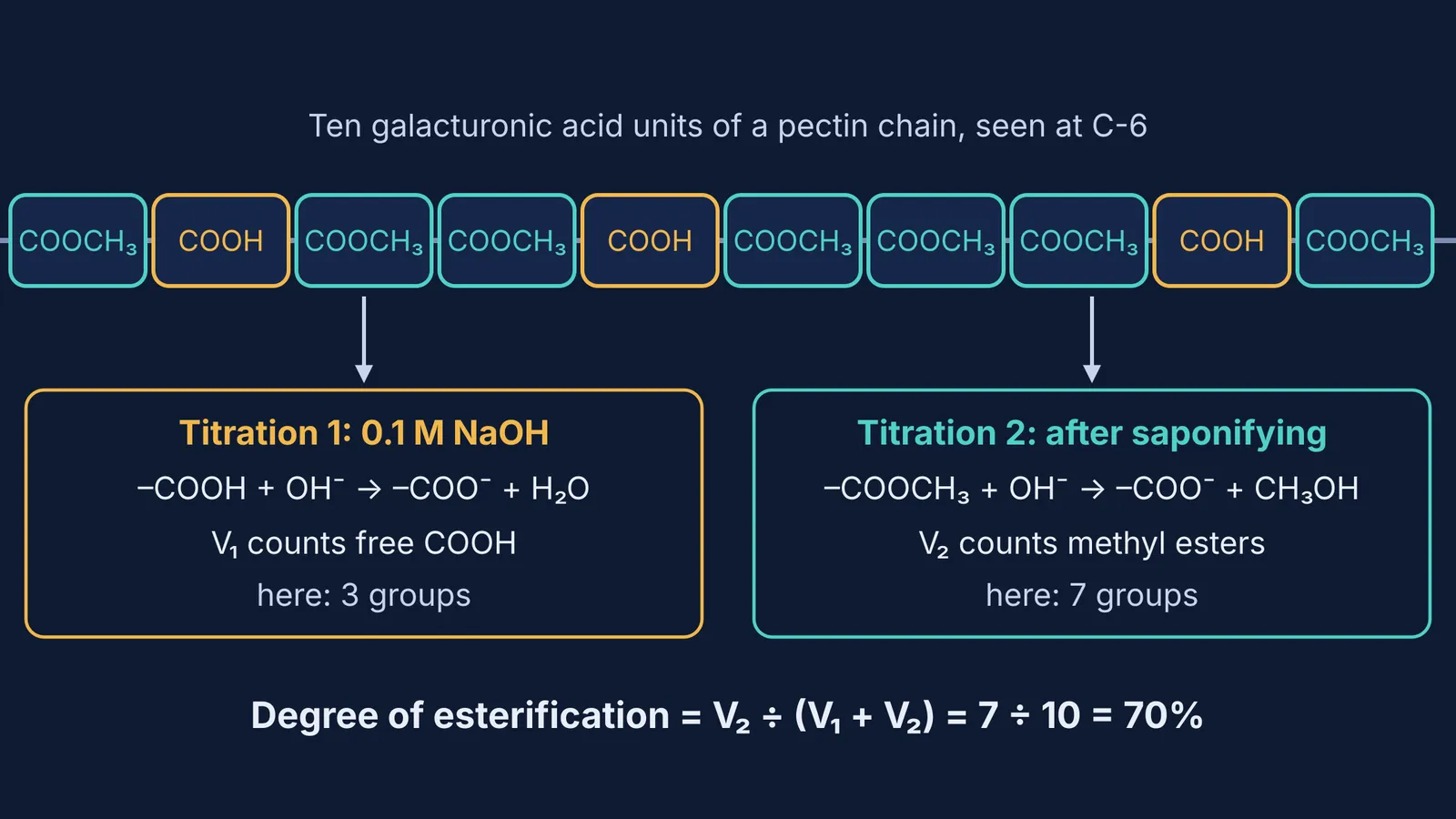
This is the initial titre, V₁. One NaOH reacts with one COOH, so V₁ × 0.1 gives the millimoles of free carboxyl groups.
How does the second titration count the methyl esters?
Add exactly 20 mL of 0.5 M NaOH (10.0 mmol), stopper, shake and leave for 15 minutes. The esters are saponified: –COOCH₃ + OH⁻ → –COO⁻ + CH₃OH.
Add exactly 20 mL of 0.5 M HCl (10.0 mmol) and shake until the pink colour goes.
Titrate with 0.1 M NaOH to a faint pink that lasts. This is the saponification titre, V₂.
Why does V₂ count the esters? Say the esters used up n mmol of OH⁻. That leaves 10 − n mmol of OH⁻. The 10 mmol of HCl neutralises it and has n mmol left over, which turns n carboxylate groups back into COOH. So the final titration needs exactly n mmol of NaOH. The two 20 mL portions cancel, and only what the esters consumed shows up.
This is a back titration with a twist: the leftover base is cancelled with an equal amount of acid. That only works if the two portions really are equal. A 1% mismatch between them is 0.1 mmol, which would shift V₂ by a whole 1 mL of 0.1 M NaOH. That is why the standard says "exactly" twice. For the alkaline hydrolysis itself, see esterification vs saponification.
For non-amidated pectin, the formula in the standard reduces to:
DE = 100 × V₂ ÷ (V₁ + V₂)
The denominator is every carboxyl group, free plus esterified. For amidated pectin, the amide groups are distilled off as NH₃ into standard HCl and that titre (B − S) joins the denominator. The full formulas also subtract an acetate-ester titre (A − A₀), which the standard calls usually insignificant for apple or citrus pectin.
How do you get DE and galacturonic acid from the titres?
Annex H gives the galacturonic acid in the titrated portion, for non-amidated pectin, as:
Galacturonic acid (mg) = 19.41 × (V₁ + V₂)
Where does 19.41 come from? Each mL of 0.1 M NaOH is 0.1 mmol, and each carboxyl group belongs to one galacturonic acid unit. Galacturonic acid, C₆H₁₀O₇, has M = 194.14 g/mol. So 1 mL stands for 0.1 × 194.14 = 19.41 mg.
Worked example. A washed, dried pectin weighs x = 4,200 mg. One-tenth, 420 mg, is titrated. V₁ = 4.5 mL and V₂ = 10.5 mL of 0.1 M NaOH.
Total carboxyl groups. V₁ + V₂ = 15.0 mL, which is 1.50 mmol.
Degree of esterification. DE = 100 × 10.5 ÷ 15.0 = 70.0%.
Galacturonic acid in the portion. 19.41 × 15.0 = 291.1 mg.
Percent. The standard multiplies by 1,000/x: 291.1 × 1,000 ÷ 4,200 = 69.3%. That is above the 65% minimum, so the sample passes.
Methanol freed by saponification. 10.5 × 0.1 = 1.05 mmol of CH₃OH, or 1.05 × 32.04 = 33.6 mg.
Notice what the factor reports: free galacturonic acid, 194.14 g/mol per unit. In the chain, a free-acid unit has lost one water (C₆H₈O₆, 176.12 g/mol), and an esterified unit is C₇H₁₀O₆ (190.15 g/mol). So a pure polygalacturonic acid would assay at 194.14 ÷ 176.12 = 110%. The standard does not explain this convention, so treat it as a question to think about: why can "percent galacturonic acid" go above 100, and what does the 65% limit then mean? For more practice turning titres into percentages, the Fermi Problem Library has a step-by-step solver that explains the reasoning at each stage.
How is galacturonic acid related to glucose?
D-galacturonic acid is D-galactose with its C-6 CH₂OH group oxidised to COOH. That is what "uronic acid" means: only the far end is oxidised. Check the formulas: galactose C₆H₁₂O₆ to C₆H₁₀O₇ is a loss of 2 H and a gain of 1 O, exactly CH₂OH → COOH.
Galactose is the C-4 epimer of glucose: the two differ only at C-4. So galacturonic acid is also the C-4 epimer of glucuronic acid. If the term is new, read epimers and anomers explained. In pectin the units are joined through C-1 and C-4 (usually described as α-1,4 links), which leaves C-6 of every unit free to be an acid, an ester or an amide.
Where does this show up in JEE and NEET?
Class 11 and 12 titration and mole concept. n-factor 1 for each COOH and for each ester. Converting mL of 0.1 M into mmol, then into mg.
Class 12 Aldehydes, Ketones and Carboxylic Acids. Alkaline hydrolysis of an ester, and a strong acid turning a carboxylate back into the acid.
Class 12 Biomolecules. Oxidised sugars, C-4 epimers and glycosidic links.
If you are revising these chapters for the exam, Fermi Test Prep is built for JEE Main and Advanced preparation, with an AI tutor.
Quick checklist
Pectin: partial methyl esters of polygalacturonic acid (IS 15929:2012).
The acid-ethanol wash turns salts into COOH and removes sugar and free HCl.
V₁: free COOH, titrated directly with 0.1 M NaOH.
V₂: esters, saponified with 10 mmol NaOH, cancelled with 10 mmol HCl, then titrated.
DE = 100 × V₂ ÷ (V₁ + V₂); galacturonic acid (mg) = 19.41 × (V₁ + V₂).
Galacturonic acid is galactose oxidised at C-6; galactose is the C-4 epimer of glucose.