

On this page
In organic chemistry, making and breaking ester bonds are fundamental processes you will encounter across multiple chapters. The forward reaction to build an ester is esterification, while breaking it apart with a strong base is saponification.
Understanding the difference between esterification and saponification is crucial for scoring well in competitive exams, as examiners frequently test your knowledge of reaction conditions, reversibility, and product stability.
What happens in esterification?
Esterification is the process where a carboxylic acid and an alcohol combine to form an ester and water. The classic synthesis is the Fischer esterification, first described by Emil Fischer and Arthur Speier in 1895 (Source). It involves treating the carboxylic acid with an alcohol in the presence of an acid catalyst, such as sulfuric acid.
This reaction is an equilibrium process. The equilibrium constant for typical esterification reactions, such as the formation of ethyl acetate, is about 5 (Source). Because it is highly reversible, chemists use Le Chatelier's principle to improve the yield of the ester by either adding an excess of alcohol or continuously removing the water as it forms.
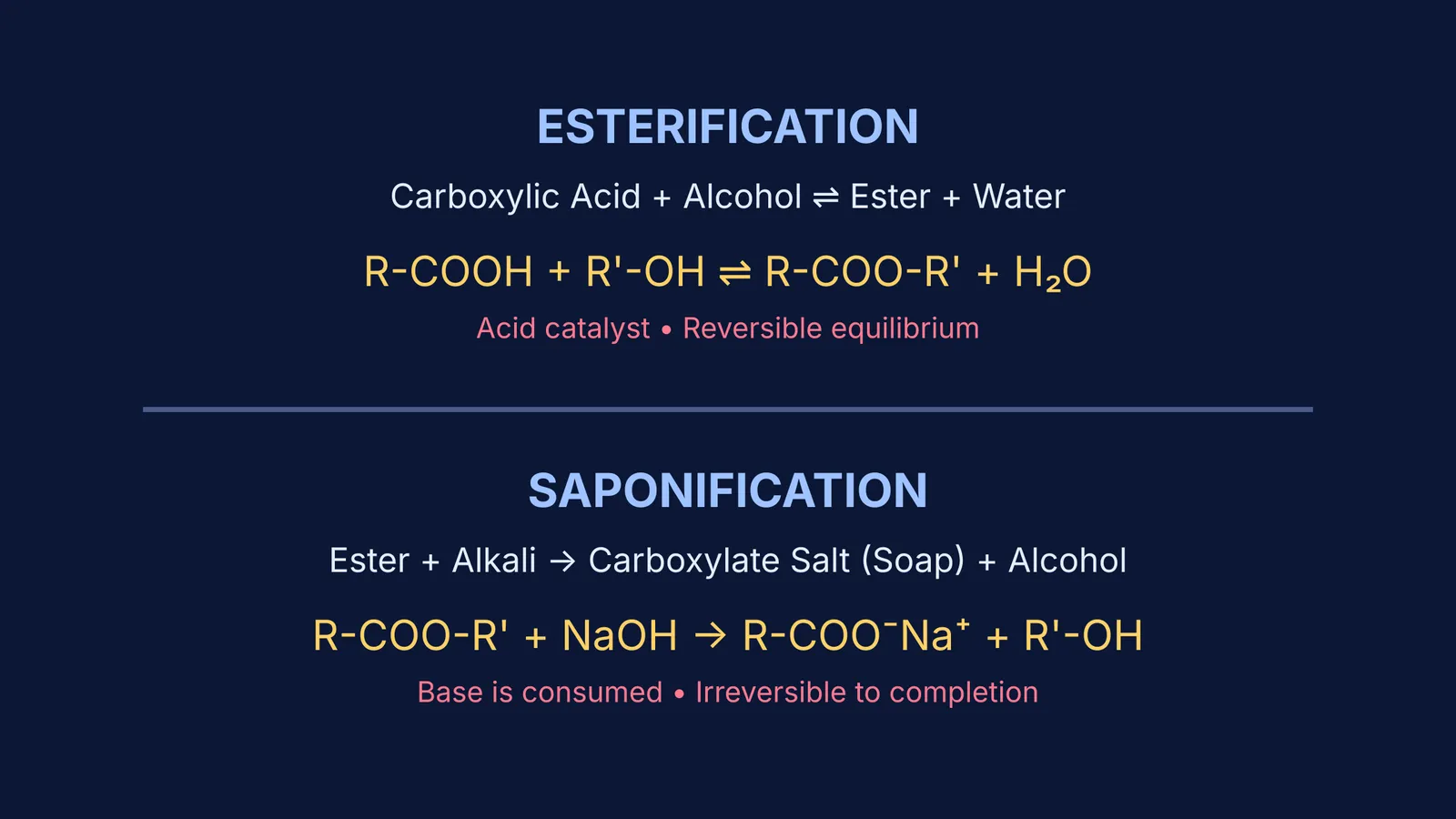
The general equation is: R-COOH + R'-OH ⇌ R-COO-R' + H₂O
The mechanism relies on the electrophilicity of the carbonyl carbon and the nucleophilicity of the alcohol. The acid catalyst protonates the carbonyl oxygen, making the carbonyl carbon more electrophilic. The alcohol's oxygen then attacks the carbonyl carbon, forming a tetrahedral intermediate. After a proton transfer converts the original -OH group into a good leaving group (-OH₂⁺), water is eliminated. Finally, deprotonation yields the ester.
For a deeper dive into the specific steps of this acid-catalysed reaction, read our guide on the Fischer esterification mechanism.
What happens in saponification?
Saponification takes its name from the Latin word *sapo*, which means soap. It is the process of cleaving an ester into a carboxylate salt and an alcohol by the action of an aqueous alkali, typically sodium hydroxide (NaOH) (Source).
Unlike esterification, basic hydrolysis of esters is not an equilibrium process. A full equivalent of the base is consumed in the reaction, driving it to completion and making it irreversible. The carboxylate salt produced is highly stable and does not react with the alcohol to reform the ester. This reaction is the industrial basis for soap making, where triglycerides (esters of fatty acids and glycerol) are saponified.
The general equation is: R-COO-R' + NaOH → R-COO⁻Na⁺ + R'-OH
In the saponification mechanism, the hydroxide ion acts as a strong nucleophile, attacking the electrophilic carbonyl carbon of the ester to form a tetrahedral intermediate. This intermediate collapses, ejecting the alkoxide ion to form a carboxylic acid. Since the alkoxide ion is a much stronger base than the carboxylate ion, a rapid proton transfer occurs. The alkoxide deprotonates the carboxylic acid to form a highly stable carboxylate salt and an alcohol, driving the reaction to completion.
If you want to review nomenclature rules before tackling these reaction schemes, explore Naming carbon compounds in Class 10.
How do you compare them for exams?
When preparing for exams, use this quick framework to contrast the two reactions:
Reactants: Esterification uses a carboxylic acid and an alcohol. Saponification uses an ester and an alkali (base).
Products: Esterification produces an ester and water. Saponification produces a carboxylate salt (soap) and an alcohol.
Catalyst vs Reagent: Esterification uses a catalytic amount of acid (like H₂SO₄). Saponification consumes a stoichiometric amount of base (like NaOH), meaning the base is a reactant, not just a catalyst.
Reversibility: Esterification is a reversible equilibrium reaction. Saponification is irreversible.
To master these organic chemistry distinctions and test your understanding of reaction mechanisms, we recommend exploring the Fermi Concept Library. It maps out these foundational principles, showing you exactly how concepts like equilibrium and catalysis connect across the curriculum.


