On this page
Sequences and series is a short JEE Main unit, so marks lost here sting: the ideas are few, and many errors are counting slips. These eight original questions follow the JEE Main multiple-choice style, from easy to hard. Attempt each before reading on.
What does the JEE Main syllabus include for sequences and series?
NTA's Syllabus for JEE (Main) 2027 lists Unit 6, Sequence and Series, as "Arithmetic and Geometric progressions, insertion of arithmetic, geometric means between two given numbers, Relation between A.M and G.M." This set covers each phrase of it. For the theory and a study plan, read how to prepare sequences and series for JEE Main.
Which sequences and series questions should you try first?
Q1. The 7th term of an AP is 32 and the 15th is 64. The 25th term is: (A) 96 (B) 100 (C) 104 (D) 108.
Solution: 8d=64−32, so d=4 and a=32−6×4=8. Then a₂₅=8+24×4=104, option (C).
Trap: (D) comes from a+25d. The nth term is a+(n−1)d.
Check: a₁₅=8+14×4=64.
Q2. The sum of all integers between 100 and 400 divisible by 7 is: (A) 10584 (B) 10836 (C) 11088 (D) 10500.
Solution: the terms run from 105=7×15 to 399=7×57, so there are 57−15+1=43 of them. S=43×(105+399)/2=43×252=10836, option (B).
Trap: (A) counts 42 terms, forgetting the +1.
Check: the middle term, 7×36=252, sits halfway between 105 and 399.
Q3. For an AP, Sₙ=3n²+5n. The 10th term is: (A) 35 (B) 56 (C) 62 (D) 350.
Solution: a₁₀=S₁₀−S₉=350−288=62, option (C).
Trap: (D) is S₁₀ itself; (A) uses Sₙ/n=3n+5, the average of the first n terms, not the nth term.
Check: a₁=S₁=8 and d=6 (twice the n² coefficient), so a₁₀=8+9×6=62.
Q4. In a GP of positive terms, the 3rd term is 12 and the 6th is 96. The sum of the first 8 terms is: (A) 381 (B) 765 (C) 768 (D) 1533.
Solution: r³=96/12=8, so r=2 and a=3. S₈=3(2⁸−1)/(2−1)=765, option (B).
Trap: (C) drops the −1; (A) sums only seven terms.
Check: 3+6+12+24+48+96+192+384=765.
Can you solve the harder means and AM-GM questions?
Q5. n arithmetic means are inserted between 7 and 49, and their sum is 364. Then n is: (A) 11 (B) 12 (C) 13 (D) 14.
Solution: the means pair off from the ends, each pair averaging (7+49)/2=28. So 28n=364 and n=13, option (C).
Trap: (A) includes 7 and 49 in the sum, solving 28(n+2)=364.
Check: d=42/14=3, so the means are 10, 13, ..., 46: thirteen numbers.
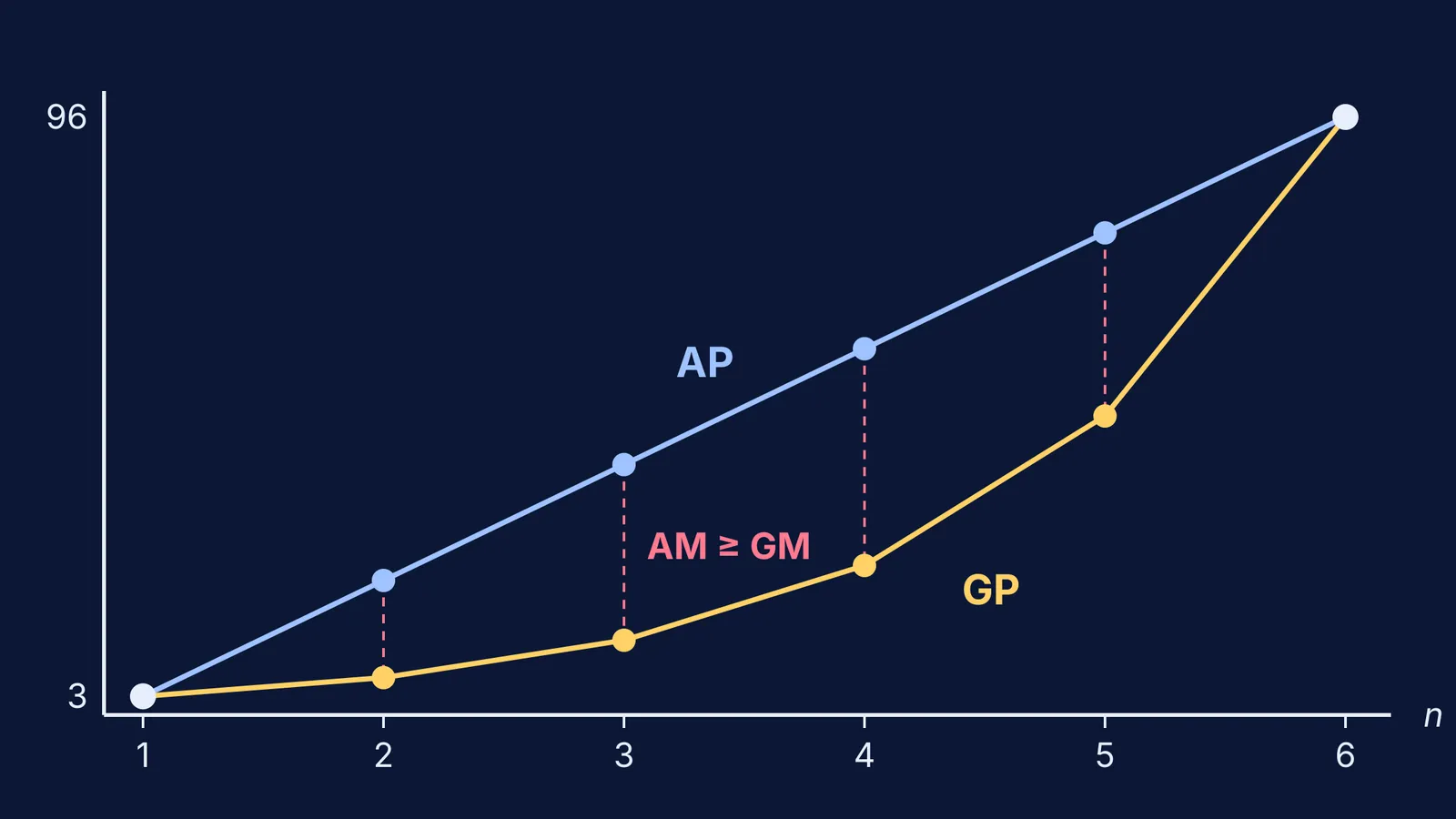
Q6. Four geometric means are inserted between 3 and 96. Their product is: (A) 288 (B) 288² (C) 288⁴ (D) 2×288².
Solution: 96=3r⁵, so r=2 and the means are 6, 12, 24, 48. Pairs from the ends (6×48, 12×24) each multiply to 3×96=288, so the product is 288², option (B).
Trap: (C) counts one 288 per mean, but each pair gives one 288. In general, n geometric means between a and b multiply to (ab)^(n/2).
Check: 6×12×24×48=82944=288².
Q7. The minimum of 4ˣ+4¹⁻ˣ over real x is: (A) 2 (B) 4 (C) 5 (D) 2√2.
Solution: both terms are positive, so AM ≥ GM gives 4ˣ+4¹⁻ˣ ≥ 2√(4ˣ·4¹⁻ˣ)=2√4=4, with equality when 4ˣ=4¹⁻ˣ, at x=1/2. Option (B).
Trap: (A) drops the 2 before the root; (C) is just the value at x=0.
Check: at x=1/2 the expression is 2+2=4.
Q8. Three numbers in an increasing AP add up to 15. Adding 1, 4 and 19 to them in order gives a GP. Their product is: (A) −2080 (B) 80 (C) 90 (D) 120.
Solution: write them as 5−d, 5, 5+d. Then 6−d, 9, 24+d are in GP, so 81=(6−d)(24+d), giving d²+18d−63=0, so d=3 or d=−21. Increasing means d=3: the numbers are 2, 5, 8, product 80, option (B).
Trap: (A) takes d=−21 (26, 5, −16), which also becomes a GP, but that AP is decreasing.
Check: 3, 9, 27 has common ratio 3.
How should you use this set in revision?
Attempt all eight in one sitting, without notes, under a short time limit.
Label every miss: wrong formula, counting slip (n versus n−1, missing end terms) or a missed condition (positive terms, increasing order).
Later in the week, redo only the misses without the solutions.
For each trap, change one number and predict which wrong option a hurried student would pick.
If one method keeps failing, the Fermi Problem Library has worked problems with a step-by-step solver that explains the reasoning rather than printing an answer. For the rest of the syllabus, Fermi Test Prep is our hub for JEE Main and Advanced preparation.
The same counting care pays off in the binomial theorem for JEE Main. And for a series off the syllabus but fun to see, try stacking books past a table edge with the harmonic series.