On this page
Sequences and Series is one of the shortest units in JEE Main maths, so it is easy to under-prepare. Here is the official list, the core ideas with examples checked twice, and a two-week plan.
What does the JEE Main syllabus include in Sequences and Series?
The NTA syllabus for JEE (Main) 2027, linked from the JEE Main website, gives Unit 6 in one line: "Arithmetic and Geometric progressions, insertion of arithmetic, geometric means between two given numbers, Relation between A.M and G.M."
The textbook behind it is Chapter 8, Sequences and Series, of NCERT Class 11 Mathematics. It covers geometric progressions, inserting geometric means, the arithmetic mean and the proof that AM ≥ GM. It notes that APs were studied in the previous class, so revise your Class 10 AP chapter too. The current reprint has no worked example of inserting arithmetic means, so practise those from past papers.
Sums of special series and arithmetico-geometric series are not named in the JEE Main unit. Learn them as extra tools; they cost little time and the special sums are listed for JEE Advanced.
What are the core ideas, with worked examples?
Arithmetic progression: the nth term is a + (n − 1)d and the sum of n terms is (n/2)[2a + (n − 1)d]. Example: the sum of the first 20 terms of 3, 7, 11, … is 10 × (6 + 76) = 820. Second check: the last term is 3 + 19 × 4 = 79, and 20 × (3 + 79) ÷ 2 = 820.
Geometric progression and inserting means: in NCERT, the nth term of a GP is ar^(n − 1) and the sum of n terms is a(r^n − 1)/(r − 1) for r ≠ 1. Example: insert two geometric means between 2 and 54. Then 54 = 2r³, so r = 3 and the means are 6 and 18. Second check: 6² = 2 × 18 = 36, as it must be for three terms in GP.
AM ≥ GM: for positive a and b, (a + b)/2 ≥ √(ab), with equality only when a = b; NCERT proves it from (√a − √b)²/2 ≥ 0. Example: the smallest value of x + 9/x for x > 0 is 2√9 = 6, reached at x = 3. Second check: x = 2 gives 6.5 and x = 4 gives 6.25, both larger.
Special series: use 1 + 2 + … + n = n(n + 1)/2, the sum of squares n(n + 1)(2n + 1)/6, and the sum of cubes [n(n + 1)/2]². Example: 1² + 2² + … + 10² = 10 × 11 × 21 ÷ 6 = 385. Second check, by adding: 1 + 4 + 9 + 16 + 25 + 36 + 49 + 64 + 81 + 100 = 385.
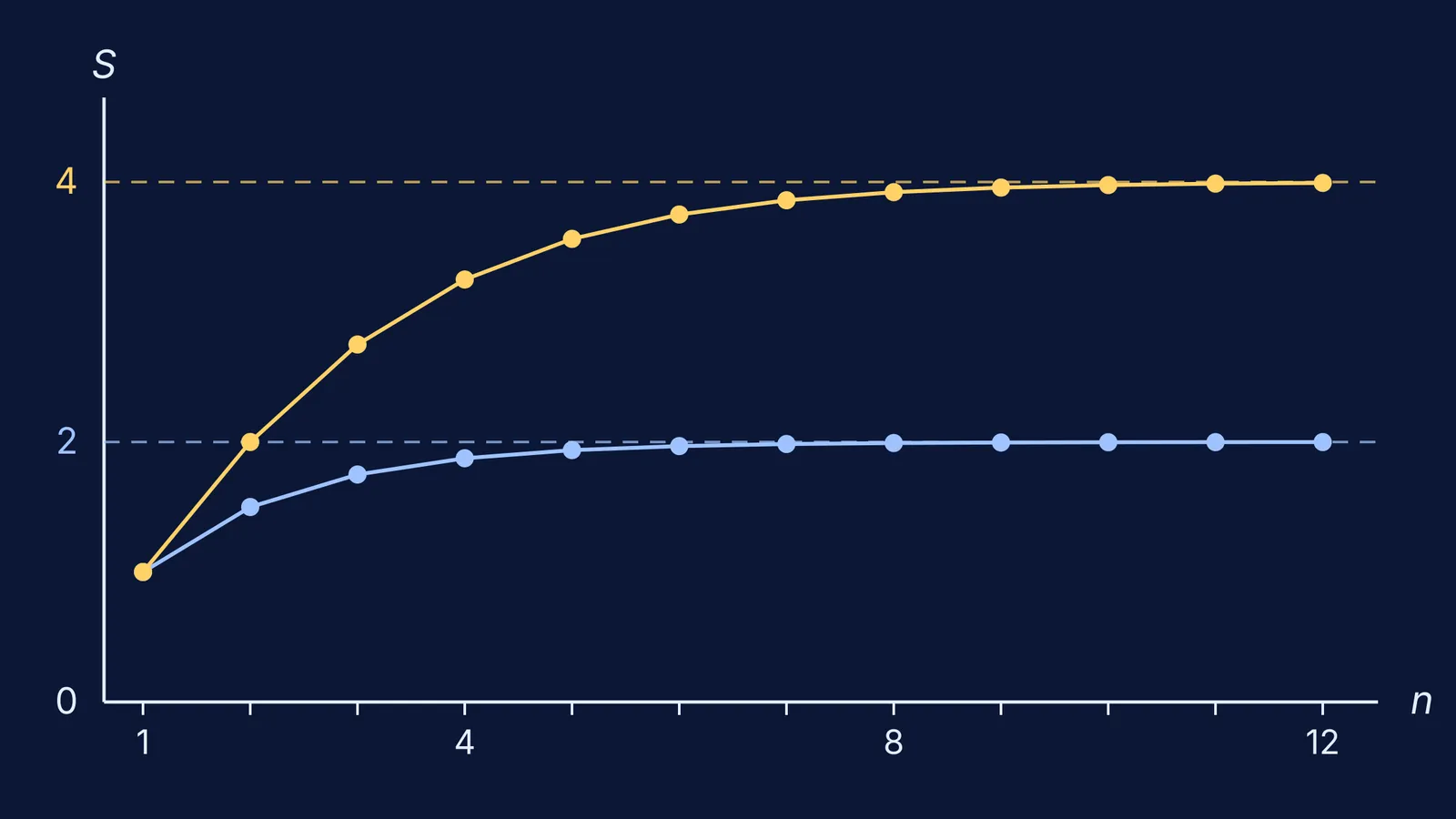
The arithmetico-geometric trick: multiply by the common ratio and subtract, the same step NCERT uses to derive the GP sum. Example: S = 1 + 2/2 + 3/4 + 4/8 + … Then S/2 = 1/2 + 2/4 + 3/8 + …, so S − S/2 = 1 + 1/2 + 1/4 + … = 2, giving S = 4. Second check: the partial sums 1, 2, 2.75, 3.25, 3.5625, 3.75 climb towards 4.
Which traps cost marks in this chapter?
Counting terms: from 7 to 97 in steps of 5 there are (97 − 7)/5 + 1 = 19 terms, not 18.
Infinite GP: the sum a/(1 − r) needs |r| < 1.
r = 1: the GP formula divides by zero; the sum is simply na.
AM–GM needs positive numbers: for x < 0, x + 9/x is at most −6, so the minimum of 6 does not apply.
Even roots: NCERT's Example 12, three geometric means between 1 and 256, has two answers, r = 4 and r = −4.
If you keep reaching for the wrong method, the Fermi Problem Library has worked problems with a step-by-step solver that explains the reasoning rather than printing an answer.
How is JEE Advanced different?
The JEE (Advanced) 2026 syllabus lists, under Algebra, progressions and means plus "infinite geometric series, sum of the first n natural numbers, sums of squares and cubes of the first n natural numbers". So infinite series and special-series sums are named for Advanced but not for Main; check for the 2027 version when it appears.
How should you plan two weeks for this chapter?
Days 1–2: APs from your Class 10 book; derive the sum formula yourself.
Days 3–4: GPs and Exercise 8.2 of NCERT Chapter 8.
Day 5: inserting arithmetic and geometric means.
Day 6: AM–GM and minimum-value questions.
Day 7: a timed mixed set; log each error as counting, sign or condition.
Days 8–9: special series and the arithmetico-geometric trick.
Days 10–11: the Chapter 8 Miscellaneous Exercise and past JEE Main papers.
Day 12: redo every logged error without notes.
Day 13: one timed test on the whole unit.
Day 14: a one-page sheet of formulas and the five traps above.
For the rest of your JEE plan, Fermi Test Prep covers JEE Main and Advanced preparation.