On this page
Fly over the middle of Greenland and you are above ice about 3 km thick. Why 3 km, and not 300 m or 30 km? Snow has been falling there for a very long time, so the thickness is not limited by supply. It is limited by the ice itself. Pile ice too high and it squeezes out sideways at its base, like a heap of wet sand. A Class 11 force balance, with one number for the strength of ice, gives the thickness to within about 10%.
Fermi News has covered how radar measures ice thickness and what melting ice sheets do to sea level. This post is about why an ice sheet has the thickness and shape it has.
How thick is the Greenland ice sheet?
At Summit, near the highest point of the sheet, the US GISP2 project drilled through the ice to bedrock in 1993. The core is 3053.44 m long, according to the NOAA data record for GISP2. So the ice there is a little over 3 km thick. Towards the coast it thins rapidly, ending in steep margins and outlet glaciers.
Why can ice not pile up as high as it likes?
Ice is a solid, but under a large enough shear stress it flows. The simplest model, set out by John Nye in Proceedings of the Royal Society A (1951), treats ice as perfectly plastic: it does not move at all until the shear stress at its base reaches a yield value τ₀, and then it flows as fast as needed to keep the stress at τ₀.
Glaciologists usually take τ₀ ≈ 100 kPa (1 bar). Niels Reeh, in Journal of Glaciology (1982), calls that choice "somewhat arbitrary" and notes that the average basal shear stress along a flow line varies from about 50 to 150 kPa, depending on how much snow falls and how warm the base of the ice is.
How does a force balance give the shape of an ice sheet?
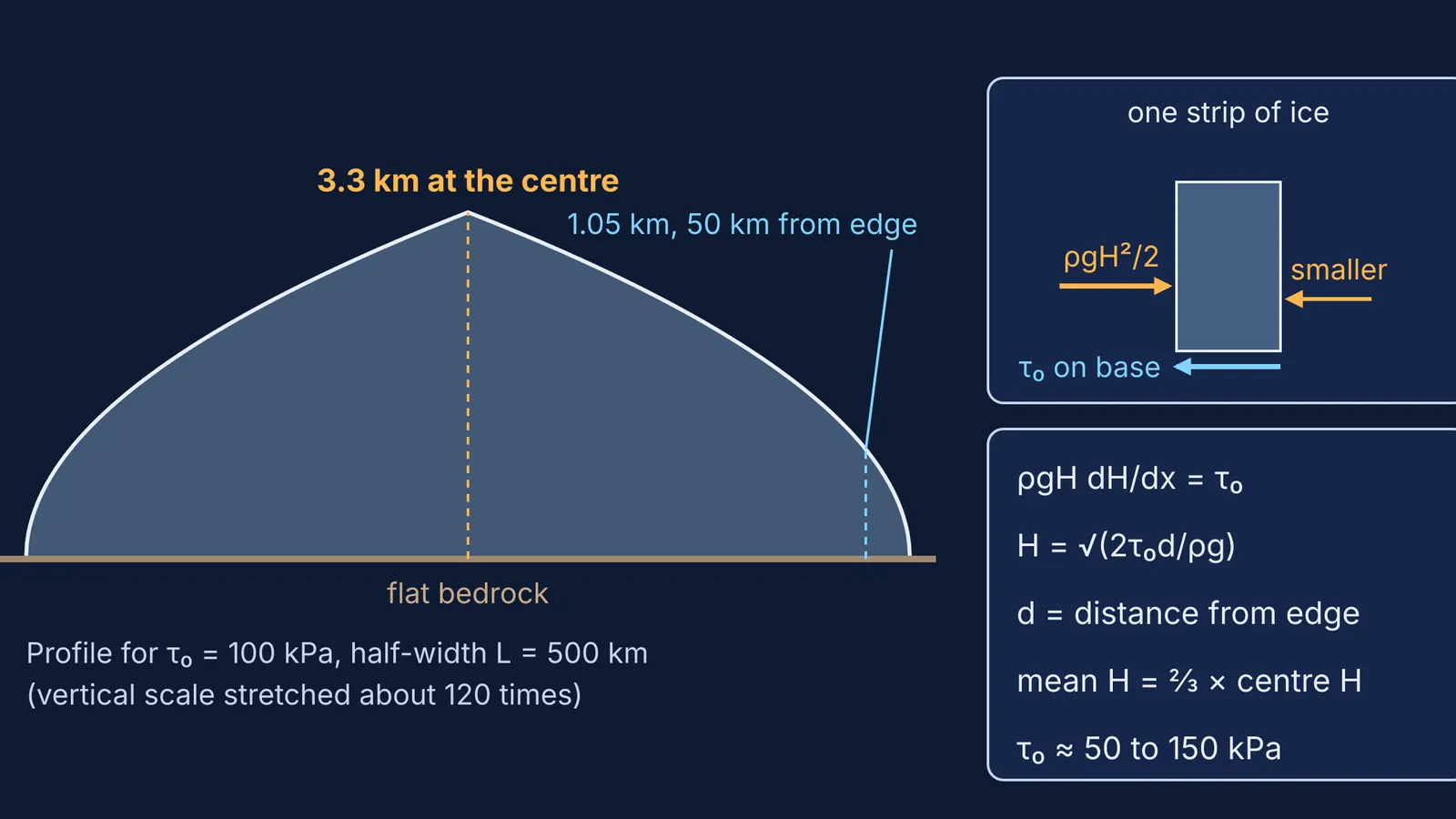
Take a vertical strip of ice of width dx, on flat bedrock, where the ice is H thick. The ice pressure at depth z is ρgz, like water. Added up over the full height, the sideways push on one face of the strip is:
F = ρgH²/2 per metre of the strip's length.
The ice is thicker on the side towards the centre, so the push from that side is bigger. The difference, ρgH dH, is the net push outwards. Only the base can hold it back, with a force τ₀ dx. So:
ρgH dH/dx = τ₀
Integrate from the edge, where H = 0, to a point a distance d inside the edge:
H² = 2τ₀d/(ρg), or H = √(2τ₀d/ρg)
Thickness grows as the square root of distance from the edge. Near the edge the profile is steep; near the centre it is almost flat. The mean thickness of such a profile is ⅔ of the maximum.
A check on the whole half-sheet: the push at the centre, ρgH²/2, must equal the total base resistance τ₀L, where L is the distance from the centre to the edge. Put H² = 2τ₀L/(ρg) into ρgH²/2 and you get τ₀L.
Worked example: how thick should the middle of Greenland be?
Use ρ = 917 kg/m³ for ice, g = 9.81 m/s² and τ₀ = 100 kPa. For L, Reeh used 500 km, the distance from the main ice divide to the margin in central West Greenland, where the bed is almost flat.
Centre thickness: H = √(2 × 10⁵ × 5 × 10⁵/(917 × 9.81)) = √(1.11 × 10⁷ m²) = 3.3 km.
Compare: the GISP2 core found 3.05 km of ice at Summit. The estimate is about 9% high. Reeh made the same comparison and found the agreement close.
50 km from the edge: H = √(2 × 10⁵ × 5 × 10⁴/9,000) = 1.05 km. The surface slope there is τ₀/(ρgH) = 10⁵/(9,000 × 1,054) = 0.011, about 1%.
10 km from the edge: H = 470 m, slope 2.4%.
1 km from the edge: H = 150 m, slope 7.5%.
Effect of τ₀: with 50 kPa the centre would be 2.4 km thick; with 150 kPa, 4.1 km. The thickness goes as √τ₀, so the 3:1 range in τ₀ changes it by only 1.7 times.
The pressure at the base under 3.3 km of ice is ρgH = 30 MPa, about 300 times atmospheric pressure.
The same formula works for a valley glacier 5 km long: H = √(2 × 10⁵ × 5,000/9,000) ≈ 330 m at its head. This is a rough figure: in a narrow valley the side walls also hold the ice back, which the strip model ignores.
How good is the perfectly plastic model?
It is a first approximation, and glaciologists treat it as one.
Real ice creeps. It does not have a sharp yield point. It deforms at any stress, faster as the stress grows (Glen's flow law, with the strain rate going roughly as the cube of the stress). Because the rate rises so steeply, the basal stress stays within a narrow band, which is why a single τ₀ works quite well.
The bedrock is not flat. Under Greenland it is uneven, and the weight of the ice has pushed it down. That is why the model is compared with thickness, not with the height of the surface above sea level.
Snowfall and temperature matter. Reeh's three-dimensional model changes τ₀ from region to region to allow for them.
None of this changes the main result: the thickness of an ice sheet is set by the strength of ice, and it grows as the square root of the sheet's size.
To revise pressure in fluids and shear stress, use the Concept Library. To practise force-balance problems on dams and walls, try the Fermi Problem Library, whose step-by-step solver explains the reasoning.
Quick checklist
Push on a vertical face of ice H thick: ρgH²/2 per metre.
Force balance on a strip: ρgH dH/dx = τ₀.
Profile: H = √(2τ₀d/ρg), steep at the edge, flat on top; mean thickness ⅔ H_max.
τ₀ ≈ 100 kPa, ρ = 917 kg/m³, L = 500 km: centre about 3.3 km.
Measured at Summit: 3,053 m of ice in the GISP2 core.
Thickness goes as √τ₀ and √L, so it is not very sensitive to either.