On this page
In 1863 two chemists in Freiberg, Reich and Richter, saw a new blue line in the spectrum of a zinc ore and named the metal behind it indium. For the next seven years chemists agreed on how much indium combines with a given mass of oxygen, but not on its formula. Was the oxide InO, like zinc's, or In₂O₃? The answer came from a heat measurement, not a weighing. This post follows that argument in two primary sources: Richard E. Meyer's 1868 Göttingen dissertation, Das Indium (Internet Archive), and the English abstracts in the Journal of the Chemical Society for 1871 (Internet Archive). Translations from the German are ours.
How was indium discovered?
Meyer opens with the discovery. Indium was found "in 1863 by Reich and Richter in Freiberg, during a spectral analysis of two zinc-blende ores from there". What tipped them off was "a beautiful indigo-blue line, unknown until then". The name comes from that colour. The metal was scarce. Meyer quotes Reich and Richter's estimate of "about 0.1%" indium in Freiberg zinc.
Spectral analysis was new. How Bunsen's clean flame made it possible is told in Robert Bunsen, his burner and the discovery of caesium.
What did chemists know about indium by 1868?
They knew its equivalent mass, the mass that combines with 8 parts of oxygen. Meyer reports:
Reich and Richter dissolved weighed indium in nitric acid, precipitated the hydroxide with ammonia and heated it to the oxide. They got 37.04.
Winkler used three methods, including reducing a sodium gold chloride solution with a weighed piece of indium and weighing the gold. His mean was 37.813. Meyer wrote, "I have taken this number as the correct one".
Then Meyer made the usual assumption. Indium is found with zinc, so he treated its oxide as InO, with the metal divalent. "Accordingly the atomic weight of indium [O = 16] would be 75.6."
Here is the trap. Weighing cannot settle the formula. Work out the percentage of indium in each candidate oxide:
InO with In = 75.63: 75.63 ÷ 91.63 = 82.54%.
In₂O₃ with In = 113.44: 226.88 ÷ 274.88 = 82.54%.
The two are identical, because both come from the same equivalent mass. Any analysis of the oxide fits both formulas equally well. You need a second, independent property. The basic method for equivalent mass is in how to find the equivalent mass of a metal from oxide data.
How did Bunsen's ice calorimeter settle it?
Robert Bunsen built an ice calorimeter, described in his 1870 paper in Poggendorff's Annalen (volume 141). A hot sample drops into a tube surrounded by ice. The heat melts some ice, the ice-water mixture shrinks, and a thread of mercury moves along a scale. The abstract says the method "is applicable to small quantities of material, and thus facilitates the estimation of the specific heat of rare substances". Indium was exactly that.
His two results for indium were 0.0574 and 0.0565 cal g⁻¹ K⁻¹. The abstract continues: "In the case of indium, it will be seen that the atomic heat is below the ordinary value." Raise the atomic weight to one and a half times the equivalent and the atomic heat becomes normal. "If this view be received, indium in indic oxide must be looked upon as trivalent."
The abstract also gives Bunsen's own new equivalent, 37.92, and a Table II that rewrites the old formulas. The yellow oxide InO becomes In₂O₃, and the chloride becomes In₂Cl₃ in that table's old-scale notation.
Why does the 1871 abstract say the atomic heat is about 3?
Watch the scale. The abstract's table lists calcium as 20, tin as 58.8 and indium as 37.8. These are on the old scale where O = 8, and all three numbers are half the modern ones. On that scale the usual "atomic heat" is about 3.2, not 6.4. Double the numbers before you compare them with your textbook.
Two derived figures in that abstract do not recompute. One and a half times 37.92 is 56.88, not the printed 56.7. And 37.8 × 0.0565 is 2.14, not the printed 2.33. Both are printed that way on the page scan, so we quote only the measured specific heats and the conclusion.
Worked example: indium's atomic mass from specific heat
Use the Dulong–Petit rule in its old form: atomic mass × specific heat ≈ 6.4 cal mol⁻¹ K⁻¹. The background is in Dulong, Petit and the law that weighed atoms with heat.
Mean specific heat. (0.0574 + 0.0565) ÷ 2 = 0.05695 cal g⁻¹ K⁻¹.
Approximate atomic mass. 6.4 ÷ 0.05695 = 112.4.
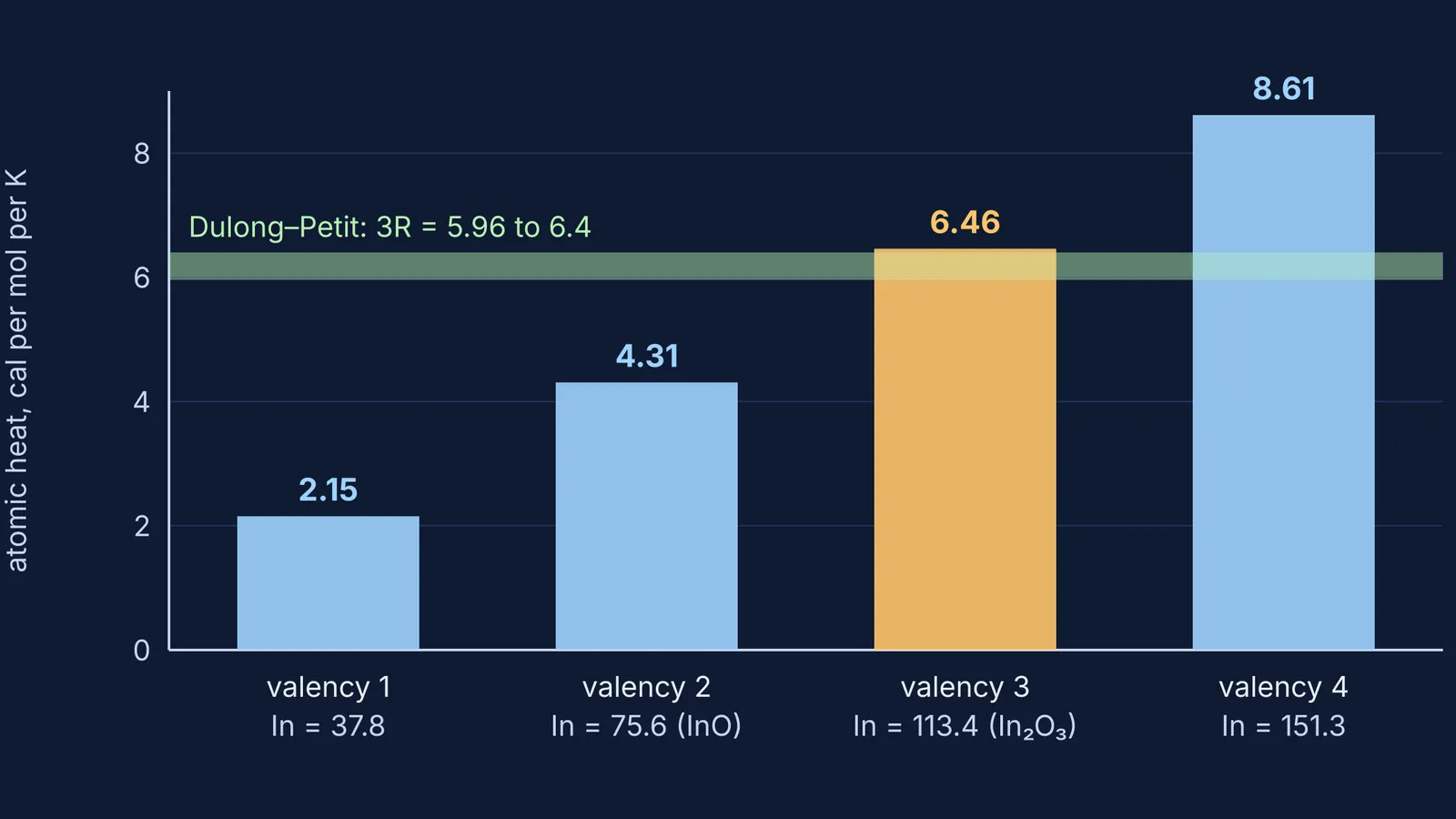
Valency. Approximate atomic mass ÷ equivalent mass = 112.4 ÷ 37.813 = 2.97. Round to the nearest whole number: 3.
Exact atomic mass. Equivalent mass × valency = 37.813 × 3 = 113.44.
Check. With 113.44 the atomic heat is 113.44 × 0.05695 = 6.46. With Meyer's 75.6 it would be 4.31, far below the other metals in Bunsen's table.
Formula. Trivalent indium gives In₂O₃: 4In + 3O₂ → 2In₂O₃. Check: 4 In and 6 O on each side.
In SI units the rule is 3R ≈ 24.9 J mol⁻¹ K⁻¹, and c = 0.05695 × 4.184 = 0.2383 J g⁻¹ K⁻¹. That gives 24.9 ÷ 0.2383 = 104.7, and 104.7 ÷ 37.813 = 2.77. The valency still rounds to 3. Dulong–Petit is rough. It works here because the choices, 75.6 and 113.4, are 1.5 times apart.
This exact chain, equivalent mass to valency to atomic mass, is a standard numerical. For timed practice, Fermi's AI tutor for JEE prep is part of Fermi Test Prep for JEE Main and Advanced.
Who adopted 113.4, and how close was it?
The same 1871 volume abstracts a paper by K. J. Bayer on purifying indium. He dissolved Freiberg zinc in hydrochloric acid, leaving a little zinc undissolved, and "all the indium present is precipitated on the zinc": 2In³⁺ + 3Zn → 2In + 3Zn²⁺. Check: 2 In and 3 Zn on each side, and a charge of +6 on each side. He wrote the formula of a new indium sulphite "adopting 113·4 for the atomic weight of indium, a number supported by Bunsen's recent determination of the specific heat of indium".
Mendeleev is often said to have placed indium at about 113 in his periodic table around the same time. We have not read his papers for this post, so we credit only the measurement here.
Today indium's atomic mass is 114.82, so its equivalent mass is 114.82 ÷ 3 = 38.27. Winkler's 37.813 was about 1.2% low, but the valency of 3 has held. Indium sits in group 13 below gallium, with +3 as its usual state. Gallium's own discovery story is in the 1875 discovery of gallium.
Quick checklist
1863: Reich and Richter find indium by its indigo-blue spectral line.
Equivalent mass about 37.8 (O = 8). The formula was the open question.
Oxide analysis cannot choose between InO and In₂O₃. Both give 82.54% In.
Bunsen: c = 0.0574 and 0.0565, so 6.4 ÷ 0.05695 ≈ 112, which means valency 3.
Atomic mass = equivalent × valency = 37.813 × 3 = 113.44. Today: 114.82.
In old papers with O = 8, atomic weights are halved and the atomic heat is about 3.2.