On this page
On 21 June 1849 Lyon Playfair read "On the Nitroprussides, a New Class of Salts" to the Royal Society. It was printed in Philosophical Transactions, volume 139, pages 477 to 518 (DOI), and the scan is free on the Internet Archive. One of his new salts is sodium nitroprusside, the reagent you add to Lassaigne's extract to test for sulphur. All quotations below are from that paper. Its header gives only "Dr. Lyon Playfair, F.R.S., F.C.S.", so we leave out the rest of his career.
Where did the purple sulphide colour come from?
Before Playfair, chemists knew that nitric acid attacks yellow prussiate of potash, K₄[Fe(CN)₆], and gives off nitrogen, cyanogen, nitric oxide and carbon dioxide. Döbereiner saw "a strong coffee-coloured liquid" form on the way. Gmelin found that this liquid turned "a magnificent purple or blue colour on the addition of an alkaline sulphide". Campbell guessed that the purple came from a "sulphuret of nitrogen".
Playfair looked for the cause. His key observation was that "nitric oxide disappeared during the action". So he tested nitric oxide on its own:
Bubbled through ferrocyanide solution alone, it caused no "sensible change".
With enough acid present, and only when hot, the solution took up the gas and then gave the purple colour with sulphides.
The first change was ferrocyanide becoming ferricyanide. "Until this change was completed not the least coloration took place" with a sulphide.
He concluded that nitric oxide had entered the iron cyanide, and he named the new salts nitroprussides. This post covers the history and the chemistry only. Making these salts releases cyanogen and hydrogen cyanide, so no method is given here.
What did Playfair say about the sulphide test?
He saw its use at once. A footnote reads: "The intensity and beauty of this coloration render the nitroprussides the most sensible of all tests for the presence of the minutest trace of a soluble sulphide." In 1849, "sensible" meant sensitive.
His table of reactions gives the behaviour you would check today:
Sulphides of the alkali metals: "Magnificent transitory purple colour".
Salts of iron(II): "Salmon-coloured precipitate".
Salts of copper: "Light green precipitate".
Salts of iron(III): "No change".
Caustic alkalis turn the red solutions orange.
He also noted that the purple "is however only transitory". The coloured compound breaks down to products that include hydrocyanic acid, ammonia, nitrogen, a ferrocyanide and a thiocyanate. So look for the violet as soon as you add the reagent. For the full test with the lead acetate check, see the sodium nitroprusside test for sulphide ions.
What is the oxidation state of iron in sodium nitroprusside?
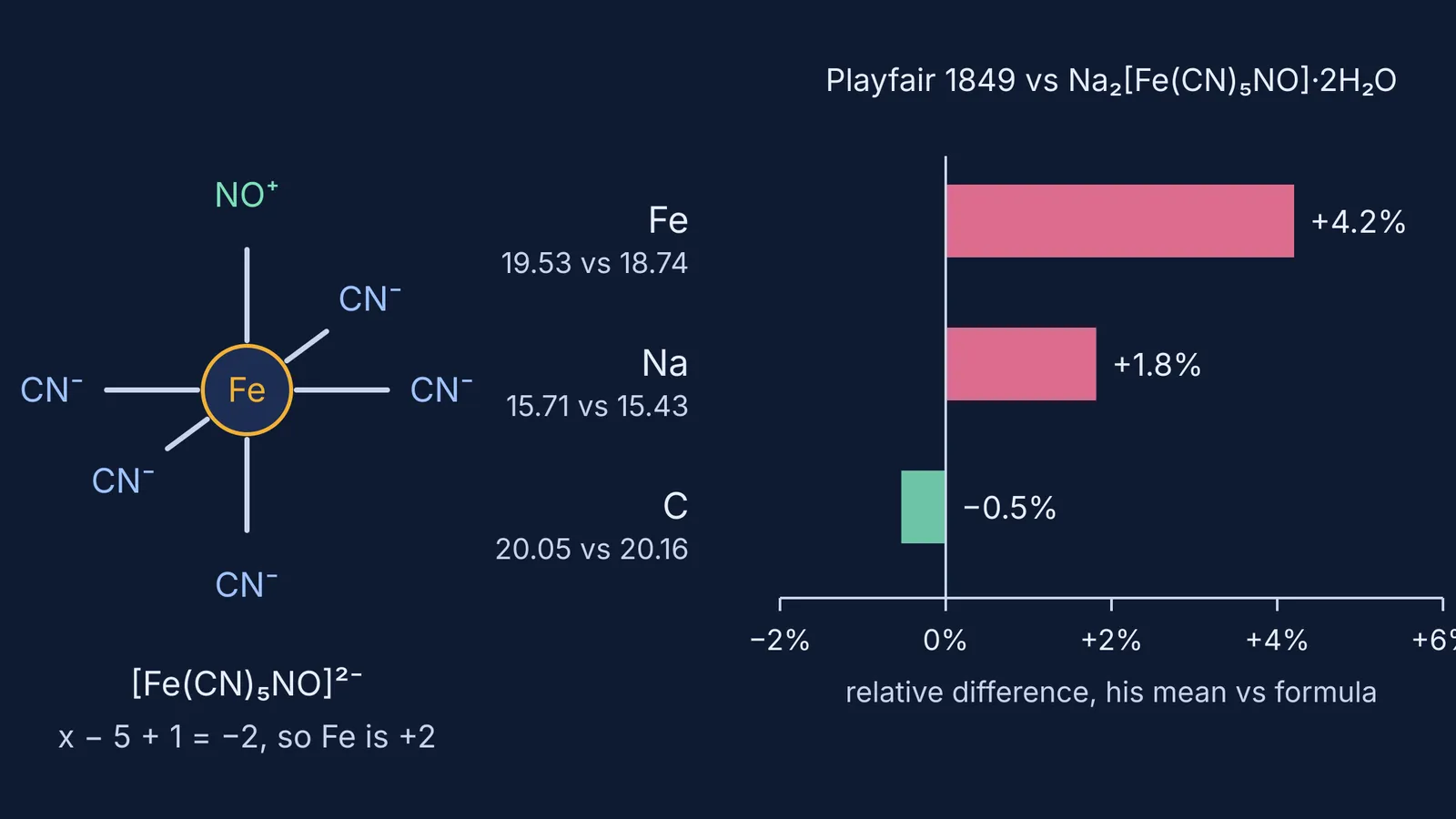
The modern formula is Na₂[Fe(CN)₅NO]. Playfair could not have written this. The idea of a complex ion, and the NO⁺ picture below, came much later.
Two Na⁺ outside the bracket, so the complex ion is [Fe(CN)₅NO]²⁻.
Each CN⁻ counts as −1. Five of them give −5.
The nitrosyl ligand is counted as NO⁺, charge +1.
x − 5 + 1 = −2, so x = +2.
So the iron is Fe(II), a d⁶ ion, and the IUPAC name is sodium pentacyanidonitrosylferrate(II). If you treat NO as a neutral ligand you get x = +3, which is the usual wrong answer. For more practice on this skill, see how to find oxidation state and coordination number in a complex.
How does the test work in Lassaigne's extract?
Fusion with sodium turns covalent sulphur into sulphide: 2Na + S → Na₂S. The extract is alkaline, so the sulphide stays in solution. Then:
Na₂S + Na₂[Fe(CN)₅NO] → Na₄[Fe(CN)₅NOS]
Check the balance: 4 Na, 1 Fe, 5 C, 6 N, 1 O and 1 S on each side. In ionic form, S²⁻ + [Fe(CN)₅NO]²⁻ → [Fe(CN)₅NOS]⁴⁻, with a charge of −4 on each side. The violet colour confirms sulphur. In the exam, write the equation and name the colour as violet or purple, as Playfair did.
Worked example: why Playfair's formula came out wrong
Playfair analysed his sodium salt nine times for iron and nine times for carbon. The masses are in grains; the unit cancels in a percentage.
Iron, Analysis I. 11.800 grains of salt gave 3.300 grains of Fe₂O₃.
Fraction of iron in Fe₂O₃ = 111.69 ÷ 159.69 = 0.6994.
Iron = 3.300 × 0.6994 = 2.308 grains.
% Fe = 2.308 ÷ 11.800 × 100 = 19.56%.
Carbon, Analysis I. 9.188 grains gave 6.870 grains of CO₂.
Fraction of carbon in CO₂ = 12.011 ÷ 44.009 = 0.2729.
Carbon = 6.870 × 0.2729 = 1.875 grains, so % C = 20.41%.
Over all nine analyses, the means are 19.53% Fe and 20.05% C. Now find the mole ratio:
Fe: 19.53 ÷ 55.845 = 0.3497
C: 20.05 ÷ 12.011 = 1.669
Fe : C = 1 : 4.77
That is close to 1 : 5, but not close enough. Playfair wrote that "if the analyses would authorise 25 equivs. of carbon instead of 24, a very much more simple formula might be given". But "this less quantity of carbon refuses to enrol itself in the simple proportion of 1 : 5". So he chose a ratio of 5 : 24, in old equivalents where Fe = 28, C = 6 and O = 8.
Compare with the modern formula, Na₂[Fe(CN)₅NO]·2H₂O, molar mass 297.95 g mol⁻¹:
Fe 18.74%, Na 15.43%, C 20.16%, N 28.21%, H 1.35%.
Playfair's means: Fe 19.53%, Na 15.71%, C 20.05%.
His carbon was within 0.6% (relative) of the true value. His iron was 4.2% too high. Put the true 18.74% Fe beside his own carbon and the ratio becomes 1 : 4.97, the simple formula he turned down. The paper does not say why his iron ran high, so we will not guess. The lesson: one high analysis can push you to a more complicated formula.
How did Playfair measure the nitrogen?
He used "Dumas' quantitative method", the one in your Class 11 book. In Analysis I, 7.903 grains (0.5121 g) of salt gave 117 cm³ of nitrogen at 11.1 °C, with the barometer at 30.415 inches of mercury (772.5 mmHg).
Treat the gas as dry N₂:
n = PV ÷ RT = (1.0165 atm × 0.117 L) ÷ (0.08206 × 284.25 K) = 5.10 × 10⁻³ mol.
Mass of N₂ = 5.10 × 10⁻³ × 28.01 = 0.1428 g.
% N = 0.1428 ÷ 0.5121 × 100 = 27.9%.
He printed 27.781%. The corrections he applied are not shown, so this simple version agrees to about 0.4%. His second run gave 28.79%, and the modern value is 28.21%. The method itself is explained in the Dumas method of nitrogen estimation.
For JEE practice on coordination compounds and percentage composition, Fermi Test Prep covers JEE Main and Advanced with an AI tutor. For more formula-from-analysis problems, the Fermi Problem Library has a step-by-step solver that explains the reasoning.
Quick checklist
1849: Playfair traced Gmelin's purple sulphide colour to nitric oxide entering the iron cyanide.
He called nitroprussides "the most sensible of all tests" for a soluble sulphide.
Na₂[Fe(CN)₅NO]: count NO as NO⁺, so Fe is +2.
Lassaigne: Na₂S + Na₂[Fe(CN)₅NO] → Na₄[Fe(CN)₅NOS], violet.
Playfair's data: Fe 19.53%, C 20.05%, so Fe : C = 1 : 4.77. With the true Fe, 1 : 4.97.
Dumas: 117 cm³ N₂ from 0.5121 g gives about 27.9% N; modern 28.21%.