On this page
Two numbers come up again and again in Class 12 and JEE questions on coordination compounds: the oxidation state of the central metal and its coordination number. Both come from the formula of the complex, and both come down to careful counting.
What do oxidation state and coordination number mean?
NCERT's Class 12 chapter on coordination compounds defines both terms.
The oxidation number of the central atom is the charge it would carry if all the ligands were removed along with the electron pairs they share with it (NCERT).
The coordination number is the number of ligand donor atoms directly bonded to the metal ion (NCERT).
The same chapter adds that only sigma bonds between ligand and metal count; pi bonds do not.
So oxidation state is about charge, and coordination number is about donor atoms. Keep the two apart and most errors disappear.
How do you find the oxidation state of the metal in a complex?
Use three steps.
Find the charge on the complex ion. If it is written as a superscript, read it. If counter ions sit outside the square bracket, balance them: K₄[...] means the bracket carries 4−, and [...]Cl₃ means it carries 3+.
Write down each ligand's charge. Anionic ligands carry their ion's charge; neutral molecules count as zero.
Write x + (sum of ligand charges) = charge on the complex, and solve for x.
The ligand charges you will meet most often, all of which appear in the NCERT chapter linked above:
Charge −1: chloride Cl⁻, cyanide CN⁻, nitrite NO₂⁻, thiocyanate SCN⁻
Charge −2: oxalate C₂O₄²⁻
Charge −4: EDTA⁴⁻
Charge 0: water H₂O, ammonia NH₃, carbon monoxide CO, ethane-1,2-diamine (en)
How do you count the coordination number?
Count donor atoms, not ligands. NCERT calls a ligand that binds through one donor atom unidentate (Cl⁻, H₂O, NH₃), one that binds through two donor atoms didentate (en, oxalate), and one with several donor atoms polydentate. EDTA⁴⁻ is hexadentate: it binds through two nitrogen and four oxygen atoms (NCERT).
Multiply the number of each ligand by its denticity, then add.
Worked examples: six complexes, step by step
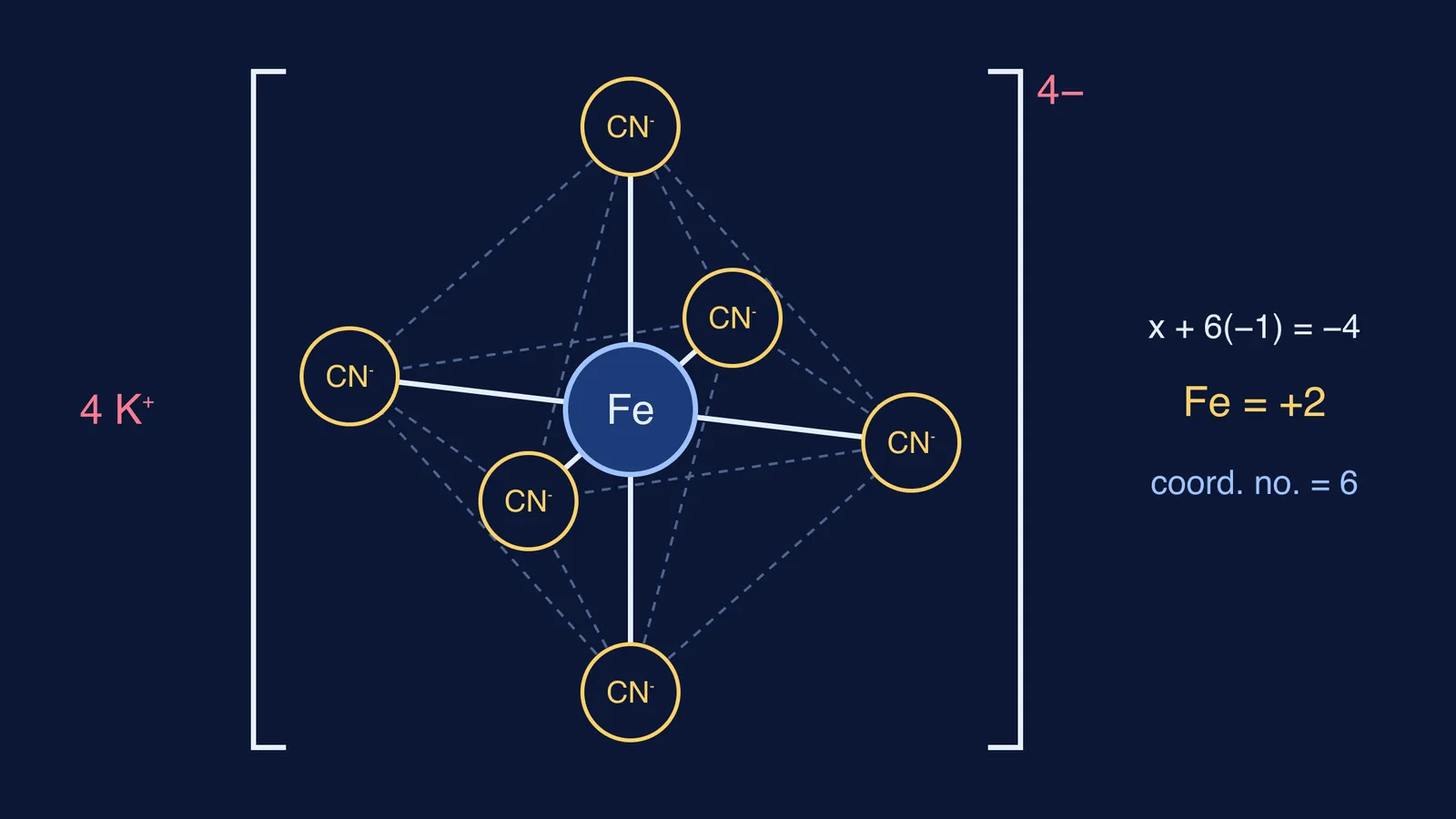
K₄[Fe(CN)₆]. Four K⁺ outside, so the complex is 4−. x + 6(−1) = −4, so iron is +2. Six unidentate CN⁻ give a coordination number of 6.
[Cu(CN)₄]³⁻. x + 4(−1) = −3, so copper is +1, written Cu(I), as in NCERT's own example. Four CN⁻ give a coordination number of 4.
[CoCl₂(NH₃)₄]Cl. One Cl⁻ outside, so the complex is 1+. x + 2(−1) + 4(0) = +1, so cobalt is +3. Two Cl⁻ and four NH₃ give a coordination number of 6.
[Co(en)₃]³⁺. en is neutral, so x = +3. Three didentate en give 3 × 2 = 6.
[Fe(C₂O₄)₃]³⁻. x + 3(−2) = −3, so iron is +3. Three didentate oxalates give a coordination number of 6.
[Ni(CO)₄]. A neutral complex with neutral ligands, so nickel is 0. Four CO give a coordination number of 4.
Slow down on examples 4 and 5: there are three ligands, but the coordination number is 6.
What are the common traps?
Ignoring counter ions. In [Co(NH₃)₆]Cl₃ the bracket is 3+, not neutral, because three Cl⁻ sit outside it.
Counting ligands instead of donor atoms with en, oxalate or EDTA.
Ambidentate ligands. NO₂⁻ can bind through nitrogen or oxygen, and SCN⁻ through sulfur or nitrogen. Either way, each binds through one atom, so it adds −1 to the charge and 1 to the coordination number.
Counting pi bonds. Only sigma bonds count towards the coordination number.
Swapping the two answers. In [Co(en)₃]³⁺ the oxidation state is +3 and the coordination number is 6. Label both.
What should you practise next?
Once these two numbers come quickly, they feed the next questions on d-electron count, hybridisation and magnetism. Our guides to finding hybridisation from the magnetic moment and inner vs outer orbital complexes pick up from there. Coordination isomerism with worked examples uses the same reading of what sits inside and outside the bracket.
If your answer keeps differing from the key, the Fermi Problem Library has worked problems with a step-by-step solver that explains the reasoning rather than printing an answer, so you can see which step went wrong. If the gap is the idea of a ligand or denticity itself, start with the chemistry lessons in the Fermi Concept Library.
Tonight, pick five complexes from the NCERT exercises, cover the answers and run the three steps on each.