

On this page
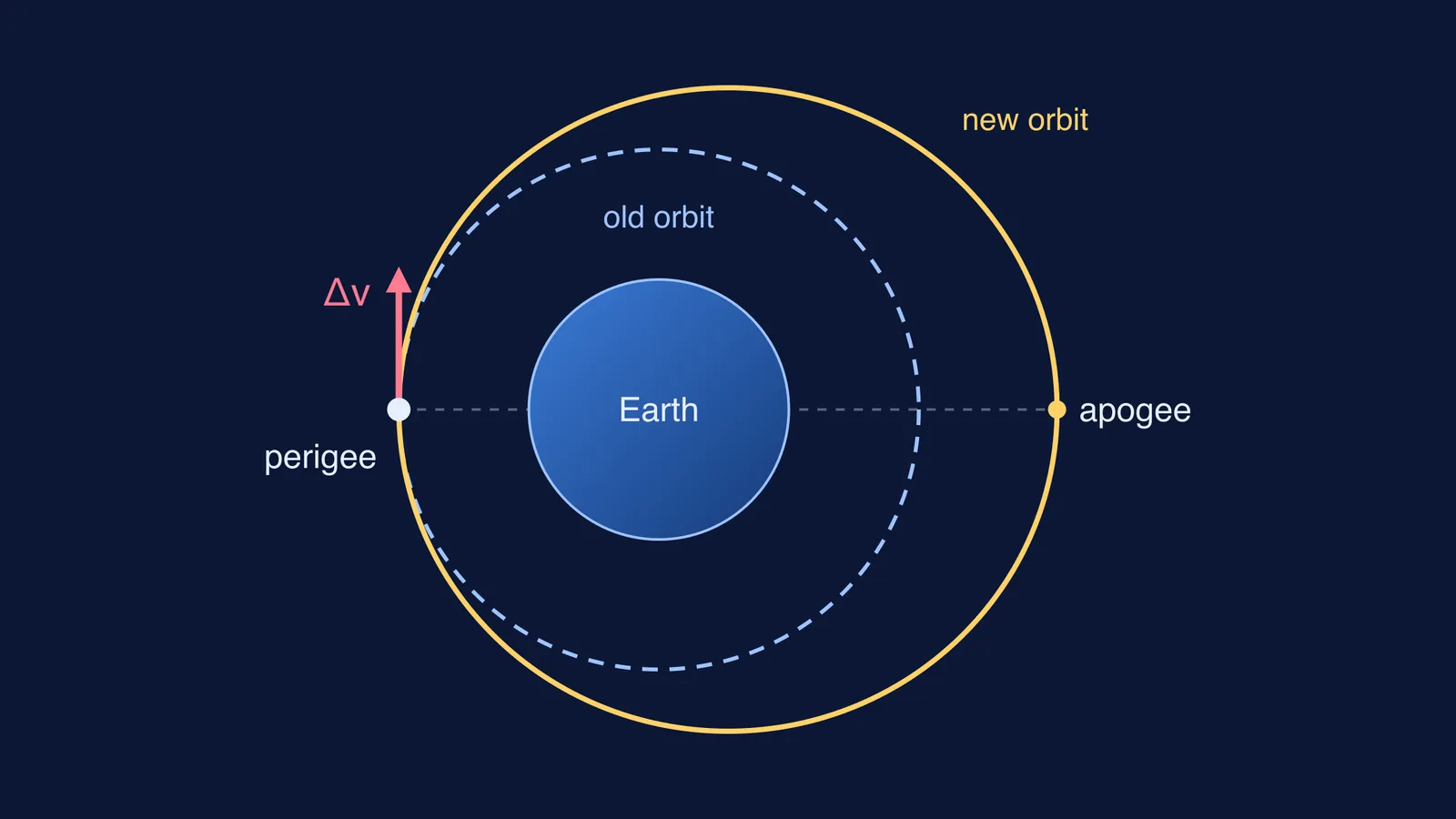
Picture a satellite circling Earth 400 km up. Its engine fires briefly, pushing forward along its path, and it gains a little speed. A common guess is that it moves out to a bigger circle. Instead, the orbit becomes an ellipse, and the place where the engine fired becomes the lowest point of the new orbit.
Why doesn't a faster satellite just move to a bigger circle?
In a circular orbit, gravity supplies exactly the centripetal force needed for one speed, v = √(GM/r). Speed up at the same r and gravity is now too weak to bend the path into that circle, so the satellite starts to climb. As it climbs, it trades kinetic energy for potential energy and slows down. On the far side gravity pulls it back down to the boost point, where it is fastest again.
The boost point becomes the perigee for two reasons. A forward push changes the speed but not the direction, so the velocity there is still perpendicular to the line to Earth's centre, and on an ellipse that only happens at the nearest or farthest point. Since the satellite now has more than circular speed, it moves outward from there, so it must be the nearest point. NASA's Basics of Space Flight puts it in one line: "A spacecraft's apoapsis altitude can be raised by increasing the spacecraft's energy at periapsis."
For the circular-speed formula, see how to derive the orbital velocity and time period of a satellite.
How do you calculate the new orbit after a speed boost?
The vis-viva equation is v² = GM(2/r − 1/a), where r is the distance from the centre of the Earth and a is the semi-major axis of the orbit. For a circle, r = a and it reduces to v² = GM/r.
We use the values on NASA's Earth fact sheet: GM = 3.986 × 10⁵ km³/s² and a mean radius of 6,371 km.
Circular orbit at 400 km altitude: r = 6,371 + 400 = 6,771 km. Speed v = √(GM/r) ≈ 7.67 km/s. Period T = 2πr/v ≈ 92.4 minutes.
Boost forward by 100 m/s: the new speed is 7.77 km/s at the same r.
Solve vis-viva for a: 1/a = 2/r − v²/GM gives a ≈ 6,953 km.
Apogee distance = 2a − r ≈ 7,136 km, which is about 765 km altitude. The perigee stays at 400 km.
Eccentricity e = (r_a − r_p)/(r_a + r_p) ≈ 0.026.
Period from Kepler's third law: T ≈ 92.4 × (6,953/6,771)^1.5 ≈ 96.2 minutes.
Speed at apogee from angular momentum, v_p r_p = v_a r_a: about 7.77 × 6,771/7,136 ≈ 7.37 km/s. See the perigee and apogee speed worked example.
A speed increase of about 1.3% lifted the far side by roughly 365 km. And after speeding up, the satellite is slower at apogee than in its old circle.
What if the boost is bigger, or the satellite slows down?
The same equation covers every case. The vis-viva article notes that escape speed is √2 times orbital speed at the same radius:
Bigger forward boost: a longer, more stretched ellipse, with the perigee still at the boost point.
Speed equal to √(2GM/r), which is √2 ≈ 1.414 times circular speed: a becomes infinite and the satellite escapes. That is a 41.4% increase. For our 400 km orbit it means about 10.85 km/s, an extra 3.18 km/s.
A slowdown instead: the boost point becomes the apogee, and the far side drops lower.
Escape speed is a speed, not a direction, which is why escape velocity does not depend on the angle of projection.
Do real spacecraft raise their orbits this way?
Yes. In a Hohmann transfer, used to move between two circular orbits, a first burn (the "perigee burn") creates the transfer ellipse and a second burn at apogee makes the new orbit circular.
India's Chandrayaan-3 used repeated perigee boosts. ISRO's mission page says the LVM3 rocket would place it in an elliptic parking orbit of about 170 × 36,500 km. After its final "Earth-bound perigee firing" in July 2023, ISRO expected an orbit of 127,609 km × 236 km, as DT Next reported. The near point stayed low while the far point grew.
A checklist for exam questions on orbit changes
"Speed increased slightly" means an ellipse, not a bigger circle.
The perigee distance equals the old radius. Only the apogee moves.
The period increases, because Kepler's third law uses a, not r.
A 41.4% increase (√2 times circular speed, from the vis-viva equation) is the escape threshold for any circular orbit.
The boost must be along the path. A sideways or radial push changes the direction too, and the boost point is no longer the perigee.
If you pick the right formula but get the orbit wrong, the Fermi Problem Library has worked problems with a step-by-step solver that explains the reasoning rather than printing an answer. To revisit gravitation from the basics, each idea has its own lesson in the Fermi Concept Library.


