

On this page
When we picture a spacecraft leaving Earth, we imagine a rocket launching straight up into the sky. It feels intuitive that heading directly away from a planet is the easiest way to escape its gravitational pull. But in physics, intuition can sometimes mislead you. Does escape velocity depend on angle of projection? The answer is a definitive no.
As long as an object is launched with enough speed and its path clears the planet's surface and atmosphere, it will escape into space regardless of the angle at which it is fired. Here is why the mathematics behind this phenomenon cares entirely about energy, not direction.
Why is escape velocity independent of angle?
To understand why the angle does not matter, you have to look at the specific nature of the forces involved. Gravity is a conservative force field. In a conservative field, the work required to move an object between two points—such as from the surface of the Earth to an infinite distance away—depends only on the starting and ending positions, not the path taken.
Because of this property, escape velocity is derived entirely from the Law of Conservation of Energy. To break free from a planet, an object must possess enough kinetic energy to overcome its negative gravitational potential energy. This requirement is a scalar equation, meaning it relies on magnitude (speed) rather than direction.
Kinetic energy is defined as K = ½mv². The velocity term here is squared, which strips away any directional vector components. Whether the object is fired straight up, at a 45° angle, or perfectly horizontally, the total mechanical energy in the system remains exactly the same. As long as the total mechanical energy is greater than or equal to zero, the object has enough energy to reach infinity.
The escape velocity formula
The mathematical proof for this independence is straightforward. An object escapes when its total mechanical energy (kinetic plus potential) reaches zero at an infinite distance.
When you set the initial kinetic energy (K = ½mv²) equal to the gravitational potential energy (U = GMm/R), the mass of the object (m) cancels out entirely. Rearranging the formula to solve for the velocity gives the standard escape speed equation:
v_e = √(2GM/R)
As detailed by HyperPhysics, this formula tells us that escape velocity depends only on the universal gravitational constant (G), the mass of the celestial body (M), and your starting distance from its centre (R). For Earth, this minimum speed is approximately 11.2 km/s. The launch angle (θ) simply does not appear in the equation at all.
If you are struggling to picture how scalar quantities override directional vectors in these scenarios, the Fermi Concept Library maps out energy conservation across different fields so you can see exactly how the terms balance out.
What happens to the shape of the path?
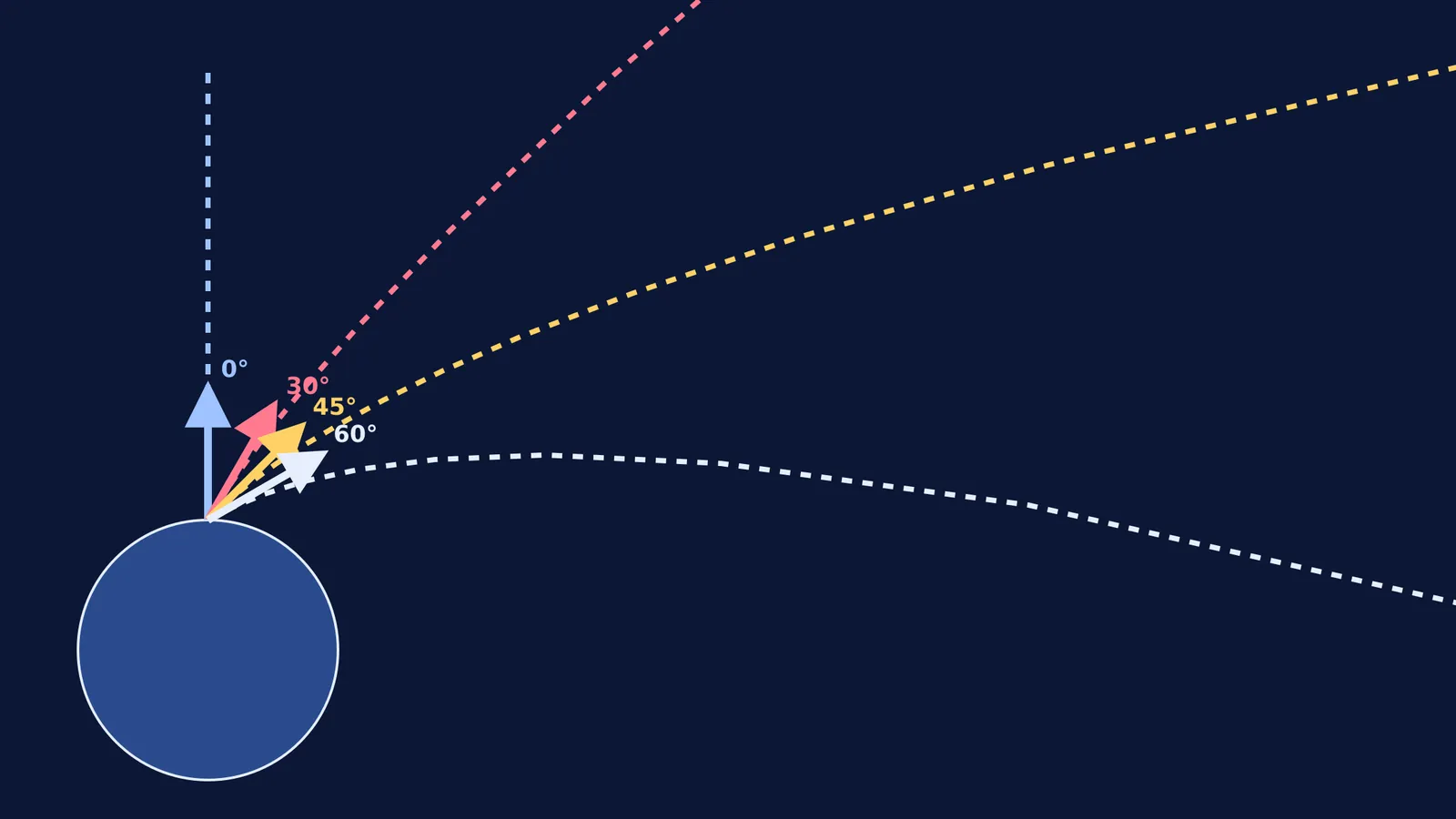
While the angle of projection does not change the initial speed required to escape, it absolutely changes the trajectory the object will follow through space.
If you launch a projectile straight up at exactly 11.2 km/s, it will travel in a straight, radial line. It will slow down continuously, and its speed will approach zero as it reaches an infinite distance.
If you launch the same object at an angle of 45°, it will still escape, but it will trace a parabolic curve that stretches out to infinity. If you fire it at a speed greater than the escape velocity, the path becomes a hyperbola. The angle dictates the geometry of the escape, but not the energy threshold required to achieve it.
What are common exam traps to watch for?
When you face multiple-choice questions in physics exams, examiners will intentionally test your understanding of this exact concept by introducing irrelevant variables. Here is a quick checklist of common traps to avoid:
The angle trap: If a question states a projectile is fired at 60° and asks for the new escape velocity, do not attempt to resolve the velocity into vector components by multiplying the standard v_e by sin 60° or cos 60°. The speed remains exactly v_e.
The mass trap: If an exam asks how the escape velocity changes when a 1,000 kg satellite is launched instead of a 10 kg stone, the answer is that it does not change. Mass cancels out of the equation entirely.
The horizontal launch trap: Sometimes a problem will ask what happens if an object is fired perfectly horizontally from a high mountain at v_e. Assuming it does not collide with the terrain, it will still escape.
Testing yourself against these conceptual tricks is the best way to prepare. If you keep getting tripped up by angle components in orbital mechanics, the Fermi Problem Library breaks down similar physics questions step-by-step so you can see why the angle term drops out of the final calculation.
Read more about related mechanics:


