

On this page
Every satellite in a circular orbit, from the International Space Station to a weather satellite parked over India, obeys two short results. Both come from one idea: gravity is the only force acting on the satellite, so gravity has to supply the centripetal force that keeps it on a circle. If you want the picture first, read how satellites stay in orbit without falling; this post is the algebra and a check against real numbers.
How do you derive the orbital velocity of a satellite?
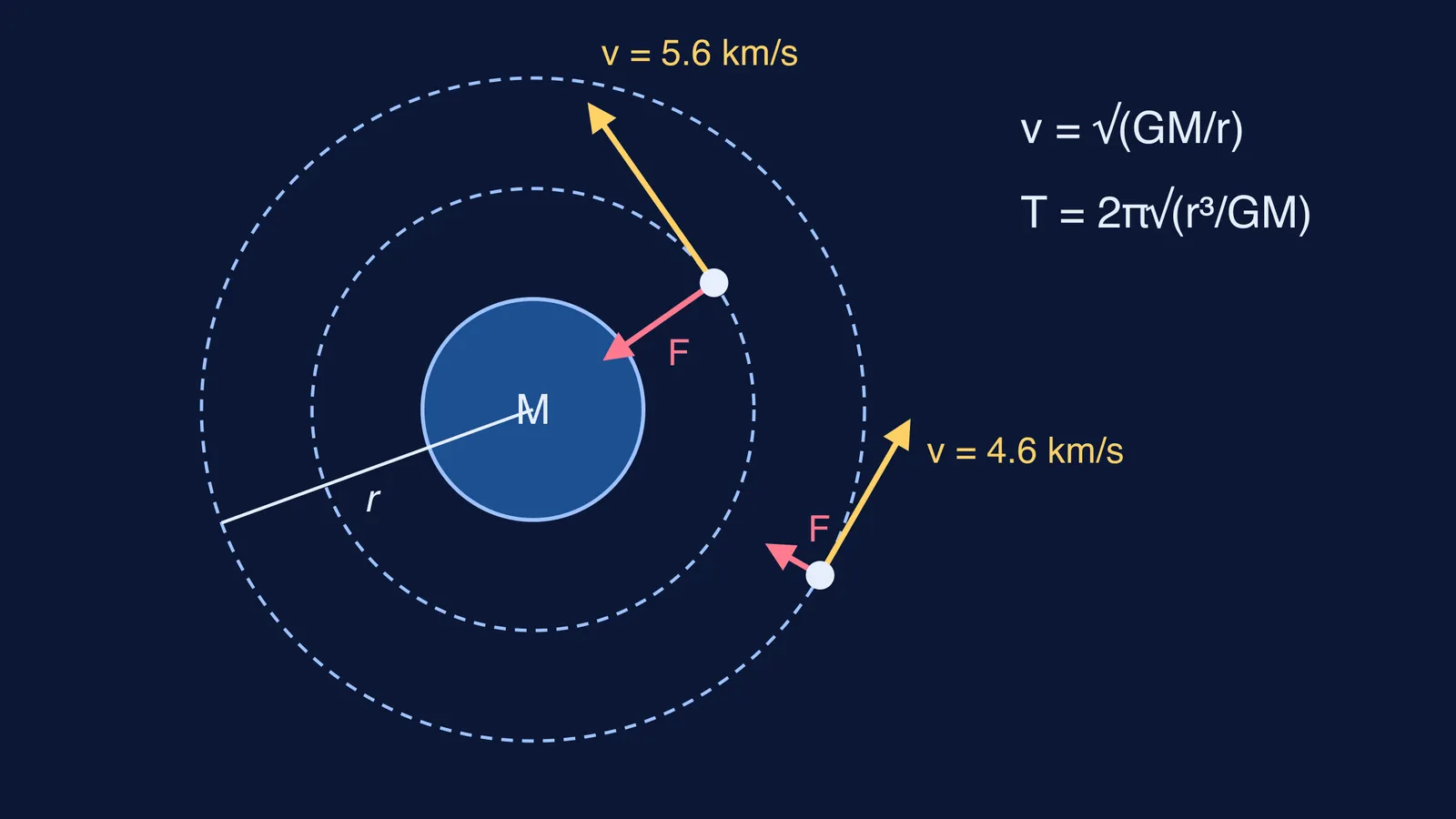
Take a planet of mass M and a satellite of mass m moving in a circle of radius r. Here r is measured from the centre of the planet, so for a satellite at height h above a planet of radius R, r = R + h.
Gravity on the satellite is F = GMm/r², pointing to the planet's centre.
Moving in a circle at steady speed v needs a centripetal force mv²/r, also pointing to the centre.
Gravity is the only force, so it supplies all of it: GMm/r² = mv²/r.
Cancel m and one r: v² = GM/r, so v = √(GM/r).
This is the same route the open textbook OpenStax University Physics, Volume 1 takes: it sets the gravitational force equal to the centripetal force and gets v = √(GM/r).
Notice that m has gone. A spanner and the whole station at the same r move at the same speed, which is also why everything on board falls together and astronauts feel weightless in orbit.
Board papers often want the answer in terms of g. At the surface, g = GM/R², so GM = gR² and v = √(gR²/(R + h)). For an orbit just above the surface (h much smaller than R), this becomes v ≈ √(gR).
How do you derive the time period of a satellite?
In one revolution the satellite covers the circumference 2πr in time T, so v = 2πr/T.
Rearrange: T = 2πr/v.
Substitute v = √(GM/r): T = 2πr ÷ √(GM/r).
Bring r inside the root: T = 2π√(r³/GM).
Square both sides and you get T² = (4π²/GM) r³, which is Kepler's third law for circular orbits. The OpenStax chapter reaches the same T = 2π√(r³/GM). That squared form is the fastest tool for ratio questions, covered in comparing orbital periods with Kepler's third law.
Does the formula match a real satellite?
Use real values. NASA's Earth fact sheet gives GM = 0.39860 × 10⁶ km³/s² and a mean radius of 6,371 km. If you prefer G and M separately, NIST lists the 2022 CODATA value G = 6.67430 × 10⁻¹¹ m³ kg⁻¹ s⁻². Using GM in km³/s² saves a step and keeps everything in kilometres.
NASA says the space station orbits at an average altitude of approximately 250 miles, about 400 km, travels at 17,500 mph and goes round every 90 minutes.
r = 6,371 + 400 = 6,771 km.
v = √(398,600 ÷ 6,771) = √58.87 ≈ 7.67 km/s.
T = 2π × 6,771 ÷ 7.67 ≈ 5,545 s, or about 92 minutes.
NASA's 17,500 mph is about 7.8 km/s, so the formula lands within about 3 per cent on both speed and period. Much of the gap is rounding: NASA's figures are round numbers, and 250 miles is only an average altitude.
Now run it backwards. The same fact sheet gives Earth's sidereal rotation period as 23.9345 hours, or 86,164 s. Setting T to that and solving r = (GMT²/4π²)^(1/3) gives r ≈ 42,164 km. Subtract the 6,378 km equatorial radius and a geostationary satellite sits about 35,786 km above the equator, moving at about 3.07 km/s.
Which mistakes cost marks in this derivation?
Putting the height h in the formula instead of r = R + h.
Mixing kilometres with G in SI units. Either convert everything to metres or use GM in km³/s².
Leaving the satellite's mass in the final answer. It cancels.
Taking a square root where a cube root is needed when solving T² ∝ r³ for r.
Assuming a higher satellite moves faster. Speed falls and period grows as r increases.
How should you practise it before an exam?
Write both derivations from a blank page, saying the reason for each line aloud: which force, which direction, what cancels.
Redo the space station check above without looking, then try the geostationary one.
Solve two ratio problems: one where r changes and you find the new T, one where T changes and you find the new r.
If centripetal force itself still feels shaky, start with circular motion in the Fermi Concept Library, where each concept has its own lesson and its place in the map. When a step in a numerical trips you up, the Fermi Problem Library has worked problems with a step-by-step solver that explains the reasoning rather than printing an answer.
Once you can write GMm/r² = mv²/r from memory and say why it holds, the rest is four lines of algebra.


