

On this page
Pens, food and people drift in mid-air on the International Space Station, including ISRO astronaut Shubhanshu Shukla, who arrived with Axiom Mission 4 on 26 June 2025 (NASA). Gravity has not switched off up there. Floating is what free fall feels like, and Class 11 physics explains it.
Is there really zero gravity on the space station?
No. NASA defines microgravity as "the condition in which people or objects appear to be weightless" (NASA, What Is Microgravity?). The important word is *appear*.
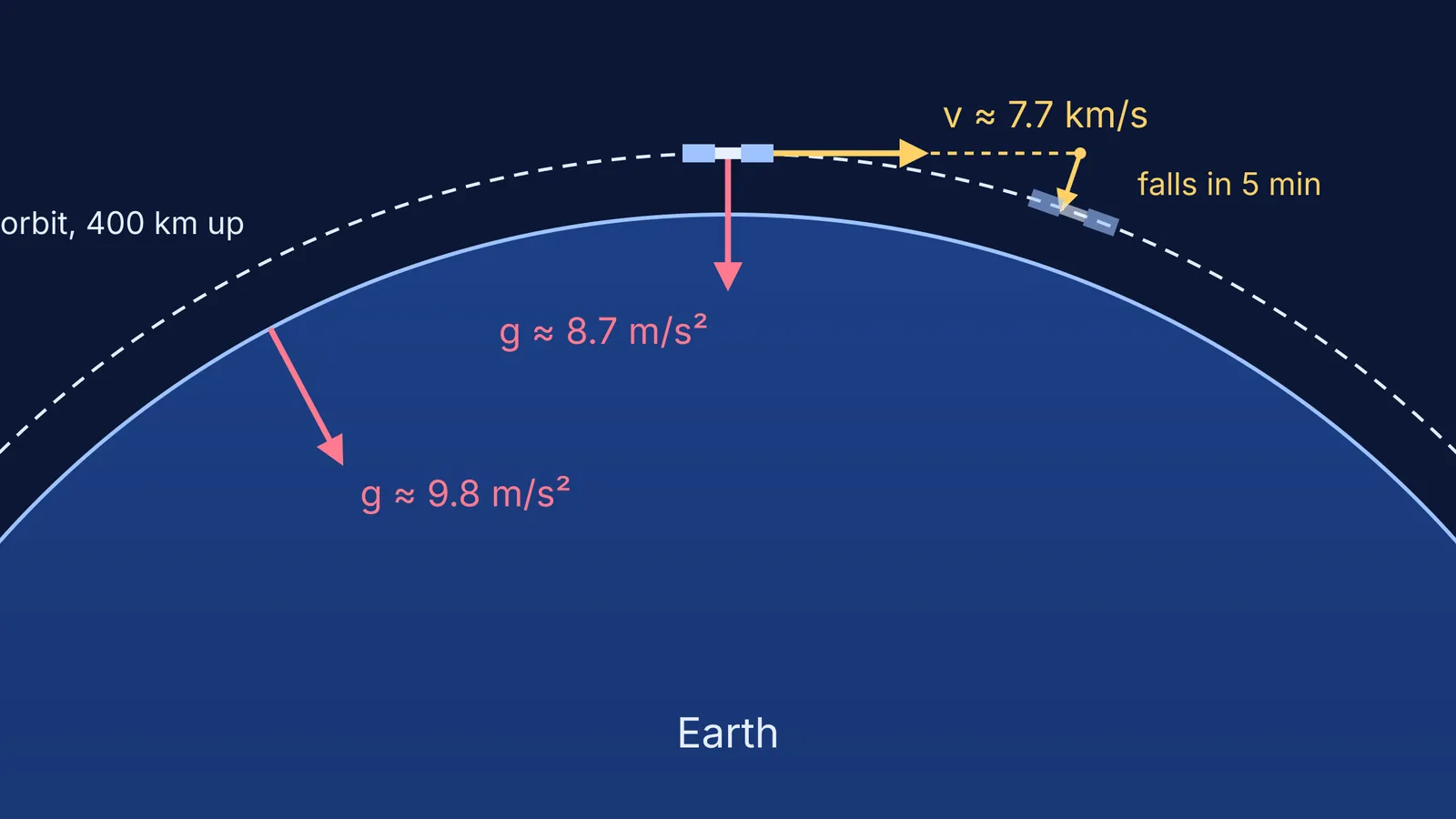
The same NASA page says the station orbits between 200 and 250 miles up, and that at that altitude Earth's gravity is about 90 percent of what it is on the surface.
NASA describes free fall as moving where gravity, and nothing else, is causing acceleration. Gravity pulls on the astronaut, the station and the pen, and all of them accelerate at the same rate, so nothing presses on anything else.
What does a weighing scale actually measure?
A scale measures how hard it pushes up on you, not gravity's pull. That push is the normal force, N: your apparent weight.
For a person of mass m in a lift accelerating downward at a, Newton's second law gives mg − N = ma, so N = m(g − a).
Worked example for a 60 kg student, taking g = 9.8 m/s²:
Lift at rest or moving at constant speed (a = 0): N = 60 × 9.8 = 588 N. The scale reads 60 kg.
Lift starting downward at a = 2 m/s²: N = 60 × 7.8 = 468 N. The scale reads about 48 kg and your stomach feels light.
Cable cut, lift in free fall (a = g): N = 60 × 0 = 0. The scale reads zero, even though gravity still pulls with 588 N.
That last line is the whole story of orbit. Watch the reading change in our guide to how a weighing scale reading changes in an accelerating lift.
At NASA's Zero Gravity Research Facility at Glenn Research Center, experiments fall 132 metres inside a vacuum chamber and get 5.18 seconds of weightlessness. Check it with s = ½gt²: t = √(2 × 132 ÷ 9.8) ≈ 5.19 s. An orbiting station is the same falling lift; it just never runs out of shaft.
How much gravity is left at space station height?
Gravity weakens with the square of your distance from Earth's centre: g(h) = g₀ × (R ÷ (R + h))².
The NASA Earth Fact Sheet gives Earth's mean radius as 6,371 km and mean surface gravity as 9.82 m/s². Take h = 400 km, near the top of NASA's 200 to 250 mile range:
R + h = 6,371 + 400 = 6,771 km.
R ÷ (R + h) = 6,371 ÷ 6,771 = 0.941.
Square it: 0.941² ≈ 0.885.
g at 400 km = 9.82 × 0.885 ≈ 8.7 m/s².
About 89 percent of surface gravity remains, matching NASA's "about 90 percent". A 60 kg astronaut is still pulled with about 520 N, yet a scale reads zero because it falls with them at 8.7 m/s².
Why doesn't the space station fall to Earth?
It does fall, all the time. In NASA's words, the spacecraft "keeps falling toward the ground but never hits it", so it falls around the planet.
The trick is sideways speed. NASA says the station travels at about five miles per second and orbits Earth about every 90 minutes, making 16 orbits in 24 hours (NASA, Space Station Facts and Figures). For a circular orbit, v = √(GM ÷ r); with the NASA Earth Fact Sheet value of GM, 398,600 km³/s², and r = 6,771 km, v ≈ 7.7 km/s.
The diagram at the top shows five minutes of this. In 300 seconds at 7.7 km/s, the station would travel about 2,300 km in a straight line; meanwhile it falls about 380 km toward Earth's centre, which keeps it on the same circle. See why a satellite falls but never lands.
How do you check you have really understood it?
True or false?
"There is no gravity in orbit." False: NASA's figure is about 90 percent of surface gravity (NASA).
"Astronauts float because they are far from Earth." False: 400 km is only about 6 percent of Earth's 6,371 km radius (NASA Earth Fact Sheet).
"A spring balance on the station reads zero." True: it measures apparent weight, N.
"A pendulum clock keeps time on the station." False: with no effective g there is no restoring force; see why a pendulum clock stops in an orbiting satellite.
If the step from N = m(g − a) to orbit still feels slippery, the Fermi Concept Library covers every concept in physics, each with its own lesson and its place in the map. For practice, the Fermi Problem Library has worked problems with a step-by-step solver that explains the reasoning rather than printing an answer.
Gravity is still there; the floor is just falling too.


