

On this page
When you ride a fast elevator, you know the sensation: your stomach feels heavy as it shoots upward, and you feel a fleeting sense of weightlessness as it brakes near the top. If you placed a bathroom scale under your feet, the numbers on the dial would jump and dip along with the motion.
What does a weighing scale actually measure?
When you step on a scale, you might think it simply measures how much Earth's gravity pulls you down. It actually measures the normal force (N): the force the floor pushes up against your feet to support you. According to OpenStax University Physics, your "apparent weight" is this normal force, and it changes whenever your vertical acceleration changes.
How do the lift's three phases affect the scale?
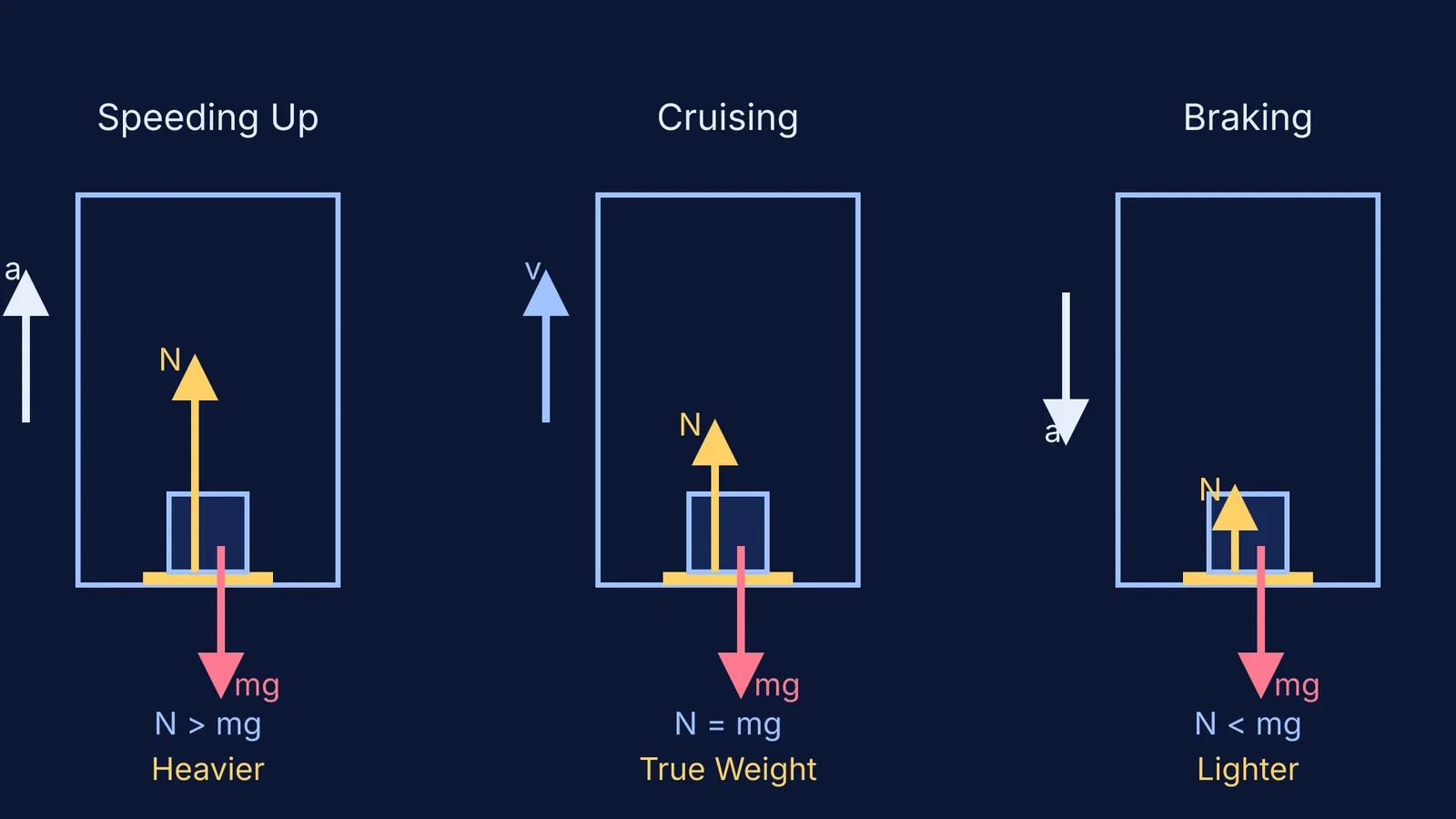
Let's track a 60 kg person riding a lift up to the top floor. Earth's gravity (g) accelerates objects downward at 9.8 m/s² (OpenStax). Their true weight is 588 N (or 60 kg on the dial).
Speeding up (Acceleration > 0): As the lift begins its ascent, it accelerates at +2.0 m/s². The floor must push up hard enough to overcome gravity and accelerate the person upward. The scale reads a higher apparent weight.
Cruising (Acceleration = 0): In the middle of the shaft, the lift reaches a constant velocity. Because the acceleration is zero, the net force on the person is zero. The floor pushes up with exactly 588 N, and the scale reads exactly 60 kg.
Braking (Acceleration < 0): Approaching the top floor, the lift slows down. The acceleration is now −2.0 m/s² (pointing downward). The floor drops away slightly, requiring less upward force to support the person. The scale reading drops.
What is the apparent weight formula?
We can calculate the exact scale reading using Newton's second law. The net force (F_net) on the person is the normal force (N) acting upward minus gravity (mg) acting downward:
N − mg = ma
Rearranging this gives the standard apparent weight formula:
N = m(g + a)
Let's plug the numbers from our 60 kg example into the equation:
Speeding up: N = 60(9.8 + 2.0) = 708 N. The scale, calibrated for gravity, divides this by 9.8, showing a reading of 72.2 kg.
Cruising: N = 60(9.8 + 0) = 588 N, reading as 60 kg.
Braking: N = 60(9.8 − 2.0) = 468 N, reading as 47.8 kg.
Testing it with an interactive simulation
Physics problems like this become much clearer when you can change the numbers and watch the forces respond in real time. Instead of just looking at a static free-body diagram on a page, you can use the Fermi Simulation Lab to set the lift's mass, velocity, and acceleration.
When you run the simulation, you see the normal force vector stretch as the lift accelerates upward, and shrink as it brakes. If you get stuck applying Newton's laws, Fermi's AI tutor can pause the simulation and walk you through the N = m(g + a) calculation step by step, ensuring you understand the reasoning behind each phase.
A checklist for solving lift problems
If you are facing an elevator problem in your JEE or NEET physics prep, use this quick framework to avoid sign errors:
Check the acceleration, not the velocity: A lift moving downward but slowing down has an *upward* acceleration (a > 0).
Assign a strict sign convention: Make upward acceleration positive and downward acceleration negative.
Apply the formula: Substitute your signed a into N = m(g + a).
Test the free-fall limit: If a problem asks what happens if the cable snaps, a = −g. The formula yields N = m(g − g) = 0, which correctly predicts complete weightlessness.
This step-by-step approach turns a tricky conceptual hurdle into a reliable scoring opportunity.


