

On this page
If you watch a broadcast from the International Space Station, the astronauts appear to float effortlessly. It is tempting to think there is zero gravity in space, but at the station's altitude, Earth's gravitational pull is still incredibly strong.
The astronauts are not floating free of gravity. They are falling.
Why does a satellite not fall to Earth?
A satellite does not crash into Earth because it is moving horizontally just as fast as it falls vertically. For example, the International Space Station travels at roughly 17,500 miles per hour. At this incredible speed, the Earth's surface curves away at the exact same rate the station falls toward it.
This means an orbit is simply a state of perpetual free fall. The object keeps falling, but it keeps missing the ground.
What was Newton's cannonball thought experiment?
Isaac Newton used a famous thought experiment to explain this exact mechanism.
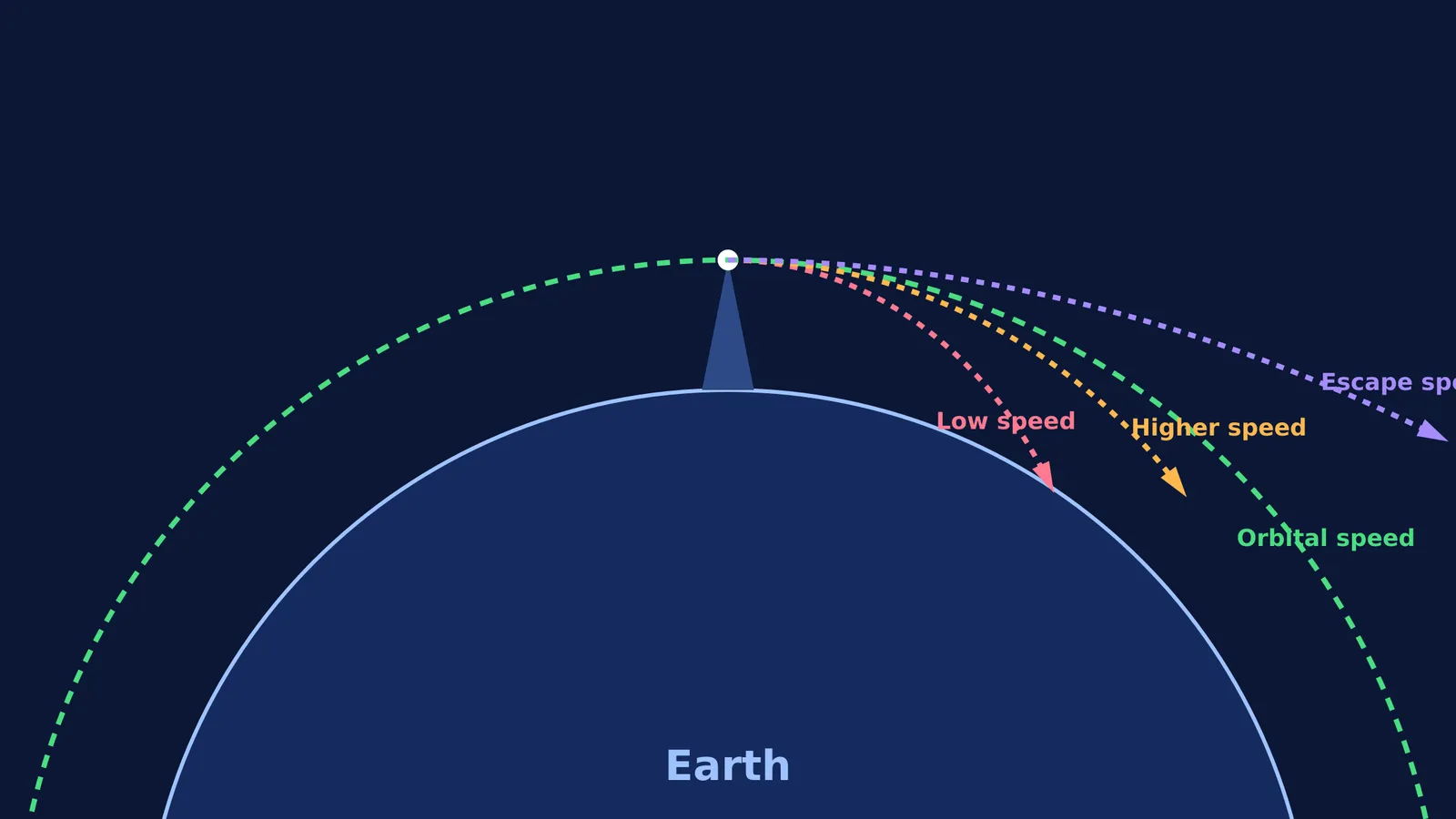
He imagined placing a cannon on an impossibly tall mountain, high above the atmosphere to ignore air resistance. If you fire a cannonball at a low speed, gravity pulls it down and it hits the ground, much like a standard horizontal projectile from a cliff. If you fire it slightly faster, it travels further before landing.
Newton realised that because the Earth is a sphere, the ground curves downward. If the cannonball is fired fast enough, the curve of its falling path will perfectly match the curvature of the Earth beneath it. The cannonball will never hit the ground, instead completing a full circle.
If you struggle to visualise how horizontal motion balances gravity to create a perfect circle, the Fermi Simulation Lab provides interactive simulations for the ideas that are easier to see than to read.
How fast do you need to go to orbit?
To stay in a low Earth orbit, an object needs a sideways velocity of about 8 kilometres per second.
This number comes from the geometry of our planet. If you draw a perfectly straight line tangent to the Earth's surface, the spherical ground will drop away by about 5 metres after a distance of 8 kilometres.
At the same time, near the Earth's surface, an object in free fall drops roughly 5 metres in its first second (from the equation d = ½gt²). Therefore, if a cannonball travels 8 kilometres horizontally in one second, it will drop 5 metres, but the Earth will also curve away by 5 metres. The cannonball remains at the exact same height above the ground.
Why do astronauts feel weightless?
If gravity is still pulling on the space station, why do astronauts float inside it? This is one of the most common points of confusion in physics.
The feeling of weight does not come from gravity itself; it comes from the ground (or a chair) pushing back up against you. This upward push is called the normal force. Because the space station and everything inside it are falling toward Earth at the exact same rate, there is no floor pushing up against the astronauts' feet. They are in continuous free fall, creating a sensation of weightlessness, often called microgravity.
If you were inside an elevator and its cable snapped, you would float alongside your suitcase until you hit the ground. A satellite is exactly like that falling elevator, except its tremendous horizontal speed means the ground is never there to stop it.
Is the speed always constant?
Circular orbits are neat, but if the satellite is fired just slightly faster than the required circular speed, it enters an elliptical orbit. In this path, the satellite's speed changes depending on its distance from the Earth. When it is closer, it moves faster, and when it is further away, it moves slower. This change in speed is governed by the conservation of angular momentum, a principle you can see clearly when studying Kepler's second law.
If you are calculating orbital velocities and get stuck on the underlying mechanics, the Fermi Concept Library covers every concept in physics, chemistry, biology, mathematics and computing.
A framework for orbital mechanics questions
When facing exam questions on orbits, follow this checklist to avoid common mistakes:
Identify the force: The centripetal force keeping the satellite in orbit is entirely provided by gravity (F = GMm/r²).
Equate and simplify: Set the gravitational force equal to the required centripetal force (mv²/r) to find the orbital velocity formula v = √(GM/r).
Check your altitude: Remember that the radius (r) is the distance from the centre of the Earth, not the surface. You must always add the Earth's radius to the satellite's altitude above ground.
Distinguish free fall from zero-g: Always define orbits as perpetual free fall caused by high horizontal velocity, rather than an absence of gravitational force.


