

On this page
Imagine taking a grandfather clock onto the International Space Station. If you pulled the pendulum to the side and let it go, it would not swing back. It would simply float at the angle you left it, or continue spinning in a full circle if you pushed it hard enough.
This scenario is a classic conceptual question in physics exams for a good reason. It tests whether you understand the difference between true zero gravity and the microgravity of an orbit, and it forces you to look closely at the forces driving an oscillator.
Why does a pendulum clock stop in an orbiting satellite?
To understand why the clock fails, you have to look at the force that makes it work. On Earth, when you pull a pendulum bob to one side, gravity pulls it back toward the lowest point, or the centre of its arc. This pull is called the restoring force, and it is what creates the continuous back-and-forth oscillation.
A satellite in orbit is not actually free from Earth's gravity. In fact, according to NASA, at the altitude of the International Space Station, Earth's gravitational pull is still 88.8% as strong as it is on the surface. Instead, the satellite is moving sideways so fast that as it falls toward Earth, the Earth's surface curves away beneath it.
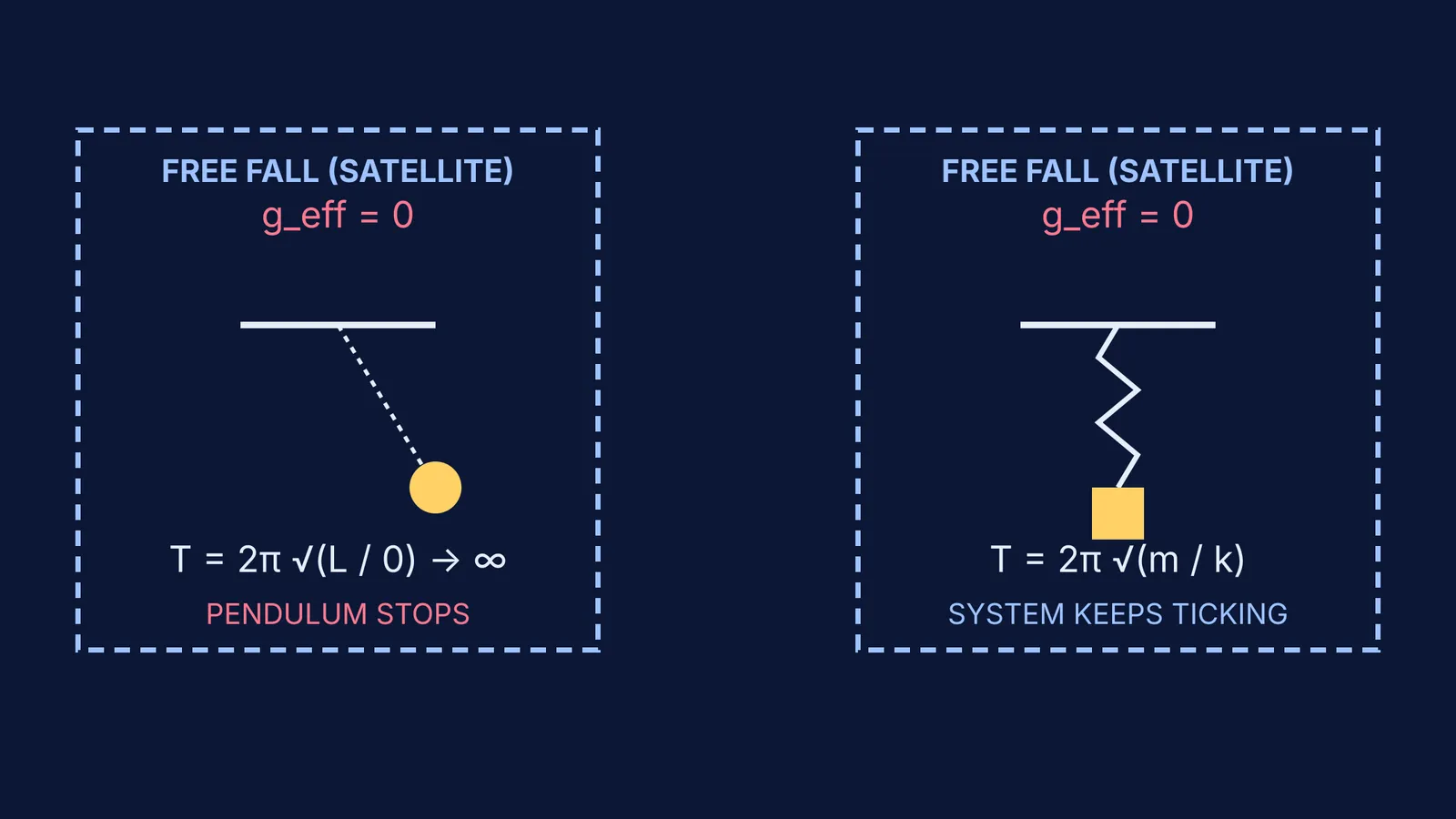
The satellite, the clock, and the pendulum bob are all in a state of continuous free fall. As NASA explains, "The condition of microgravity comes about whenever an object is in free fall." Because the clock and the pendulum bob are falling together at the exact same rate, there is no relative gravity between them. Inside the frame of reference of the satellite, the effective acceleration due to gravity, g_eff, is strictly zero.
The period of a simple pendulum is given by the formula T = 2π√(L/g), where L is the length and g is the acceleration due to gravity (HyperPhysics). If you replace g with an effective gravity of zero, you are dividing by zero, which makes the period T mathematically infinite. An infinite period means the pendulum takes forever to complete one single swing—so the clock stops ticking.
Why does a mechanical watch keep working?
If you swap the gravity-driven grandfather clock for a mechanical wristwatch, timekeeping returns to normal. A mechanical watch does not rely on a gravitational restoring force to keep its rhythm. Instead, it uses a tiny coiled spring (called a hairspring) attached to a weighted balance wheel.
The physics of a spring-mass system is entirely different from a pendulum. The period is given by T = 2π√(m/k), where m is the mass of the object and k is the spring constant (HyperPhysics).
Neither the mass of the balance wheel nor the stiffness of the metal spring depends on gravity. Because the restoring force comes entirely from the internal elasticity of the metal, the watch ticks at the same rate in the free fall of orbit as it does sitting on your desk at home.
How do you calculate effective gravity in moving frames?
The concept of effective gravity, g_eff, is a powerful tool. It solves many standard mechanics problems without requiring you to draw complex relative-motion vectors from an outside perspective. You just find the net acceleration of the frame of reference and adjust g accordingly.
Here is a quick framework for finding the period of a pendulum in different moving frames along a vertical line:
Stationary or constant velocity: The frame is not accelerating. g_eff = g. The period remains normal.
Lift accelerating straight up: The floor pushes up harder, making objects inside feel heavier. g_eff = g + a. The restoring force is stronger, so the pendulum swings faster (yielding a shorter period).
Lift accelerating straight down: The floor begins to fall away, making objects feel lighter. g_eff = g - a. The pendulum swings slower (yielding a longer period).
Satellite in orbit (free fall): The downward acceleration a exactly equals g. Therefore, g_eff = g - g = 0. The period becomes infinite, and the pendulum stops.
If you struggle to apply these rules to trickier cases—such as calculating the exact tension in a simple pendulum string when a lift accelerates, or working out how a seconds pendulum changes with length in a new gravity field—the Fermi Problem Library has worked problems with a step-by-step solver that explains the reasoning rather than printing an answer.
You can also apply this proportional logic to other environmental changes. For instance, just as a drop in gravity lengthens the period, an increase in length due to heat can lead to a pendulum clock losing time in summer. In every case, writing out the T = 2π√(L/g_eff) formula first will point you to the right physical outcome.


