

On this page
When a JEE Main or NEET-UG question asks whether [Fe(CN)₆]³⁻ is an inner or outer orbital complex, it is really asking two things: which d orbitals the metal uses to bond, and how many unpaired electrons are left. Get the first right and the magnetic moment follows.
What is the difference between inner and outer orbital complexes?
According to the NCERT Class 12 chapter on coordination compounds, valence bond theory says a metal ion, under the influence of ligands, hybridises either its (n−1)d, ns and np orbitals or its ns, np and nd orbitals.
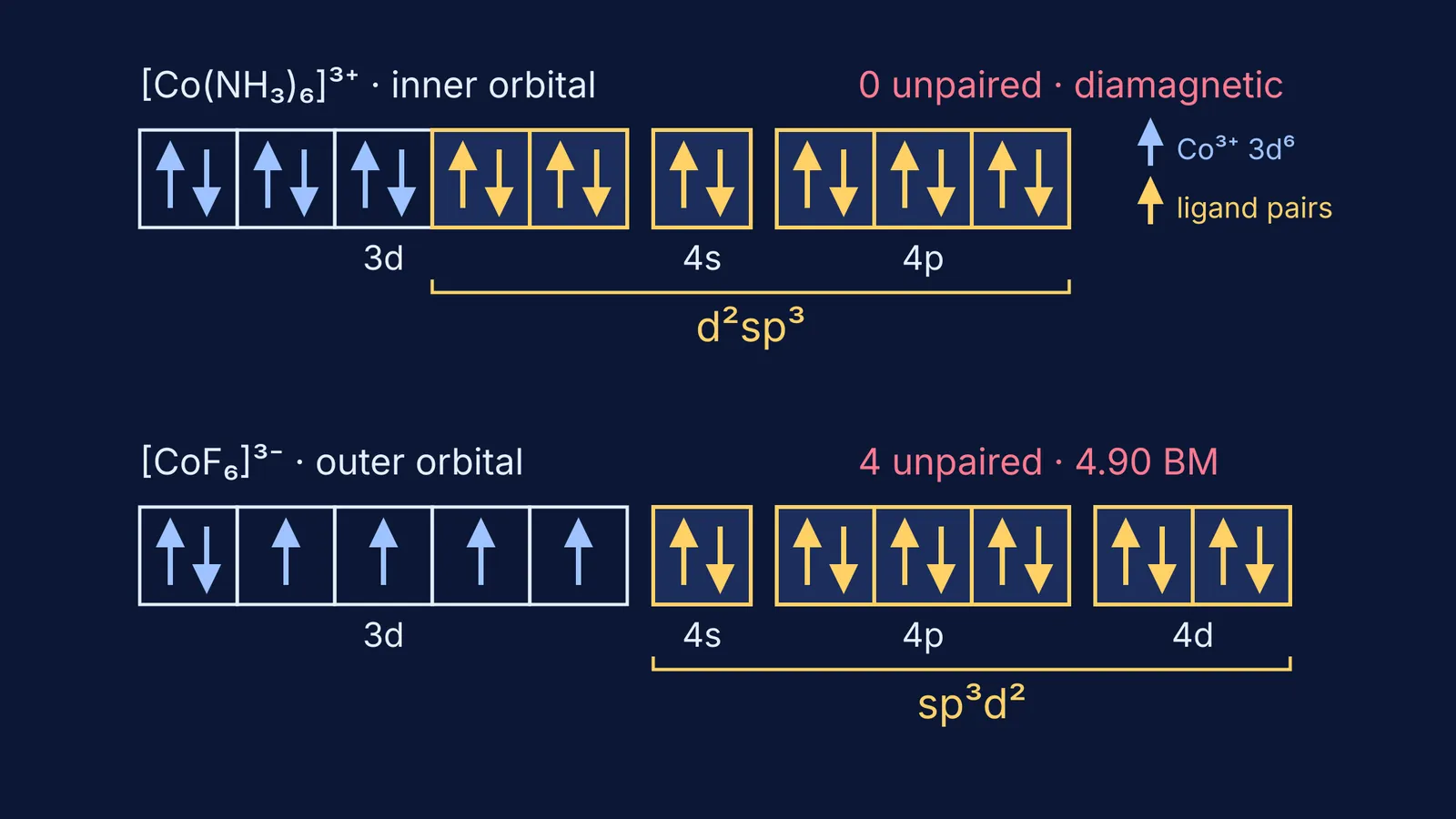
An inner orbital complex uses two (n−1)d, one ns and three np orbitals: d²sp³. For cobalt, that is 3d, 4s and 4p.
An outer orbital complex uses one ns, three np and two nd orbitals: sp³d². For cobalt, that is 4s, 4p and 4d.
Both give an octahedron. What changes is where the metal's own d electrons sit. To free two 3d orbitals, the metal often has to pair its electrons. NCERT also calls inner orbital complexes low spin or spin paired, and outer orbital complexes high spin or spin free.
NCERT's own pair shows it: [Co(NH₃)₆]³⁺ is an inner orbital complex and diamagnetic, while [CoF₆]³⁻ is an outer orbital complex and paramagnetic, though both contain Co³⁺ with a 3d⁶ configuration. The full title of Linus Pauling's 1931 paper The Nature of the Chemical Bond already ties bonding to a theory of paramagnetic susceptibility.
Which ligands form inner orbital complexes?
Ligand strength decides whether pairing happens. The NCERT chapter gives the spectrochemical series, weakest field first: I⁻ < Br⁻ < SCN⁻ < Cl⁻ < S²⁻ < F⁻ < OH⁻ < C₂O₄²⁻ < H₂O < NCS⁻ < edta⁴⁻ < NH₃ < en < CN⁻ < CO.
Strong field ligands, such as CN⁻ and CO, push a d⁴–d⁶ ion's electrons into pairs and leave two 3d orbitals empty: inner orbital, d²sp³.
Weak field ligands, such as F⁻ and Cl⁻, leave the electrons spread out by Hund's rule, so the metal uses its 4d orbitals instead: outer orbital, sp³d².
Two exceptions catch students out. First, the d count can settle the question before the ligand does. NCERT notes that ions with up to three d electrons, such as Ti³⁺, V³⁺ and Cr³⁺, already have two vacant 3d orbitals. Ni²⁺ is d⁸: even after pairing it cannot free two 3d orbitals, so [Ni(NH₃)₆]²⁺ is outer orbital, as a Purdue University review of the valence-bond approach also explains. Second, valence bond theory does not distinguish between weak and strong ligands, by NCERT's own account. NCERT places the spectrochemical series in its crystal field section and calls it 'an experimentally determined series'.
How does inner or outer orbital change the magnetic moment?
For first-row transition metal ions, the NCERT d- and f-block chapter gives the spin-only formula μ = √(n(n+2)) BM, where n is the number of unpaired electrons. Its table lists spin-only values of 1.73 BM for one unpaired electron, 2.84 for two, 3.87 for three, 4.90 for four and 5.92 for five.
The coordination compounds chapter gives these contrasts:
[Fe(CN)₆]³⁻, inner orbital: one unpaired electron. [FeF₆]³⁻, outer orbital: five.
[Mn(CN)₆]³⁻, inner orbital: two unpaired electrons. [MnCl₆]³⁻, outer orbital: four.
[Co(C₂O₄)₃]³⁻, inner orbital: diamagnetic. [CoF₆]³⁻, outer orbital: four unpaired electrons.
For more practice, see how to calculate the spin-only magnetic moment, and for the iron pair in detail, why the cyanide complex of iron(III) is weakly but the fluoride complex strongly paramagnetic.
How do you decide inner or outer orbital in an exam?
Work through [Fe(CN)₆]³⁻ using the NCERT spectrochemical series and spin-only formula:
Find the oxidation state and d count. Six CN⁻ give −6 and the ion is −3, so iron is +3 and d⁵.
Try the d-count shortcut. d¹ to d³ give d²sp³ anyway; d⁸ in a six-coordinate complex gives sp³d².
For d⁴ to d⁶, place the ligand in the spectrochemical series. CN⁻ is strong, so the five electrons crowd into three 3d boxes (two pairs, one single), leaving two empty. Inner orbital, d²sp³.
Count unpaired electrons and apply the formula. Here n = 1, so μ ≈ 1.73 BM.
Now [FeF₆]³⁻: Fe³⁺ is again d⁵, F⁻ is weak, nothing pairs, and the metal uses 4s, 4p and 4d. Outer orbital, sp³d², five unpaired electrons, about 5.92 BM.
If step 3 is where you keep slipping, the Fermi Problem Library has worked problems with a step-by-step solver that explains the reasoning rather than printing an answer, so you can see which step went wrong.
Where does valence bond theory fall short?
The NCERT chapter says VBT explains the formation, structures and magnetic behaviour of complexes to a large extent, but gives no quantitative interpretation of magnetic data and does not explain their colour. It also reminds you that hybrid orbitals do not actually exist; hybridisation is a mathematical manipulation of wave equations.
Crystal field theory instead compares the splitting Δo with the pairing energy; our guide to deciding high spin or low spin covers that.
If the spectrochemical series or Hund's rule still feels shaky, the Fermi Concept Library has every concept in chemistry, each with its own lesson and its place in the map.


