

On this page
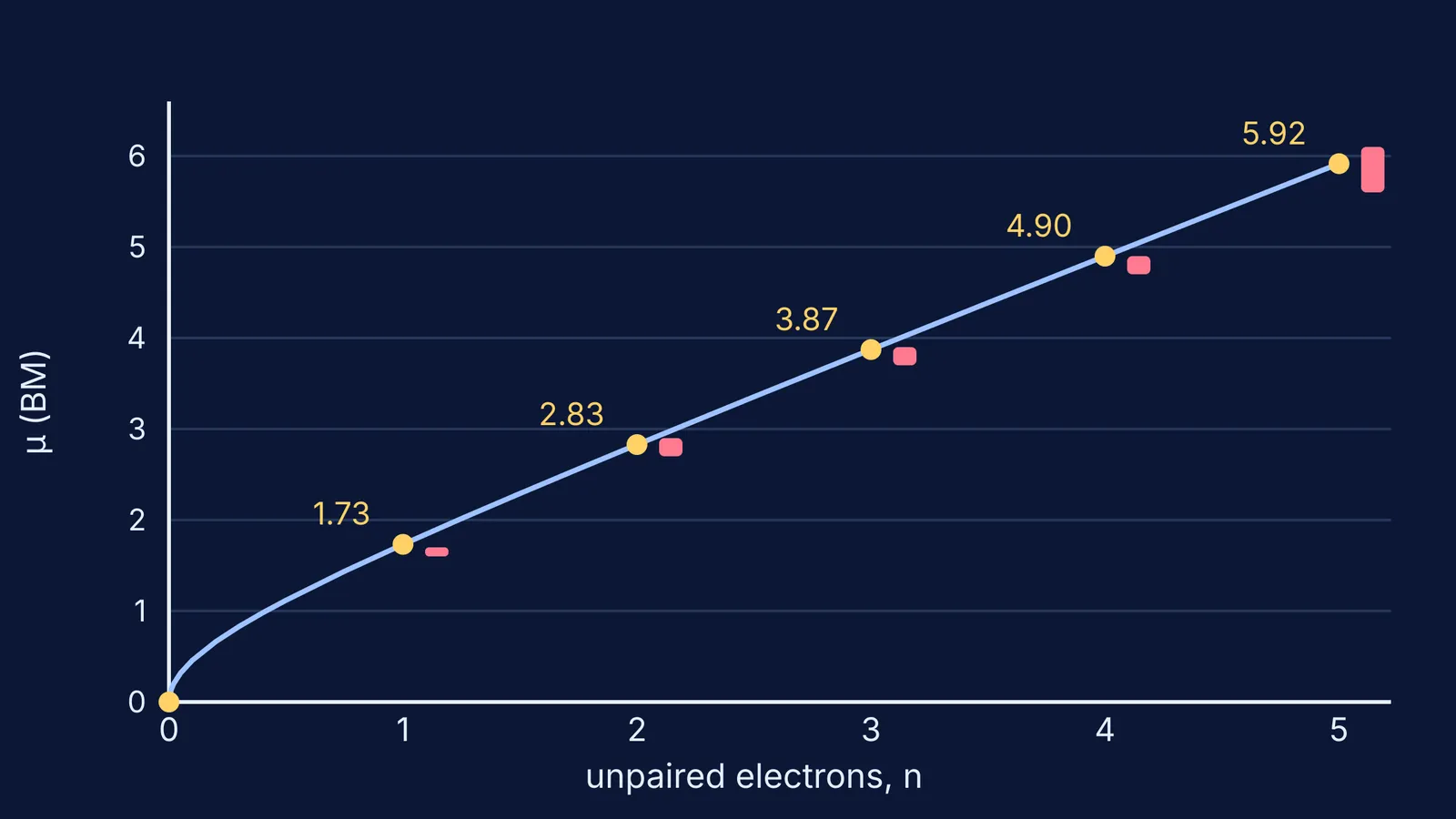
In first-row (3d) transition metal ions, most of the magnetism comes from unpaired electron spins, so a single formula does most of the work. The spin-only magnetic moment is μ = √(n(n+2)) BM, where n is the number of unpaired electrons; it is the same as √(4S(S+1)) with S = n/2, as set out in LibreTexts' notes on magnetic moments of transition metals/Crystal_Field_Theory/Magnetic_Moments_of_Transition_Metals). The unit, the Bohr magneton, is 9.274 × 10⁻²⁴ J/T in the 2022 CODATA values published by NIST.
The whole skill is counting n correctly. The square root is the easy part.
How do you calculate the spin-only magnetic moment of an ion?
Write the neutral atom's configuration, for example Fe = [Ar] 3d⁶ 4s².
Remove electrons for the charge, taking 4s electrons first and then 3d. Fe³⁺ is [Ar] 3d⁵. If this step trips you up, our guide to electron configurations of ions like Fe³⁺ and Cu⁺ walks through it.
Decide how the d electrons sit. For a bare ion, or when the question names no ligand, fill the five d orbitals singly before pairing (Hund's rule).
Count the unpaired electrons, n, and substitute into √(n(n+2)).
Learn these six results, which match the LibreTexts table/Crystal_Field_Theory/Magnetic_Moments_of_Transition_Metals) (it rounds √15 to 3.88):
n = 0 gives 0 BM (diamagnetic)
n = 1 gives √3 = 1.73 BM
n = 2 gives √8 = 2.83 BM
n = 3 gives √15 = 3.87 BM
n = 4 gives √24 = 4.90 BM
n = 5 gives √35 = 5.92 BM
Worked examples: free ions and complexes
Free ions first, with values as in LibreTexts/Crystal_Field_Theory/Magnetic_Moments_of_Transition_Metals):
Mn²⁺ (atomic number 25): [Ar] 3d⁵, five unpaired, √35 = 5.92 BM.
Ti³⁺: 3d¹, one unpaired, 1.73 BM.
Ni²⁺: 3d⁸, two unpaired, 2.83 BM.
Cu²⁺: 3d⁹, one unpaired, 1.73 BM.
Zn²⁺: 3d¹⁰, none unpaired, 0 BM, so it is diamagnetic.
In an octahedral complex, the ligand can change the answer for d⁴ to d⁷. A weak-field ligand leaves the electrons spread out (high spin); a strong-field ligand such as cyanide (or ammonia with Co³⁺) pairs them in the lower t₂g set (low spin). The LibreTexts table/Crystal_Field_Theory/Magnetic_Moments_of_Transition_Metals) lists low-spin d⁶ Co(III) at 0 BM, calculated and observed. So:
[CoF₆]³⁻: Co³⁺ is d⁶, fluoride is weak field, four unpaired, 4.90 BM.
[Co(NH₃)₆]³⁺: still d⁶, but low spin, all paired, 0 BM.
[Fe(CN)₆]³⁻: Fe³⁺ is d⁵, low spin, one unpaired, 1.73 BM.
For the hybridisation side of the same complexes, see valence bond theory for complexes.
How do you find the oxidation state from a magnetic moment?
Run the method backwards. Square the moment, solve n² + 2n = μ² for a whole number, then ask which d count and which charge give that n. A JEE Main question from April 2023 gave a calculated moment of 4.90 BM and asked for the unpaired electrons: 4.90² ≈ 24 = 4² + 2(4), so n = 4.
Now a harder one. A manganese ion has a spin-only moment of 3.87 BM. What is its oxidation state?
3.87² ≈ 15 = 3² + 2(3), so n = 3.
Three unpaired electrons means d³ or d⁷ (the mirror shortcut).
Manganese has seven electrons beyond argon (3d⁵ 4s²). Reaching d³ means losing four, so Mn⁴⁺. Reaching d⁷ would mean losing none, which is not an ion.
Answer: +4.
The same logic works for iron. An iron complex at 5.92 BM has n = 5, so it is high-spin d⁵, which is Fe³⁺. An iron cyanide complex at 0 BM is low-spin d⁶, which is Fe²⁺, as in [Fe(CN)₆]⁴⁻.
Why do measured moments differ from the spin-only values?
The formula counts spin only, by design, and ignores any contribution from the electrons' orbital motion. For many ions the gap is small: LibreTexts/Crystal_Field_Theory/Magnetic_Moments_of_Transition_Metals) lists octahedral Cr(III) at 3.7-3.9 BM observed against 3.88 calculated. For others it is larger: high-spin octahedral Co(II) is observed at 4.3-5.2 BM against 3.88, and tetrahedral Ni(II) at 3.7-4.0 BM against 2.83.
In JEE Main and NEET-UG questions that say "spin-only", use the formula and ignore these gaps. They matter when a question gives an experimental value and asks you to explain why it does not match. For colour, oxidation states and the rest of the chapter, our d- and f-block elements overview covers the background.
A five-minute practice set
Try these: V³⁺, Cr³⁺, Fe²⁺ (free ion), [Fe(CN)₆]⁴⁻, and a cobalt ion at 3.87 BM. The answers, matching the LibreTexts values/Crystal_Field_Theory/Magnetic_Moments_of_Transition_Metals), are 2.83, 3.87, 4.90 and 0 BM, then Co²⁺ (d⁷).
If you get a d count wrong, the Fermi Problem Library has worked problems with a step-by-step solver that explains the reasoning rather than printing an answer. If crystal field splitting itself is hazy, start with its lesson in the Fermi Concept Library.


