

On this page
Iron(III) hexacyanide and iron(III) hexafluoride look like twins: same metal, same +3 charge, six ligands in an octahedron. Yet a magnet pulls weakly on one and strongly on the other. The difference comes entirely from the ligand, and you can explain it with crystal field theory (CFT) or valence bond theory (VBT). The pair is a useful test case because it needs electron counting, the spectrochemical series and the spin-only formula.
Why is [Fe(CN)₆]³⁻ weakly paramagnetic but [FeF₆]³⁻ strongly paramagnetic?
Iron has atomic number 26, so the neutral atom is [Ar]3d⁶4s². To make Fe³⁺ it loses both 4s electrons and one 3d electron, leaving 3d⁵. The NCERT Class 12 chapter on coordination compounds lists Fe³⁺ among the d⁵ ions (NCERT Chemistry Part I, Unit 5).
The same chapter states the experimental result directly: [Fe(CN)₆]³⁻ has the magnetic moment of a single unpaired electron, while [FeF₆]³⁻ has the moment of five unpaired electrons. Paramagnetism comes from unpaired electrons, so one means weak attraction and five means strong. Note that weakly paramagnetic is not diamagnetic: one electron is still unpaired.
What does crystal field theory say?
In an octahedral complex, the six ligands raise the energy of the two d orbitals that point at them (the eg set) and lower the three that point between them (the t2g set). NCERT calls the gap between these sets the crystal field splitting, written Δo (NCERT Unit 5).
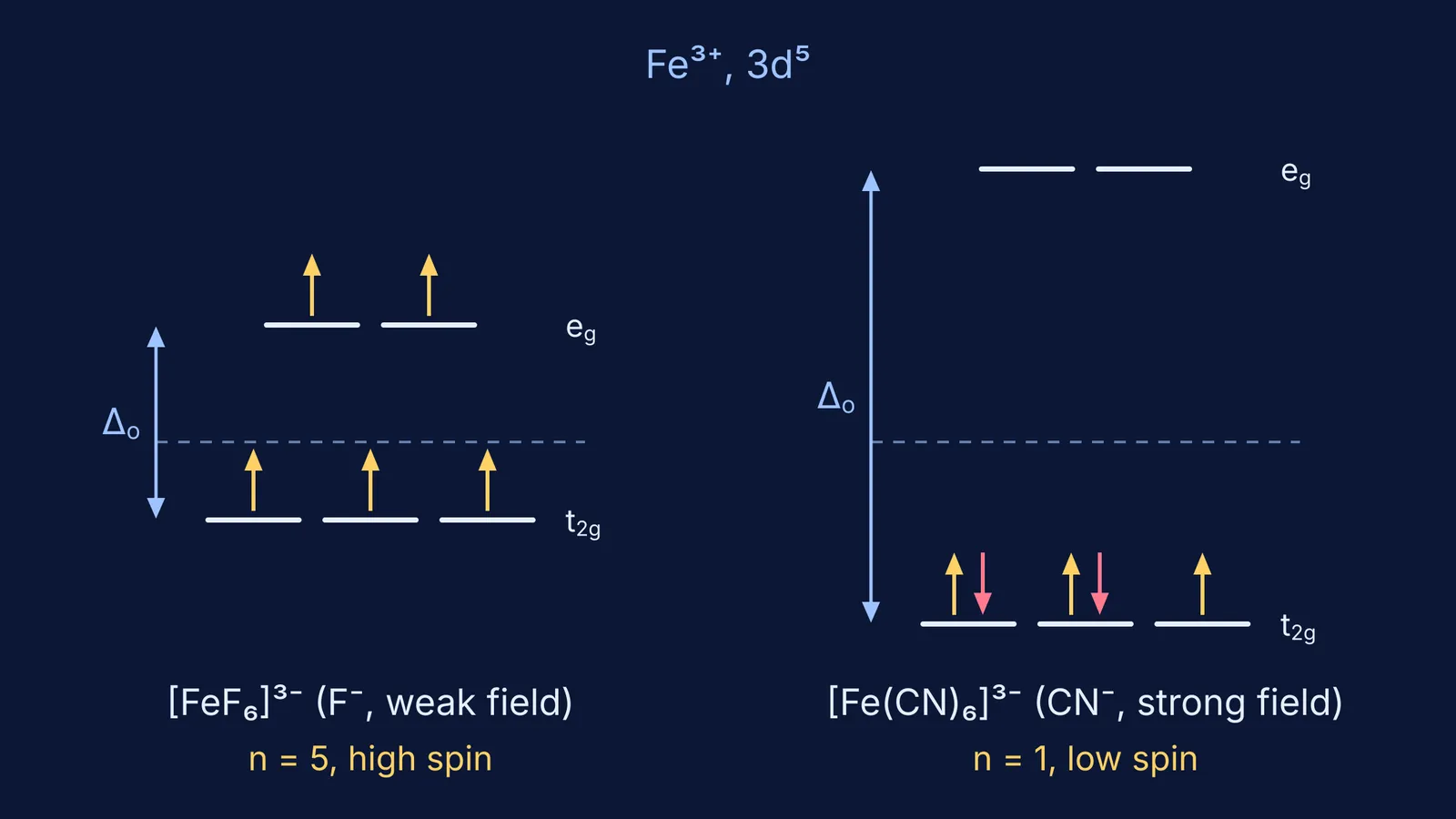
Where the electrons go depends on a contest between Δo and the pairing energy P, the energy needed to put two electrons in one orbital. Ligands for which Δo < P are weak field ligands and form high spin complexes; ligands that make Δo > P are strong field ligands and form low spin complexes.
The spectrochemical series ranks ligands by the splitting they produce: I⁻ < Br⁻ < SCN⁻ < Cl⁻ < S²⁻ < F⁻ < OH⁻ < C₂O₄²⁻ < H₂O < NCS⁻ < edta⁴⁻ < NH₃ < en < CN⁻ < CO. F⁻ sits near the weak end and CN⁻ near the strong end. Now fill in five electrons:
[FeF₆]³⁻: Δo is small, so electrons spread over all five orbitals before pairing. The configuration is t2g³ eg², with five unpaired electrons.
[Fe(CN)₆]³⁻: Δo is large, so all five electrons crowd into t2g. The configuration is t2g⁵ eg⁰: two pairs and one unpaired electron.
How does valence bond theory explain it?
VBT asks which orbitals the iron ion hybridises to accept six electron pairs. NCERT describes the iron pair as inner orbital versus outer orbital complexes (NCERT Unit 5).
[Fe(CN)₆]³⁻: the 3d electrons pair up into three orbitals, freeing two inner 3d orbitals. With 4s and three 4p orbitals they form d²sp³ hybrids: an inner orbital, low spin complex with one unpaired electron.
[FeF₆]³⁻: no pairing happens. Iron uses 4s, three 4p and two outer 4d orbitals to form sp³d² hybrids: an outer orbital, high spin complex with five unpaired electrons.
VBT gets the right answer, but NCERT lists among its shortcomings that it does not distinguish between weak and strong ligands. Our guide to valence bond theory for coordination complexes works through more examples.
How do you calculate the magnetic moment of each complex?
For ions of the first transition series, NCERT gives the spin-only formula μ = √(n(n+2)) BM, where n is the number of unpaired electrons and BM is the Bohr magneton (NCERT Chemistry Part I, Unit 4).
[Fe(CN)₆]³⁻, n = 1: μ = √(1 × 3) = √3 ≈ 1.73 BM, the value NCERT gives for a single unpaired electron.
[FeF₆]³⁻, n = 5: μ = √(5 × 7) = √35 ≈ 5.92 BM, the value NCERT works out for the d⁵ Mn²⁺ ion.
These are spin-only predictions: NCERT's table of calculated and observed moments shows measured values can differ from them. For more practice, see our spin-only magnetic moment worked examples.
A four-step check for any octahedral complex
Find the metal's oxidation state from the overall charge and the ligand charges.
Write the d-electron count of the ion, removing 4s electrons before 3d.
Place the ligand on the spectrochemical series. For d⁴ to d⁷ ions, a ligand near the CN⁻ and CO end pairs electrons in t2g first; one near the halide end spreads them out first.
Count unpaired electrons and put n into √(n(n+2)).
Try it on NCERT's intext question 5.7, which asks why [Fe(H₂O)₆]³⁺ is strongly paramagnetic while [Fe(CN)₆]³⁻ is weakly paramagnetic (NCERT Unit 5). Run the steps and water behaves like fluoride here: five unpaired electrons. Our explainer on high-spin and low-spin complexes covers more cases.
If splitting still feels shaky, the Fermi Concept Library covers every concept in chemistry, each with its own lesson and its place in the map. To test yourself, the Fermi Problem Library has worked problems with a step-by-step solver that explains the reasoning rather than printing an answer.


