

On this page
Every high-spin or low-spin question comes down to one comparison: is it cheaper for the next electron to pair up in a low d orbital, or to jump to a higher one? Read that from the ligand and the metal, and magnetism and colour follow.
How do you decide if a complex is high spin or low spin?
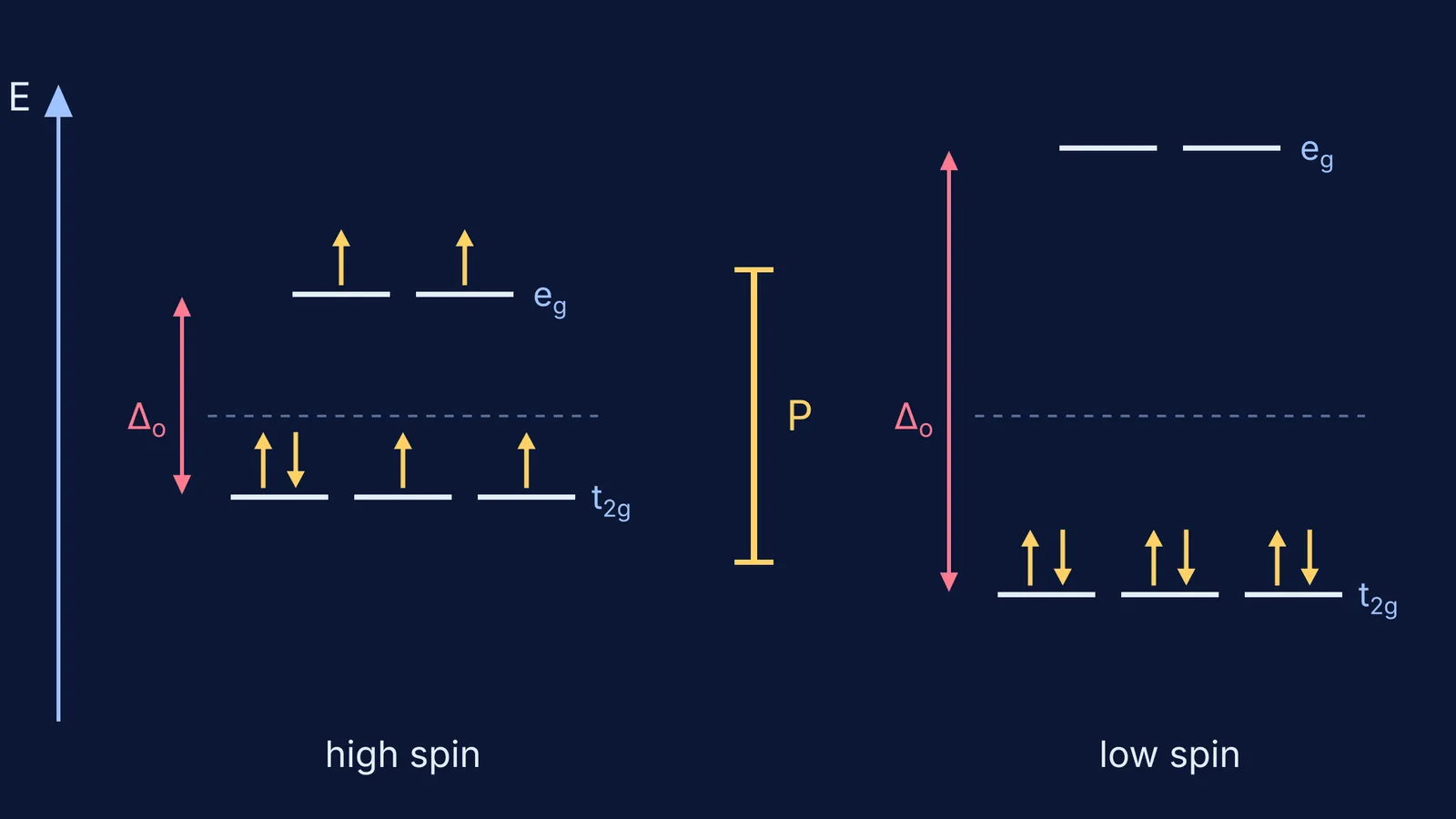
In an octahedral complex the five d orbitals split into a lower t2g set and an upper eg set, separated by the crystal field splitting energy Δo. Putting a second electron into an occupied orbital costs the pairing energy P. According to LibreTexts' chapter on crystal field stabilisation and pairing, a complex is low spin if Δo > P and high spin if Δo < P. The same source gives a typical P for 3d elements of about 15,000 cm⁻¹.
OpenStax Chemistry 2e notes that high- and low-spin arrangements differ only for d4, d5, d6 and d7. For d1 to d3 and d8 to d10 octahedral ions there is only one way to fill the orbitals, so skip the comparison.
What does the spectrochemical series tell you?
The spectrochemical series ranks ligands by how strongly they split the d orbitals. One version, from a LibreTexts inorganic chemistry course, runs: I⁻ < Br⁻ < S²⁻ < SCN⁻ < Cl⁻ < NO₃⁻ < N₃⁻ < F⁻ < OH⁻ < C₂O₄²⁻ ≈ H₂O < NCS⁻ < CH₃CN < py < NH₃ < en < bipy < phen < NO₂⁻ < PPh₃ < CN⁻ ≈ CO. The ordering goes back to Ryutaro Tsuchida's 1938 paper on the absorption spectra of coordination compounds.
For exams, three zones are enough:
Weak field (halides, OH⁻, H₂O): usually high spin with 3d metals.
Strong field (NO₂⁻, CN⁻, CO): usually low spin.
Middle (NH₃, en): here the metal decides.
How does the metal's oxidation state change the answer?
Δo depends on the metal as well as the ligand. According to a LibreTexts chapter on the factors that affect splitting, Δo for an M(III) ion is typically about 50% greater than for the M(II) ion of the same metal. [Fe(H₂O)₆]²⁺ has Δo = 10,400 cm⁻¹, while [Fe(H₂O)₆]³⁺ has 14,300 cm⁻¹ (same source).
The same page shows Δo rising down a group, from 22,900 cm⁻¹ for [Co(NH₃)₆]³⁺ to 34,100 cm⁻¹ for the rhodium analogue and 40,000 cm⁻¹ for iridium. That is why 4d and 5d complexes are treated as low spin.
A tetrahedral splitting is only about 4/9 of the octahedral value for the same metal and ligands (LibreTexts), so tetrahedral complexes are high spin (OpenStax).
Worked exam examples: spin, magnetism and colour
Once you know the number of unpaired electrons n, use the spin-only formula μ = √(n(n+2)) BM. The LibreTexts page on the spin-only formula lists 1.73, 2.83, 3.87, 4.90 and 5.92 BM for one to five unpaired electrons.
[Fe(H₂O)₆]²⁺: Fe²⁺ is d6 and water is weak field. Δo = 10,400 cm⁻¹ (LibreTexts) is below the typical P, so it is high spin, t2g⁴eg², with four unpaired electrons, as OpenStax states. It is paramagnetic, μ ≈ 4.90 BM.
[Fe(CN)₆]⁴⁻: still d6, but cyanide is strong field. Low spin, t2g⁶, no unpaired electrons; OpenStax lists it as diamagnetic.
[Co(NH₃)₆]³⁺ against [CoF₆]³⁻: both are Co³⁺, d6. Ammonia is a middle ligand, but with Co³⁺ Δo reaches 22,900 cm⁻¹ (same LibreTexts page), well above P, so the complex is low spin and diamagnetic. Fluoride is weak, so [CoF₆]³⁻ is high spin (LibreTexts) with four unpaired electrons and 4.90 BM.
[Co(H₂O)₆]²⁺ against [Co(CN)₆]⁴⁻: Co²⁺ is d7. The aqua complex is high spin with three unpaired electrons and the cyano complex low spin with one (LibreTexts), giving 3.87 and 1.73 BM.
Colour comes from the same gap: a complex absorbs light that lifts an electron across it and you see the complementary colour. OpenStax gives [Ti(H₂O)₆]³⁺ as the classic case: it absorbs from 450 to 600 nm, peaking at 499 nm, and looks purple. Strong-field complexes absorb higher-energy violet or blue light and tend to look yellow, orange or red; weak-field ones absorb yellow, orange or red light and look blue-green, blue or indigo.
Which mistakes cost the most marks?
Counting d electrons from the group number without subtracting the oxidation state.
Running the Δo-versus-P comparison for d3 or d8 octahedral ions, where there is no choice.
Calling a tetrahedral 3d complex low spin.
If naming or isomerism is still shaky, start with our guide to coordination compound naming, isomerism and crystal field basics, then compare this picture with valence bond theory's hybridisation approach to complexes. Ligand types are covered in denticity, ambidentate ligands and the chelate effect.
To practise, work through coordination problems in the Fermi Problem Library, where the step-by-step solver explains the reasoning rather than printing an answer, so you can see whether your d count or your ligand zone went wrong. If Δo itself still feels abstract, the Fermi Concept Library gives each concept its own lesson and its place in the map.


