

On this page
A typical exam question gives a complex and its measured magnetic moment, then asks for hybridisation and shape. The moment tells you how many electrons are unpaired, and that number tells you whether the metal had to pair up its d electrons to make room for the ligands.
How do you get unpaired electrons from a magnetic moment?
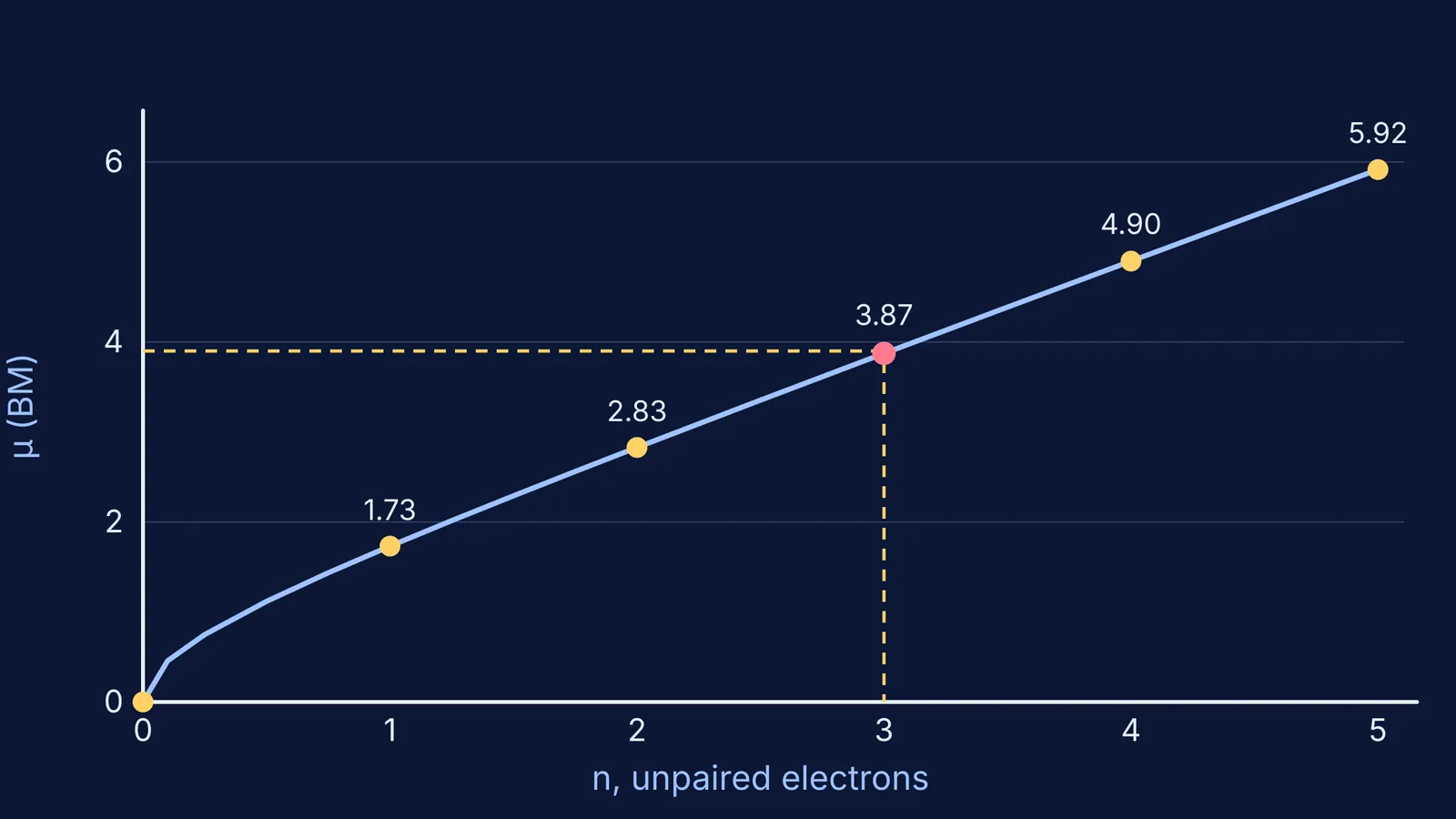
The spin-only formula links the two: μ = √(n(n+2)) Bohr magnetons (BM), where n is the number of unpaired electrons (Chemistry LibreTexts, Magnetic Moments/08%3A_8_Coordination_Chemistry/07%3A_Magnetic_Moments)). Learn these six values:
n = 0 gives 0 BM (diamagnetic)
n = 1 gives √3 = 1.73 BM
n = 2 gives √8 = 2.83 BM
n = 3 gives √15 = 3.87 BM
n = 4 gives √24 = 4.90 BM
n = 5 gives √35 = 5.92 BM
Measured moments often sit near these values rather than on them. In the same LibreTexts tables, octahedral Fe(II) with 4 unpaired electrons is observed at 5.1 to 5.7 BM against a spin-only 4.90, and tetrahedral Ni(II) with 2 unpaired electrons is observed at 3.7 to 4.0 BM against 2.83. The gap is usually put down to an orbital contribution, which the spin-only formula leaves out. So pick the nearest n that the metal's d count actually allows.
The formula itself is worked through in our post on calculating the spin-only magnetic moment.
Which hybridisation goes with which d-electron arrangement?
In valence bond theory, the metal mixes its (n-1)d or nd orbitals with its ns and np orbitals to make a set of equivalent hybrid orbitals, one per ligand (Careers360 summary of VBT). The four cases in Class 12 and JEE questions:
Coordination number 4, sp³: tetrahedral
Coordination number 4, dsp²: square planar (needs one empty 3d orbital)
Coordination number 6, d²sp³: octahedral, inner orbital (needs two empty 3d orbitals)
Coordination number 6, sp³d²: octahedral, outer orbital (uses 4d orbitals instead)
Inner-shell complexes use 3d, 4s and 4p orbitals for d²sp³ hybrids, while outer-shell complexes use 4s, 4p and 4d for sp³d² (Purdue University, valence-bond approach). Which one happens depends on the ligand: strong-field ligands such as CN⁻ push electrons to pair up, weak-field ligands such as Cl⁻ and F⁻ do not (OpenStax Chemistry 2e, section 19.3).
In a tetrahedral complex the d-orbital splitting is only about 4/9 of the octahedral splitting, and the LibreTexts magnetic moments page/08%3A_8_Coordination_Chemistry/07%3A_Magnetic_Moments) treats all tetrahedral complexes as high spin. More on pairing: high spin or low spin, and how to decide.
The four-step method
Find the oxidation state of the metal and write its d count (Ni²⁺ is d⁸, Fe³⁺ is d⁵, Co³⁺ is d⁶).
Convert the measured moment to n using the list above, choosing a value the d count allows.
Compare n with the free-ion count from Hund's rule. Same number: no pairing happened. Fewer: electrons paired up.
Count the empty 3d orbitals left. Two empty with 6 ligands means d²sp³. One empty with 4 ligands means dsp². None to spare means sp³d² (6 ligands) or sp³ (4 ligands).
Worked examples: how do you decide hybridisation from the magnetic moment?
All moments below are the observed ranges listed by Chemistry LibreTexts/08%3A_8_Coordination_Chemistry/07%3A_Magnetic_Moments).
Ni(II), four ligands, μ = 0 BM. Ni²⁺ is d⁸ with 2 unpaired electrons as a free ion. Zero means both paired: eight electrons fill four 3d orbitals, leaving one empty. Hybridisation dsp², square planar. LibreTexts notes that square planar Ni(II) complexes are all diamagnetic.
Ni(II), four ligands, μ = 3.7 to 4.0 BM. Not n = 3: a d⁸ ion cannot have 3 unpaired electrons. The answer is n = 2 with an orbital contribution. Nothing paired, no empty 3d orbital, so sp³ and tetrahedral. Our post on the hybridisation of Ni(CO)₄, NiCl₄²⁻ and Ni(CN)₄²⁻ compared works through the same pair with real ligands.
Fe(III), six ligands, μ = 5.6 to 6.1 BM. That is n = 5, the full free-ion count for d⁵. No 3d orbital is free, so the metal uses 4d: sp³d², outer orbital octahedral.
Fe(III), six ligands, μ = 1.8 to 2.1 BM. That is n = 1. Five electrons squeezed into three 3d orbitals leave two empty: d²sp³, inner orbital octahedral.
Co(III), six ligands, μ = 0 BM. Six d electrons paired in three 3d orbitals leave two empty, so d²sp³. Purdue's valence-bond page uses Co(NH₃)₆³⁺ as its d²sp³ example.
Where to practise
Do ten mixed questions in one sitting, writing the d count, n and empty orbitals before you look at the options. If one step keeps going wrong, the Fermi Problem Library has worked problems with a step-by-step solver that explains the reasoning rather than printing an answer. If the gap is in the idea itself, the Fermi Concept Library gives each chemistry concept its own lesson.


