

On this page
In transition metal chemistry, nickel presents one of the most instructive puzzles for students preparing for competitive examinations. The central nickel atom can bind four identical ligands to form complexes with completely different geometries, hybridisations, and magnetic behaviours. Depending on the surrounding ligands, nickel forms tetrahedral diamagnetic [Ni(CO)4], tetrahedral paramagnetic [NiCl4]²⁻, or square planar diamagnetic [Ni(CN)4]²⁻. Understanding why the same element switches between sp³ and dsp² hybridisation reveals how metal oxidation states and ligand fields dictate molecular architecture.
Why do nickel complexes have different geometries and hybridisations?
The foundation for explaining these geometry shifts was laid by Linus Pauling in his 1931 paper The Nature of the Chemical Bond in the *Journal of the American Chemical Society*, which introduced orbital hybridisation to explain magnetic susceptibility. Pauling showed that magnetic measurements directly expose whether inner d-orbitals participate in coordinate bonding. Later, in 1938, Japanese chemist Ryutaro Tsuchida published the spectrochemical series in the *Bulletin of the Chemical Society of Japan*, ordering ligands by field strength from weak-field halides to strong-field carbon donors. When exploring how ligand ordering and electronic configuration interact across coordination compounds, the Fermi Concept Library covers every concept across chemistry, with its own lesson and its place in the map.
How does Ni(CO)4 achieve sp3 hybridisation and diamagnetism?
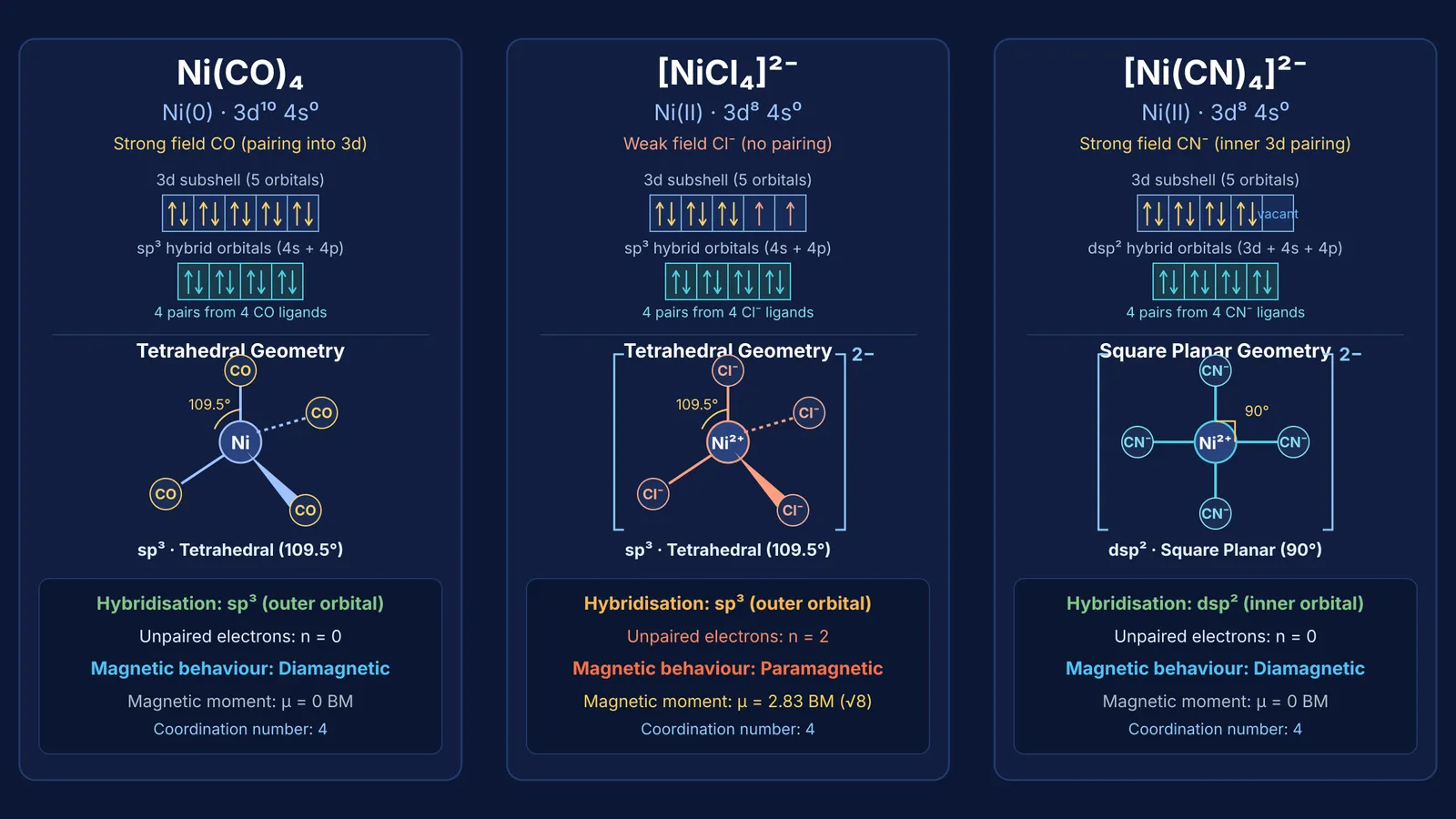
Discovered in 1890 by Ludwig Mond, Carl Langer, and Friedrich Quincke, nickel tetracarbonyl [Ni(CO)4] formed the historical basis for the industrial Mond process of nickel refining. In this neutral complex, nickel has an oxidation state of 0, giving an electronic configuration of [Ar] 3d⁸ 4s². Carbon monoxide is a neutral ligand and a strong-field carbon donor with powerful π-acceptor capabilities.
As four carbon monoxide molecules approach the nickel atom, the intense ligand field forces the two outer 4s electrons into the 3d subshell. These electrons pair with the two unpaired 3d electrons, creating a filled 3d¹⁰ configuration. With no inner d-orbitals vacant, the empty 4s and three 4p orbitals intermix into four equivalent sp³ hybrid orbitals. As documented in the NCERT Chemistry textbook, each carbon monoxide donates an electron pair into these sp³ orbitals to produce a tetrahedral geometry with bond angles of 109.5°. Because all valence electrons are paired, [Ni(CO)4] has 0 unpaired electrons and is diamagnetic.
Why is [NiCl4]2- paramagnetic while [Ni(CN)4]2- is diamagnetic?
Both [NiCl4]²⁻ and [Ni(CN)4]²⁻ contain nickel in the +2 oxidation state. Neutral nickel loses its two 4s electrons upon oxidation, leaving nickel(II) with a valence configuration of [Ar] 3d⁸ 4s⁰. Under Hund's rule, these 8 electrons fill the five 3d orbitals such that three orbitals contain pairs and two hold single, unpaired electrons. Despite identical oxidation states and coordination numbers of 4, the complexes diverge because of their ligands.
In [NiCl4]²⁻, chloride is a weak-field halide ligand. The crystal field splitting created by chloride is small and cannot overcome the electron pairing energy. As shown in the NCERT Chemistry textbook, the two unpaired 3d electrons remain unpaired. Bonding uses the vacant outer 4s and three 4p orbitals in sp³ hybridisation, producing a tetrahedral shape. With 2 unpaired electrons, the spin-only magnetic moment equals √(2(2+2)) = √8 ≈ 2.83 Bohr Magnetons, making [NiCl4]²⁻ paramagnetic.
In [Ni(CN)4]²⁻, cyanide is a strong-field ligand providing large crystal field splitting that exceeds pairing energy. The approach of four cyanide ligands forces the two unpaired 3d electrons to pair within a single orbital, clearing one inner 3d orbital. Nickel(II) uses this empty 3d orbital, the vacant 4s orbital, and two 4p orbitals to form four dsp² hybrid orbitals. Described in Pauling's 1931 study, this yields a square planar geometry with 90° bond angles. Because all 8 valence electrons are paired, [Ni(CN)4]²⁻ has 0 unpaired electrons, a magnetic moment of 0 Bohr Magnetons, and diamagnetic behaviour.
What is the step-by-step checklist to solve coordination questions?
Questions on transition metal coordination appear regularly in syllabi set by the National Testing Agency and examination papers from the Central Board of Secondary Education. To determine the geometry and magnetism of any four-coordinate nickel complex, work through four steps:
Find the oxidation state: Determine whether nickel is neutral (0) as in carbonyls or divalent (+2) as in coordination salts.
Write the configuration: Ni(0) is 3d⁸ 4s², whereas Ni²⁺ is 3d⁸ 4s⁰.
Check ligand strength: Carbonyl and cyanide are strong-field donors; halides and water are weak-field donors.
Trace hybridisation and spin: For Ni(0), strong ligands push 4s electrons into 3d to yield 3d¹⁰ and sp³ tetrahedral diamagnetism. For Ni(II), weak ligands leave two unpaired electrons to yield sp³ tetrahedral paramagnetism (2.83 Bohr Magnetons), whereas strong ligands force 3d pairing to yield dsp² square planar diamagnetism.
To practise applying these rules across diverse metal-ligand pairs, the Fermi Problem Library provides worked problems with a step-by-step solver that explains the reasoning rather than printing an answer.


