On this page
You have a conversion question in front of you: benzaldehyde to mandelic acid. The route takes two reactions from the Class 12 aldehydes chapter, and the clue is that the product has one more carbon than the starting material.
How do you convert benzaldehyde to mandelic acid?
Start by comparing the two structures. Benzaldehyde is C6H5–CHO. Mandelic acid is 2-hydroxy-2-phenylacetic acid, also listed as alpha-hydroxyphenylacetic acid, formula C8H8O3 (PubChem, mandelic acid). The old carbonyl carbon is still there, now carrying an –OH, and one new carbon has appeared as –COOH.
One reagent adds both an –OH and a new carbon to a carbonyl group: hydrogen cyanide. The route is:
Benzaldehyde + HCN (with a little base as catalyst) gives 2-hydroxy-2-phenylacetonitrile, the cyanohydrin, also called mandelonitrile (PubChem, mandelonitrile).
The cyanohydrin, heated with aqueous acid (H3O+), is hydrolysed to mandelic acid, and the nitrogen leaves as ammonium ion.
Why does HCN need a base to add to benzaldehyde?
The NCERT Class 12 Chemistry textbook, Unit 8 says aldehydes and ketones react with HCN to give cyanohydrins, but the reaction "occurs very slowly with pure HCN". So it is catalysed by a base, and the cyanide ion this generates is the stronger nucleophile. The mechanism has three moves:
Base removes the proton from HCN: HCN + OH⁻ ⇌ CN⁻ + H2O.
CN⁻ attacks the slightly positive carbonyl carbon. That carbon changes from sp2 to sp3, and you get a tetrahedral alkoxide intermediate.
The alkoxide picks up a proton to give the neutral cyanohydrin.
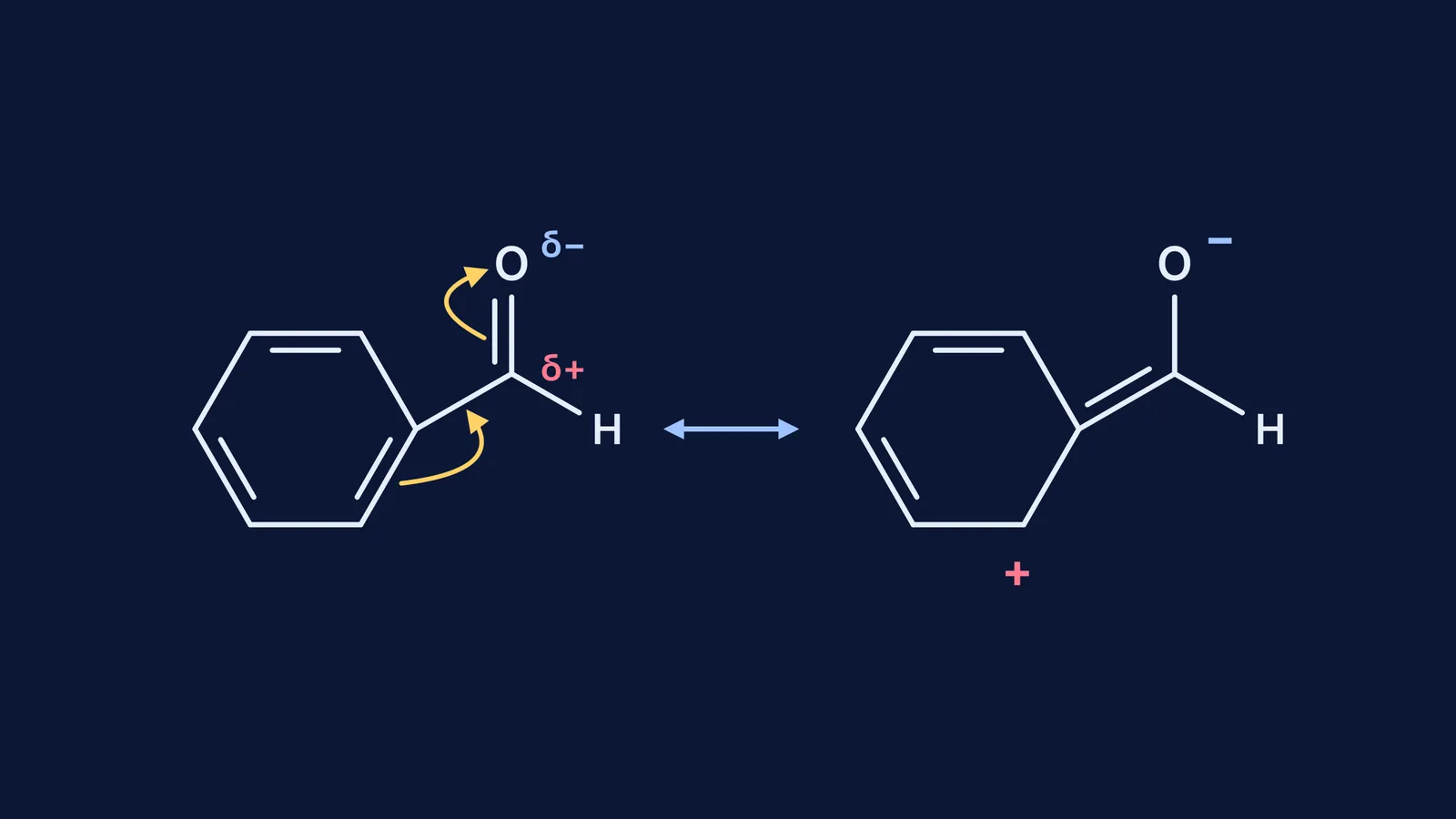
Benzaldehyde is a little less reactive than an aliphatic aldehyde such as propanal, because resonance with the ring makes the carbonyl carbon less electrophilic; the same NCERT chapter works this through as Example 8.3. But as an aldehyde it has only one large group beside the C=O, so the nucleophile can reach the carbon. Crowded ketones are a different story; see why 2,2,6-trimethylcyclohexanone resists cyanohydrin formation.
What happens when the nitrile is hydrolysed?
The same NCERT chapter, in its section on preparing carboxylic acids, says nitriles are hydrolysed first to amides and then to acids with H+ or OH⁻ as catalyst, and that mild conditions stop the reaction at the amide stage. So for the full conversion, heat with aqueous acid:
C6H5–CH(OH)–CN → C6H5–CH(OH)–CONH2 → C6H5–CH(OH)–COOH
The –OH survives untouched. If you hydrolyse with base instead, you get the carboxylate salt and have to acidify at the end to get the free acid. If "hydration" and "hydrolysis" blur together for you, read our explainer on hydration vs hydrolysis.
There is one more detail examiners like. The old carbonyl carbon now carries four different groups (H, OH, C6H5 and COOH), so it is a stereocentre. NCERT notes that the nucleophile attacks from a direction roughly perpendicular to the flat carbonyl group. Cyanide can come in from either face with equal ease, so the ordinary reaction gives a racemic mixture: equal amounts of both mirror-image forms of mandelic acid.
How should you write this answer in a board or JEE exam?
Question: Convert benzaldehyde into 2-hydroxy-2-phenylethanoic acid (mandelic acid).
Answer, in two lines:
C6H5CHO + HCN, with OH⁻ as catalyst, gives C6H5CH(OH)CN (benzaldehyde cyanohydrin).
C6H5CH(OH)CN, with H3O+ and heat, gives C6H5CH(OH)COOH (mandelic acid).
Run this checklist before you move on:
Did you name or draw the intermediate? It shows the examiner your route.
Did you write the catalyst above the first arrow, not only "HCN"?
Did you write "heat" for the hydrolysis? Mild conditions stop at the amide.
Did you keep the –OH? A common slip is writing phenylacetic acid, C6H5CH2COOH, which has no –OH. That compound belongs to a different conversion: benzyl alcohol to 2-phenylethanoic acid.
Did you avoid oxidising the aldehyde? An oxidising agent turns benzaldehyde into benzoic acid, which still has 7 carbons, so the new carbon never arrives.
If you want more conversions like this with every step shown, the Fermi Problem Library has worked problems with a step-by-step solver that explains the reasoning rather than printing an answer.
Can you try this reaction in a school lab?
No. This is a reaction to learn on paper. Hydrogen cyanide is a fast-acting poison: the CDC's NIOSH emergency card for hydrogen cyanide says symptoms begin within seconds to minutes after breathing it in, death may occur within minutes, and skin absorption is rapid. NIOSH also says a large proportion of people cannot detect its odour, so the smell gives no adequate warning.
If nucleophilic addition to C=O still feels shaky, start from the concept itself: the Fermi Concept Library gives every concept in chemistry its own lesson and its place in the map, so you can see where carbonyl chemistry fits.