

On this page
When water interacts with chemical compounds, it can either join a substance without breaking its framework or act as a chemical blade that splits bonds in two. Students frequently confuse these two behaviors because both processes take place in aqueous solutions. Knowing the difference between hydration and hydrolysis helps you navigate physical chemistry equilibria and organic mechanisms with clarity.
What is the fundamental difference between hydration and hydrolysis?
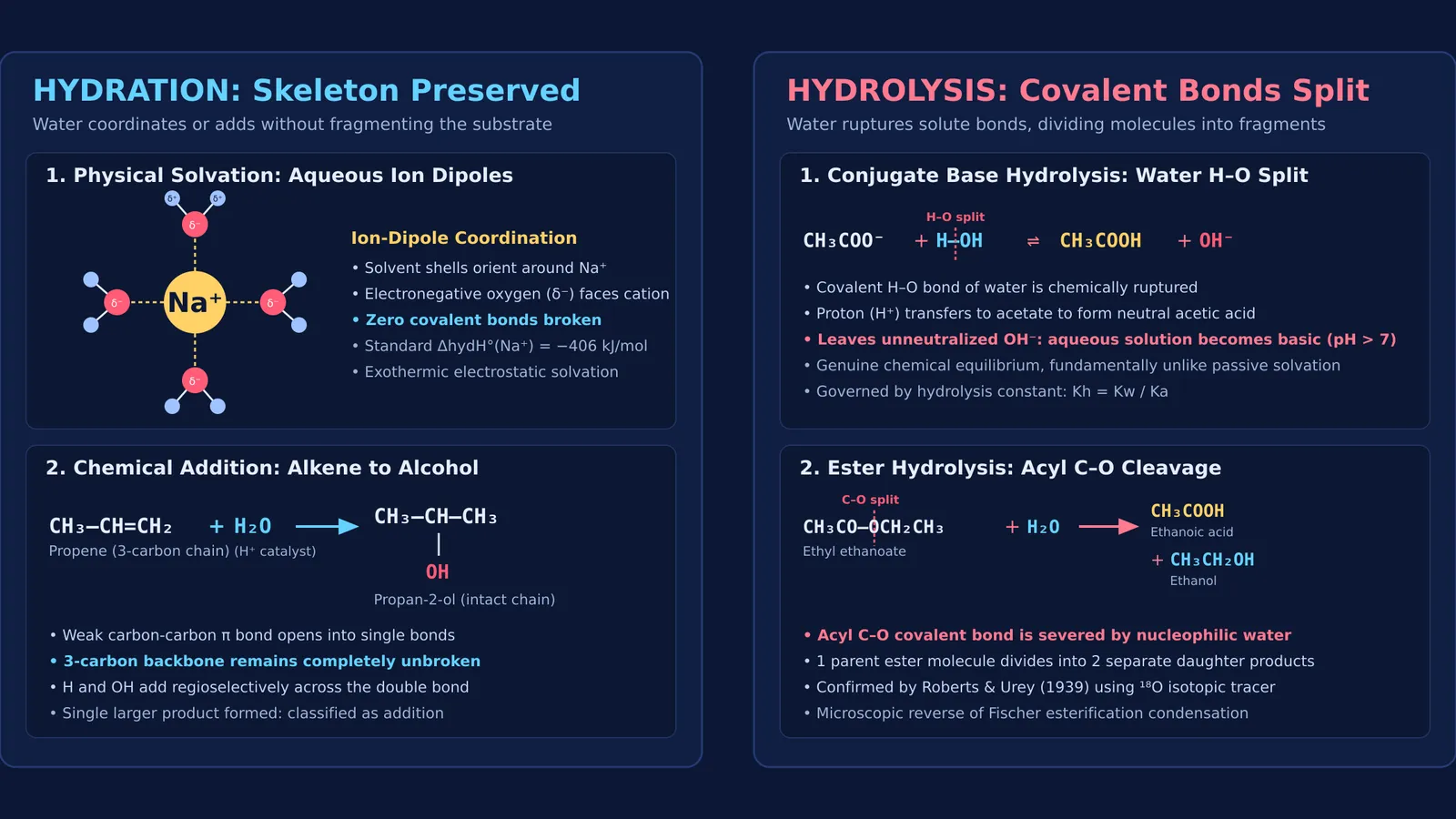
The central distinction lies in what happens to the reacting molecule. Hydration describes either the physical coordination of water molecules around a solute or the addition of water across an unsaturated bond without dividing the carbon skeleton. In contrast, hydrolysis (from the Greek roots for water and cleavage) is a chemical reaction where water ruptures one or more covalent bonds, dividing a parent substance into two or more distinct products.
The IUPAC Gold Book definition of hydration recognises two primary settings: physical solvation, where water molecules form a solvent shell around solutes, and chemical addition, where water adds across a multiple bond. By contrast, the IUPAC Gold Book definition of solvolysis defines hydrolysis as a reaction involving the rupture of one or more bonds in the reacting solute, with water acting as the nucleophile. In short, hydration preserves the molecular skeleton, whereas hydrolysis cuts it apart.
To see where these mechanisms fit into broader chemical pathways, the Fermi Concept Library covers every concept in physics, chemistry, biology, mathematics and computing, each with its own lesson and its place in the map.
How does ion hydration differ from salt hydrolysis?
When common table salt dissolves in water, the process is purely physical hydration. Water molecules possess a permanent dipole with partial negative charge on oxygen and partial positive charges on hydrogen. In solution, the negative oxygen ends orient toward sodium cations, while positive hydrogens surround chloride anions. No covalent bonds break; the process simply releases hydration enthalpy as ion-dipole attractions form.
In a thermodynamic evaluation in the *Journal of the Chemical Society, Faraday Transactions*, Marcus (1987) established the absolute standard molar enthalpy of hydration for the proton at −1103 kJ/mol. In the same study, sodium ions release −406 kJ/mol upon forming primary hydration shells, while doubly charged magnesium ions release −1921 kJ/mol due to their higher charge density.
Salt hydrolysis, by contrast, is a chemical reaction. When sodium acetate dissolves in water, the acetate anion reacts chemically:
CH₃COO⁻ + H₂O ⇌ CH₃COOH + OH⁻
Here, a covalent H−O bond in water is cleaved. A proton transfers to the acetate ion, leaving free hydroxide ions that turn the solution alkaline with a pH above 7. The underlying equilibrium expressions are explored further in our walkthrough of salt hydrolysis in ionic equilibrium.
Why is alkene hydration an addition reaction?
In organic chemistry, alkene hydration adds the elements of water (H and OH) across a carbon-carbon double bond:
CH₃CH=CH₂ + H₂O → CH₃CH(OH)CH₃
The crucial feature is that the three-carbon chain remains intact. One weak carbon-carbon π bond breaks, while two strong σ bonds (one C−H and one C−OH) form. Because the carbon backbone never fragments, it is an addition reaction rather than hydrolysis.
The kinetics of this addition were verified by Kresge and coworkers (1971) in the *Journal of the American Chemical Society*. Measuring Brønsted catalysis coefficients between 0.5 and 0.7 across simple olefins, they showed that rate-determining proton transfer creates a carbocation intermediate before water attacks. The regiochemistry follows Markovnikov addition to alkenes, forming secondary or tertiary alcohols without loss of the carbon skeleton.
How does ester hydrolysis split covalent bonds?
Treating an ester like ethyl ethanoate with aqueous acid or base yields a fundamentally different result:
CH₃COOCH₂CH₃ + H₂O ⇌ CH₃COOH + CH₃CH₂OH
Water splits the substrate into two separate molecules: ethanoic acid and ethanol. Experimental proof for this cleavage was demonstrated by Roberts and Urey (1939) in the *Journal of the American Chemical Society*. Using oxygen-18 (¹⁸O) isotopic tracing, they proved that the acyl-oxygen bond (C−O) undergoes cleavage rather than the alkyl-oxygen bond.
Because a covalent bond in the substrate is severed to produce two daughter molecules, the reaction is classic hydrolysis. It represents the microscopic reverse of ester synthesis, as detailed in our guide to the mechanism of Fischer esterification.
How do you classify reactions with water during exam prep?
When analyzing a reaction involving water, apply this four-step diagnostic test:
Count the organic products: If a single substrate splits into two or more independent molecules, the reaction is hydrolysis.
Inspect the carbon skeleton: If water adds across a multiple bond to yield a single intact product, the reaction is chemical hydration.
Test for pH changes: If ions assemble a solvent shell without altering neutral pH, it is physical hydration; if water's H−O bond is cleaved to produce H₃O⁺ or OH⁻, it is salt hydrolysis.
Track stoichiometry: In hydrolysis, water is consumed stoichiometrically as a bond-cleaving reactant. In physical hydration, water acts as a coordinating dielectric solvent.
When practicing multi-step synthesis or equilibrium problems, the Fermi Problem Library has worked problems with a step-by-step solver that explains the reasoning rather than printing an answer, helping you verify whether water coordinates, adds, or cleaves at each step.


