

On this page
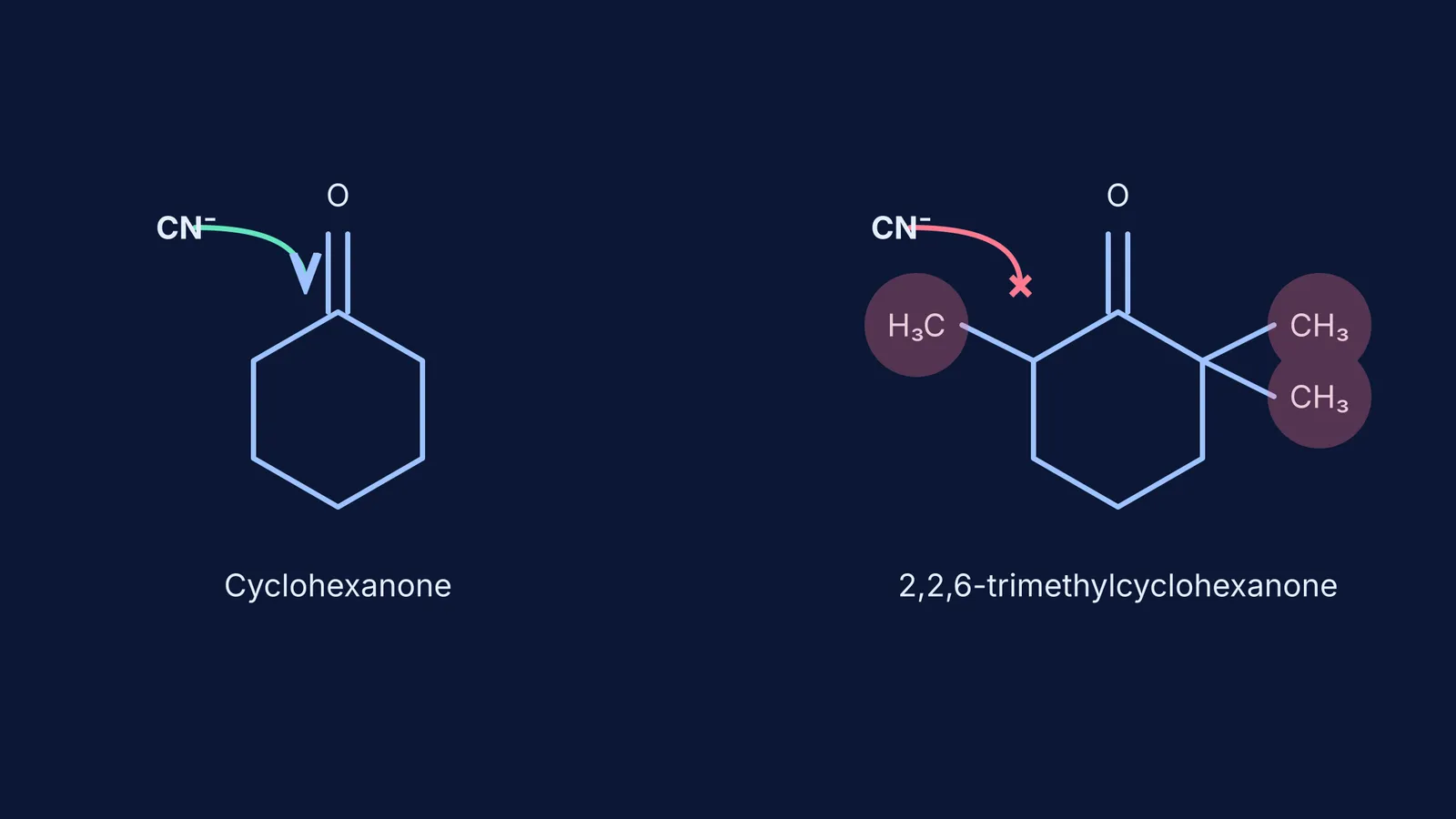
When you study aldehydes and ketones for the Class 12 board exams or competitive tests like JEE and NEET-UG, you quickly learn that cyanohydrin formation is a standard reaction. A classic NCERT question asks why cyclohexanone reacts smoothly with hydrogen cyanide to form a cyanohydrin, while 2,2,6-trimethylcyclohexanone barely reacts at all under the exact same conditions.
The answer comes down to the physical space around the reacting atoms, a concept known as steric hindrance, and how that space affects the stability of the final product. Understanding this difference is crucial because the same principles apply to many other addition reactions in organic chemistry.
How does cyanohydrin formation work?
The formation of a cyanohydrin is a nucleophilic addition reaction. The cyanide ion (CN⁻) acts as the nucleophile and attacks the positively polarised carbonyl carbon (C=O) of the ketone. According to standard organic chemistry principles, this reaction is entirely reversible, meaning it exists in an equilibrium between the starting ketone and the cyanohydrin product.
For the reaction to yield a product, the cyanide ion must be able to physically reach the carbonyl carbon. Furthermore, the carbon atom must change its geometry. In the starting ketone, the carbonyl carbon is sp² hybridized, meaning it is flat and planar with bond angles of 120°. In the cyanohydrin product, that same carbon becomes sp³ hybridized, creating a tetrahedral shape with bond angles of 109.5°.
If you struggle to picture how these 3D shapes transition during a reaction, the Concept Library has a lesson for every concept in chemistry and its place in the map.
Why does cyclohexanone react easily?
In a simple cyclohexanone molecule, the carbonyl carbon is highly accessible to incoming nucleophiles. The carbon atoms immediately next to the carbonyl group—known as the α-carbons—hold only small hydrogen atoms.
Because hydrogen atoms are the smallest elements and take up very little physical space, the approach path for the incoming cyanide ion is completely clear. The nucleophile attacks the carbonyl carbon without any physical resistance. When the carbon atom transitions from its flat sp² shape to the tetrahedral sp³ shape, it does not create any significant crowding. The new —OH and —CN groups fit comfortably without pushing against their neighbours. As a result, the equilibrium heavily favours the cyanohydrin product, leading to a very good yield.
Why does 2,2,6-trimethylcyclohexanone block the reaction?
The situation changes drastically when you look at 2,2,6-trimethylcyclohexanone. This molecule has three large methyl (—CH₃) groups attached to the α-carbons. Specifically, there are two methyl groups on one side (at the 2-position) and one methyl group on the other (at the 6-position).
These three methyl groups create severe steric hindrance. They act like a physical shield around the carbonyl carbon, blocking the cyanide ion from making a successful attack. The incoming nucleophile simply cannot find a clear trajectory to bond with the electrophilic center.
Even if a cyanide ion manages to squeeze past the shield and attack, the resulting cyanohydrin is highly unstable. Moving from 120° to 109.5° bond angles forces the newly attached —OH and —CN groups into the exact same tight space occupied by the three bulky methyl groups. This creates intense van der Waals strain, meaning the electron clouds of the atoms repel each other violently.
Because the final tetrahedral product is so strained and sterically crowded, the reaction's equilibrium shifts heavily back toward the planar, unreacted ketone.
Furthermore, the methyl groups exert an electron-donating inductive effect (+I effect). This pushes electron density toward the carbonyl carbon, making it slightly less positive and therefore less attractive to the negative cyanide ion. However, it is the steric hindrance that is the primary reason the reaction fails.
When you are stuck on why a specific reaction yields no product, the Fermi Problem Library explains the underlying reasoning step by step, rather than just printing an answer.
How to spot steric hindrance in an exam?
Steric hindrance is a recurring theme in organic chemistry, and examiners love to test your understanding of it. You will see it dictate the products in everything from this cyanohydrin reaction to the rules of SN1 and SN2 stereochemistry: Inversion and racemisation explained.
Use this four-step checklist whenever you need to predict if a nucleophilic attack will succeed on a ketone or aldehyde:
Locate the reaction centre: Find the electrophilic carbon (like the C=O carbon).
Check the neighbours: Look at the α-carbons immediately adjacent to the centre.
Count the bulky groups: Are there methyl, ethyl, or tert-butyl groups on those neighbours?
Predict the block: If there are three or more bulky groups nearby, the nucleophile is likely blocked, and the reaction will either fail or switch to a different mechanism altogether.
Mastering this checklist will help you avoid common traps in reaction mechanisms. If you want to test whether your mental models of these reactions are correct, looking at AI analogies for chemical bonding: are they right? can help you refine your understanding and score higher in your exams.


