

On this page
You ask a chatbot to explain chemical bonding, and it replies: "Imagine two dogs fighting over a bone." For ionic bonding, one dog snatches the bone. For covalent bonding, they share it. It makes intuitive sense and feels easy to remember. But when you look closer, these common AI analogies often build a flawed foundation for learning chemistry, introducing ideas that you will have to unlearn later.
Why do AI analogies for chemical bonding mislead students?
AI tools draw on the most common ways humans explain concepts across the internet. In chemistry, that means relying heavily on the "octet rule" and giving atoms human traits. A seminal 1998 study by Keith Taber in the *International Journal of Science Education* found that students frequently develop an "octet framework" misconception. They start believing that atoms actively "want" or "need" eight electrons to be "happy" or "stable."
When AI describes atoms as having desires, it obscures the real physical science at play. Bonding is always driven by electrostatic forces and the minimisation of energy, not by an atom's social life or feelings. When students rely on the "desire" analogy, they struggle later when they encounter exceptions to the octet rule. If atoms bond just to reach eight electrons, why do molecules like phosphorus pentachloride or sulfur hexafluoride exist? If you believe atoms bond merely to fulfil a need for a full shell, these advanced topics become confusing contradictions rather than natural extensions of the same physical laws.
Where does the "giving and taking" analogy for ionic bonds fail?
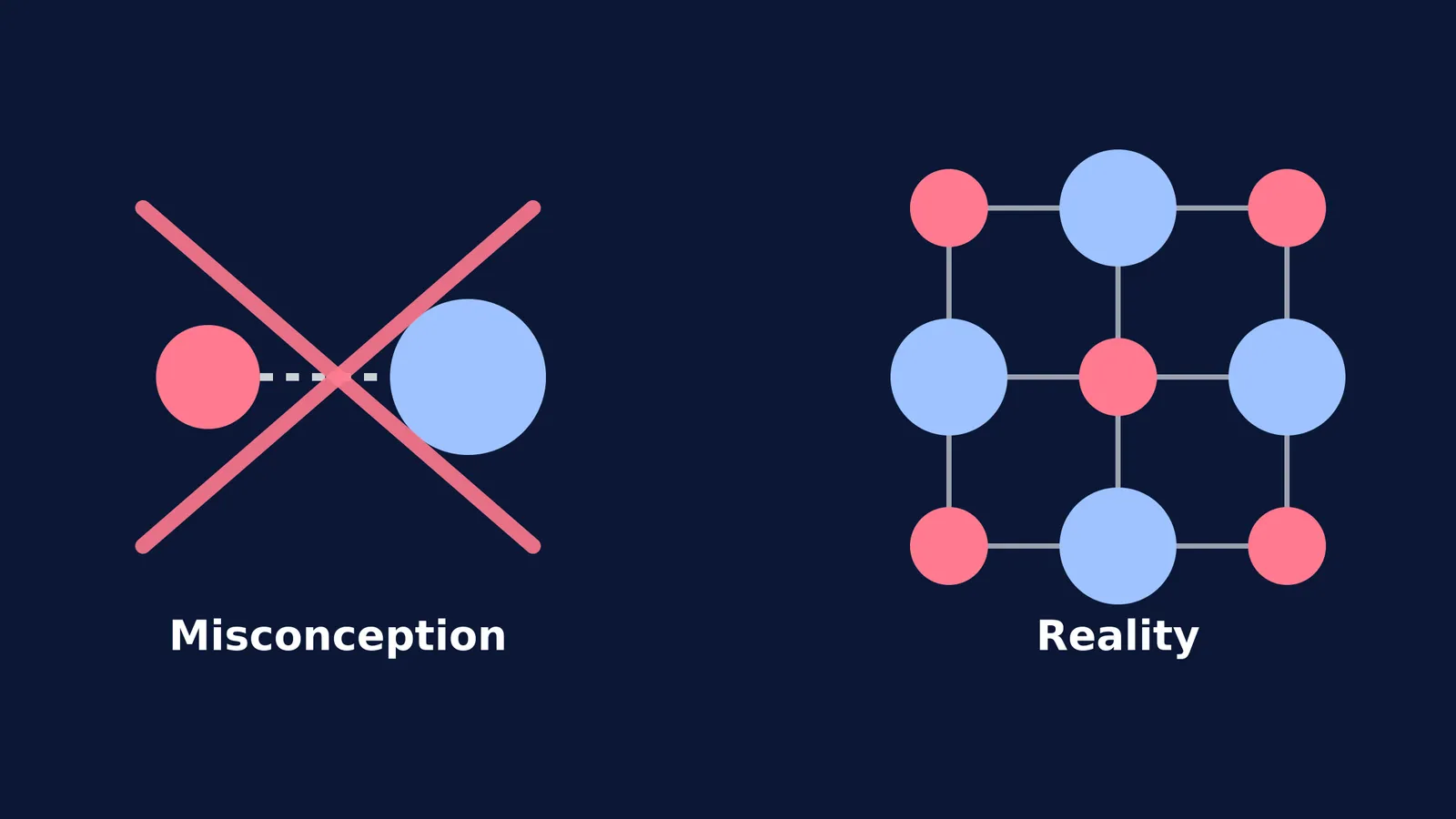
If you ask an AI about sodium chloride, it will likely say that sodium "gives" an electron to chlorine to empty its outer shell, while chlorine "takes" it. This commonly leads to the "ion-pair" misconception. Students start to imagine an ionic bond as a single, isolated molecule made of one sodium ion and one chloride ion holding hands in space.
In reality, ionic compounds form a continuous three-dimensional lattice. A single sodium ion in a salt crystal is surrounded by, and equally attracted to, six chloride ions. The chloride ions are similarly surrounded. The bond is not a private transfer of property between two specific atoms; it is a strong, multi-directional electrostatic attraction acting across a giant structure. Treating ionic bonds as simple pairs makes it nearly impossible to understand why salt crystals have such high melting points or how they dissolve in water.
Does "sharing a sandwich" explain covalent bonds?
For covalent bonds, AI tutors often use the analogy of friends sharing a sandwich or pulling a blanket over themselves. This sounds friendly, but it implies that electrons are physical objects shared equally between two identical partners.
Most covalent bonds are polar, meaning the sharing is entirely unequal. One atom is more electronegative and pulls the shared electrons closer to its own nucleus. If you practice with the Fermi Problem Library, its step-by-step solver explains the reasoning behind this electrostatic tug-of-war. The bond is not a shared physical object; it is the electrical attraction between two positive nuclei and the negative electrons located between them. Reducing this complex electrical interaction to "sharing a sandwich" hides the true nature of bond polarity and dipole moments.
How can you check AI analogies while studying?
If you are using an AI tool to help with exam preparation, you do not have to discard its analogies entirely. Analogies are useful starting points. Instead, use a simple framework to interrogate the AI's explanation and dig down to the real physics:
Ask for the limitations: After the AI gives an analogy, follow up by asking: "Where does this analogy break down?" or "What does this analogy get wrong about the physics?"
Focus on the forces: Prompt the AI to explain the concept using only electrostatic forces (protons attracting electrons) rather than wants or needs. For more ideas on how to frame your questions, see our guide on ChatGPT prompts for physics.
Switch to visual models: Ask the AI to describe the three-dimensional structure or the Electron dot structures of covalent molecules in Class 10 to ground the concept in established scientific representation rather than a story about dogs.
If you are looking for an AI that is designed to avoid these pitfalls from the beginning, you can explore Fermi's AI tutor. It holds a line of reasoning across a session, notices where a student is stuck, and decides whether to explain, ask, or show the actual physics at work rather than falling back on misleading stories.


