

On this page
When a chiral alkyl halide undergoes a nucleophilic substitution, the 3D shape of the product depends entirely on the pathway the reaction takes. The two primary mechanisms—SN1 and SN2—produce completely different stereochemical outcomes.
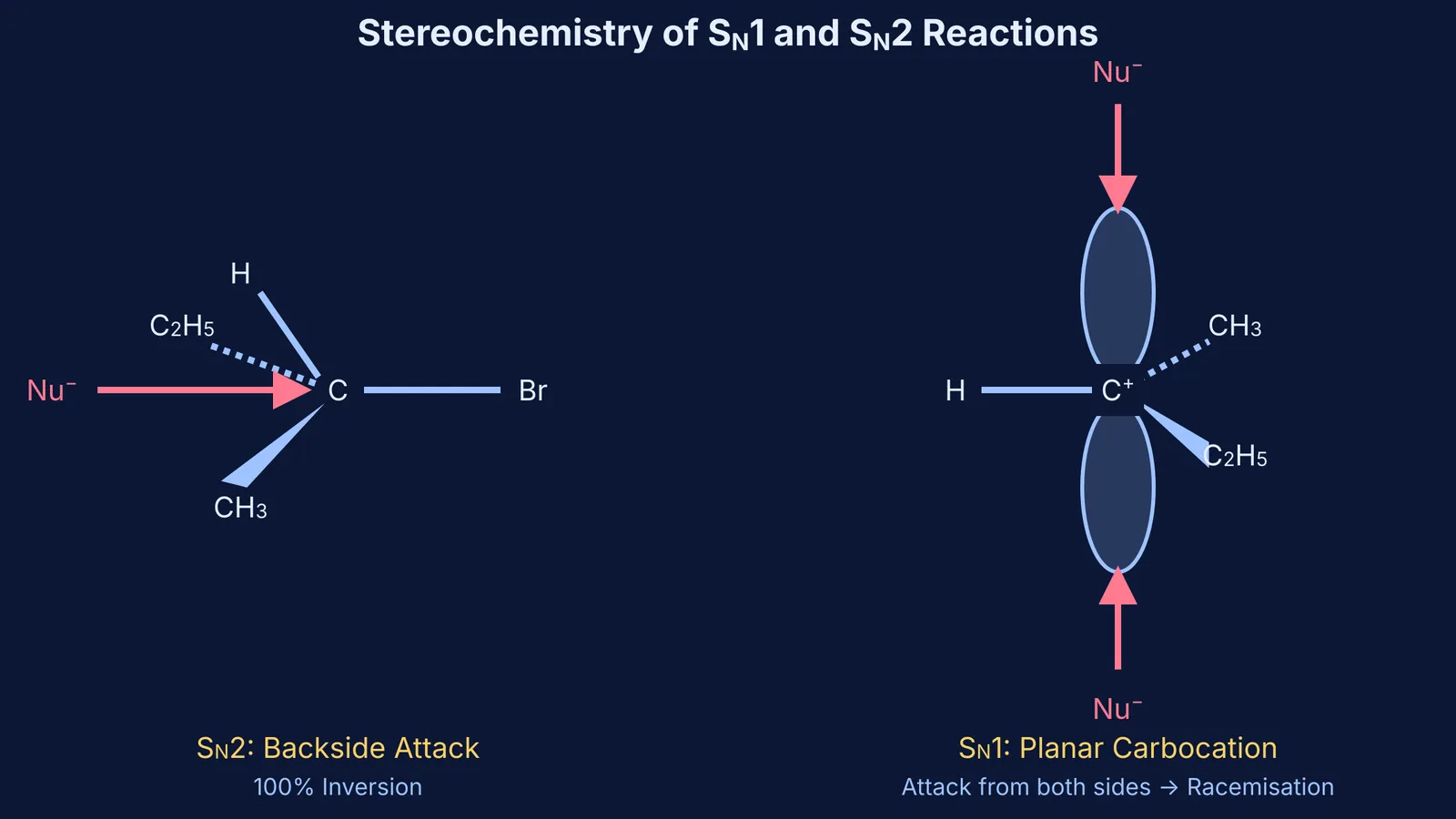
In short, the SN2 mechanism turns the molecule inside out, while the SN1 mechanism erases the original stereochemistry to produce a mixture. Here is how the geometry changes in each pathway and how to predict the products for a classic substrate like 2-bromobutane.
Why does SN2 cause inversion of configuration?
The SN2 (Substitution Nucleophilic Bimolecular) reaction is a concerted process: the bond to the leaving group breaks at the exact same time the new bond to the nucleophile forms 1.
Because the bulky leaving group (such as a bromide ion) blocks the front of the molecule, the incoming nucleophile must approach from the opposite side. This backside attack forces the other three groups attached to the carbon to flip across to the other side, much like an umbrella blowing inside out in a strong wind 1.
This complete reversal of stereochemistry is known as a Walden inversion. If you start with a single enantiomer—for example, a molecule with an (S) configuration—an SN2 reaction will yield a product with 100% optical purity in the inverted (R) configuration (assuming the priority of the groups remains the same) 1.
Why does SN1 lead to racemisation?
The SN1 (Substitution Nucleophilic Unimolecular) reaction takes a stepwise route. The rate-determining step is the departure of the leaving group, which leaves behind a positively charged carbon atom 1.
This intermediate is a carbocation. Because it has only three attached groups and an empty p-orbital, the carbocation adopts a flat, trigonal planar geometry 1. At this point, the molecule has lost its chirality. When the nucleophile attacks in the second step, it can approach the flat carbocation from either the front face or the back face with equal probability 1.
Attack from one side gives retention of the original configuration, while attack from the other side gives inversion. Because both occur at roughly the same rate, the result is a 50:50 mixture of the two enantiomers 1. This equimolar mixture is optically inactive and is called a racemic mixture, meaning the reaction has undergone racemisation.
If visualising these 3D changes from text is difficult, the Fermi Simulation Lab provides interactive simulations for the ideas that are easier to see than to read, letting you watch the transition states form in real time.
Worked example: Stereochemistry of 2-bromobutane
Because 2-bromobutane is a secondary alkyl halide, it can undergo either SN1 or SN2 reactions depending on the conditions. The central carbon is chiral because it is bonded to four different groups: a hydrogen, a methyl group, an ethyl group, and a bromine atom.
Under SN2 conditions: If we react (S)-2-bromobutane with a strong nucleophile like a hydroxide ion (OH⁻) in a polar aprotic solvent like acetone, the reaction proceeds via the SN2 pathway. The OH⁻ performs a backside attack, snapping the umbrella of the methyl, ethyl, and hydrogen groups to the other side. The sole product is (R)-2-butanol, showing 100% inversion 1.
Under SN1 conditions: If we instead dissolve (S)-2-bromobutane in water (a polar protic solvent that acts as a weak nucleophile), the SN1 pathway takes over. The bromine leaves first, creating a planar secondary carbocation. This is the same intermediate seen in carbocation rearrangements during the dehydration of alcohols. The water molecule can then attack this flat carbocation from the top or the bottom. After losing a proton, the final product is a 50:50 mixture of (S)-2-butanol and (R)-2-butanol—a racemic mixture 1.
How to predict the outcome in exams
When facing a stereochemistry problem with a chiral halide (or in reactions like the Finkelstein and Swarts reactions), you can determine the outcome by identifying the mechanism:
Identify the substrate: Primary halides favour SN2 (inversion). Tertiary halides strictly follow SN1 (racemisation). Secondary halides can do either.
Check the nucleophile: Strong nucleophiles push the reaction toward the concerted SN2 pathway.
Check the solvent: Polar aprotic solvents favour SN2, while polar protic solvents stabilise the carbocation intermediate, favouring SN1.
Organic chemistry mechanisms require careful step-by-step logic. The Fermi Concept Library contains every concept in physics, chemistry, biology, mathematics and computing, mapping exactly how these substitution pathways fit into the broader subject.


