

On this page
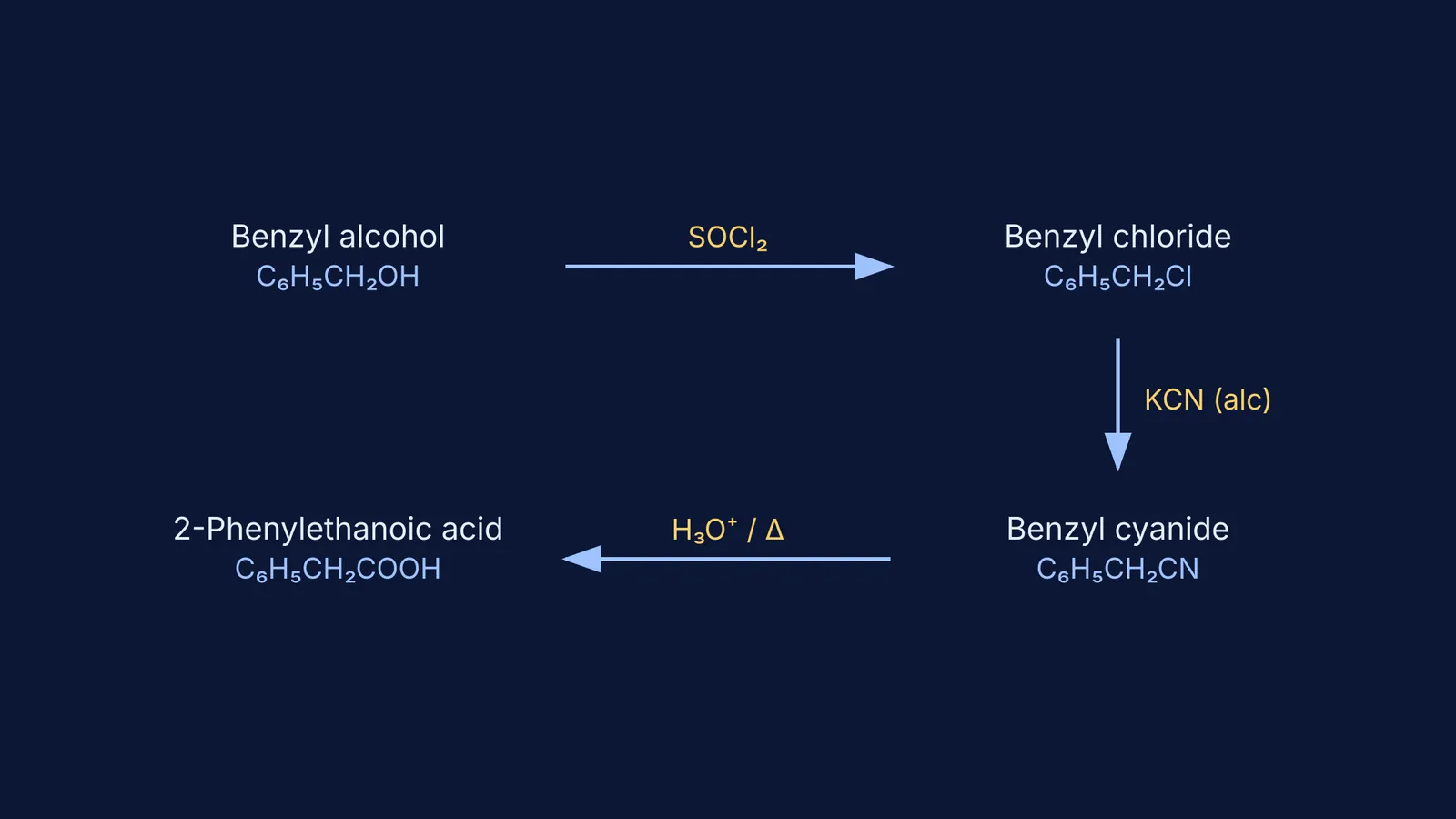
The conversion of benzyl alcohol to 2-phenylethanoic acid (also known as phenylacetic acid) is a classic "step-up" reaction in organic chemistry, similar to adding one carbon to ethanol. Because the product has one more carbon atom than the starting material's side chain, you cannot simply oxidise the alcohol. Instead, you must add a carbon atom using a cyanide intermediate. This exact reaction sequence is a staple in the Class 12 chemistry syllabus and frequently appears in board exams and competitive tests. Mastering this sequence is vital for students who want to improve their organic chemistry skills. Whenever an exam question asks for a product with one additional carbon atom, the cyanide pathway should instantly come to mind. Practising this sequence also builds a stronger foundation for understanding how nucleophiles attack polarised bonds and how leaving groups affect the speed of a reaction.
Why does the conversion of benzyl alcohol to 2-phenylethanoic acid require three steps?
Benzyl alcohol (C₆H₅CH₂OH) contains seven carbon atoms, while 2-phenylethanoic acid (C₆H₅CH₂COOH) contains eight. Direct oxidation of benzyl alcohol would yield benzoic acid (C₆H₅COOH), completely missing the extra carbon atom.
To lengthen the carbon chain by exactly one atom, chemists use a nucleophilic substitution reaction with a cyanide ion. However, the hydroxyl (-OH) group is a poor leaving group, so it must first be converted into a better leaving group, such as a chloride ion.
Step 1: How do you convert benzyl alcohol to benzyl chloride?
The first step is to replace the hydroxyl group with a chlorine atom. This is best achieved by reacting benzyl alcohol with thionyl chloride (SOCl₂).
C₆H₅CH₂OH + SOCl₂ → C₆H₅CH₂Cl + SO₂ + HCl
While you can also use phosphorus pentachloride (PCl₅) or phosphorus trichloride (PCl₃), thionyl chloride is the preferred reagent. This is because both byproducts — sulphur dioxide and hydrogen chloride — are gases that escape the reaction mixture, leaving behind pure benzyl chloride without the need for complex separation.
Step 2: How do you step up the carbon chain with KCN?
Once you have benzyl chloride, you can introduce the extra carbon atom. Treat the benzyl chloride with an ethanolic solution of potassium cyanide (KCN).
C₆H₅CH₂Cl + KCN → C₆H₅CH₂CN + KCl
This is a classic SN2 nucleophilic substitution reaction (much like the inversion seen in SN2 stereochemistry). The cyanide ion (CN⁻) acts as a nucleophile, attacking the slightly positive carbon atom of the benzyl group and displacing the chloride ion. The product is benzyl cyanide (also called phenylacetonitrile), which now contains the required eight carbon atoms.
Step 3: How do you hydrolyse benzyl cyanide?
The final step is to convert the nitrile group (-CN) into a carboxylic acid group (-COOH). This is done by heating the benzyl cyanide with a dilute mineral acid, such as hydrochloric acid or sulphuric acid (H₃O⁺).
C₆H₅CH₂CN + 2H₂O + H⁺ → C₆H₅CH₂COOH + NH₄⁺
The acid catalyses the addition of water across the carbon-nitrogen triple bond, eventually cleaving the nitrogen off as an ammonium ion and leaving 2-phenylethanoic acid. When performed in the laboratory using 80% sulphuric acid, this hydrolysis step typically yields about 80% of the final carboxylic acid.
If you are struggling to remember the reagents for these conversions, the Fermi Concept Library breaks down the mechanisms behind each functional group change. For students working through exam papers, the Fermi Problem Library will help you piece together multi-step syntheses by showing the reasoning behind each step, rather than just printing the final equation. You can even ask an AI tutor the 'why' behind named organic reactions to build deeper intuition.


