

On this page
If you treat organic chemistry like a vocabulary test, you will eventually run out of memory. When learning named reactions like Aldol, Cannizzaro, or Hofmann, the default strategy for many students is to memorise the starting materials, reagents, and products. But what happens when an exam tweaks a substituent or introduces a molecule you have never seen?
Pattern matching fails when the pattern changes. To survive advanced chemistry, you have to move from memorising isolated facts to understanding the underlying electron flow. Asking an AI tutor to explain the "why" behind the mechanism is a faster, more permanent way to learn.
Why is rote memorisation failing students?
In organic chemistry, relying on rote memorisation means you only learn surface-level features rather than the implicit properties that drive a reaction. When students try to memorise their way through the curriculum, the immense cognitive load forces them to treat reactions as isolated, disconnected events.
A 2024 study in *Science Education International* found that 67.0% of undergraduate chemistry students struggle with drawing complete reaction mechanisms. The researchers attributed this high failure rate directly to students attempting to memorise synthesis steps rather than understanding the mechanistic "why" behind them.
When you only memorise that a Cannizzaro reaction turns an aldehyde into an alcohol and a carboxylic acid, you add another disconnected fact to your mental flashcards. You miss the underlying logic: why does a strong base attack this specific carbon, and how does the hydride shift happen? Without that mechanistic foundation, an exam question featuring a slightly modified substrate will feel completely unfamiliar.
How can AI help remembering named organic reactions?
Named reactions are essentially shorthand used by chemists to describe complex transformations quickly. They were never meant to be learned as a giant list. If you group them by their mechanism family—such as nucleophilic addition, elimination, or electrophilic substitution—you reduce hundreds of reactions into a handful of logical, predictable rules.
This is where a teaching AI changes the study process. Instead of asking a chatbot to print the answer, you can use AI to build a framework for sense-making. To understand the approach, read What is Fermi?. Fermi's AI tutor notices where a student is stuck and decides whether to explain, ask, or show. It holds a line of reasoning across a whole session, working out what you already know and building a plan to bridge the gap.
If you are confused by the Hofmann bromamide degradation, the tutor teaches through the mechanism step by step. It draws the figures and checks your understanding as you go, rather than just printing the final amine product.
The mechanism over memorisation framework
To genuinely learn a named reaction, you need to break it down into entities (the molecules and electrons), properties (polarity and charge), and activities (bond breaking and forming).
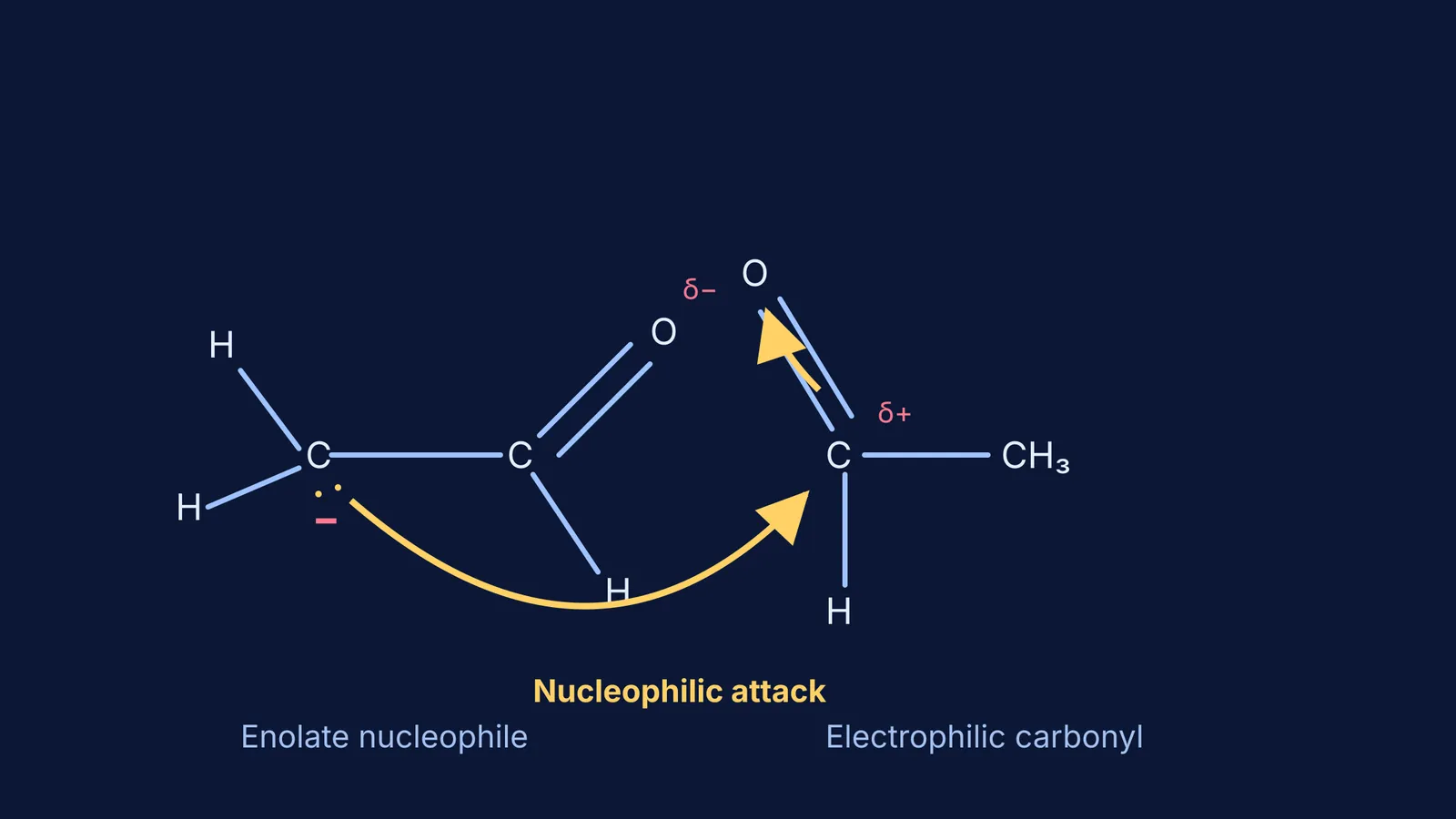
Every time you encounter a new named reaction, you should trace the electron-pushing formalism. Where is the most electron-rich site? Where is the most electron-poor site? Once you answer those two questions, the first step of almost any mechanism writes itself. For example, learning the Reimer-Tiemann and Kolbe reactions of phenol becomes much easier when you realise both rely on phenol's ability to activate the aromatic ring for electrophilic attack.
What to ask the AI instead of "what is the product?"
To shift your study habits from remembering to reasoning, you have to change how you prompt your AI tutor. Stop asking for outcomes and start asking for the electronic logic.
Here is a practical script of prompts to use for any new named reaction:
Find the family: "Do not give me the product. Tell me what family of mechanisms this named reaction belongs to, and explain the core principle of that family."
Trace the electrons: "Walk me through the electron-pushing formalism for this reaction. Start by helping me identify the most nucleophilic and electrophilic sites."
Compare and contrast: "I am confusing the Aldol addition with the Cannizzaro reaction. Ask me a series of questions to help me figure out why they require different types of aldehydes."
Test for transfer: "Give me a starting molecule that is slightly different from the textbook example. Watch me work through the mechanism and point out if my electrons flow incorrectly."
When you focus on the "why" instead of the "what," named reactions stop being a list of disconnected names to cram. They become predictable, logical extensions of rules you already know.


