

On this page
In organic chemistry, increasing the length of a carbon chain by exactly one atom is known as an ascent of series. This stepping-up process completely changes a molecule's properties. For example, the boiling point jumps from 78.37 °C for ethanol to 141 °C for propanoic acid, driven by the strong dimer hydrogen bonds that carboxylic acids form (Sigma-Aldrich). These systematic changes help chemists design precisely the materials they need.
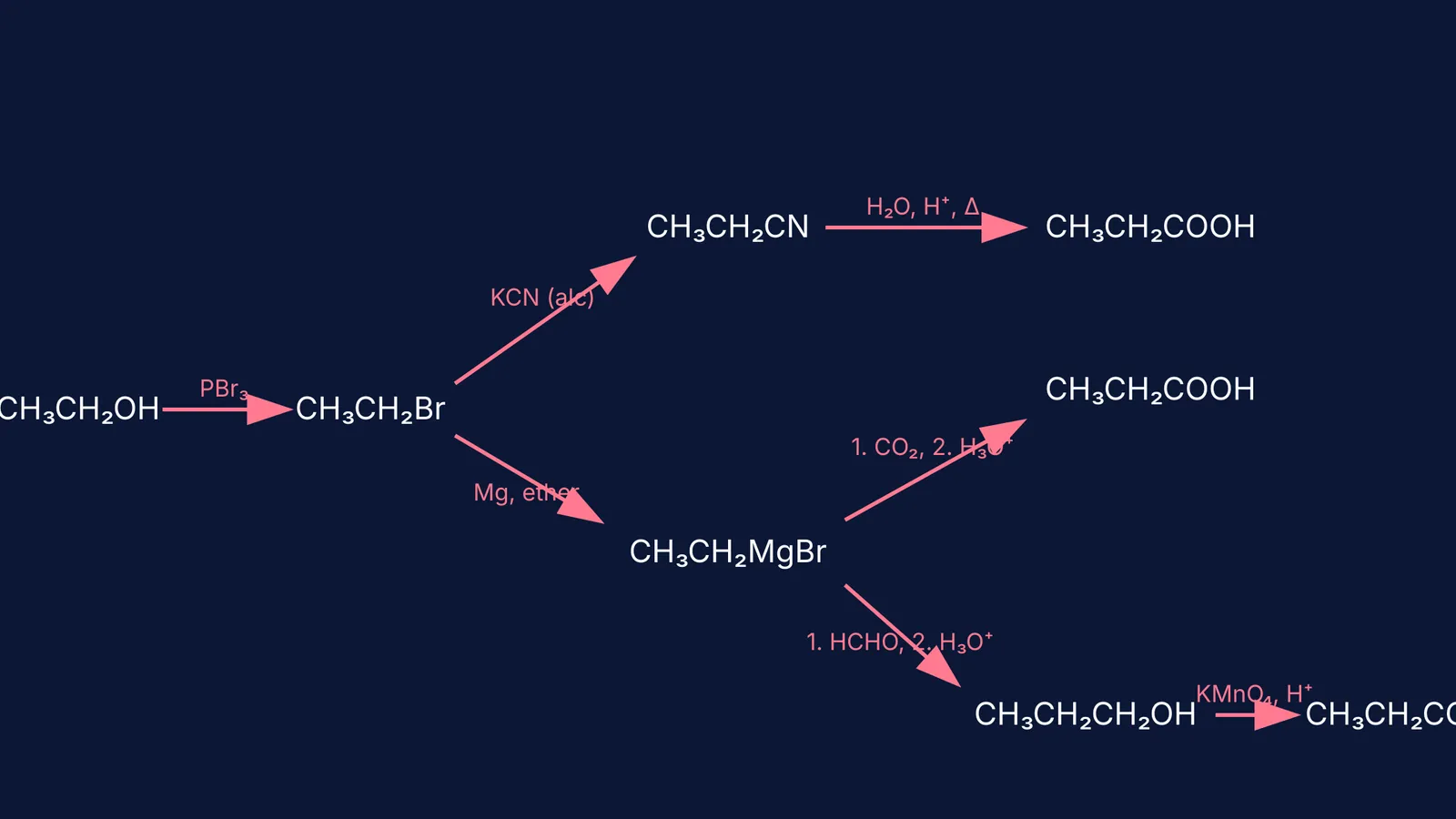
Whether you are preparing for a board exam, tackling competitive tests like JEE or NEET, or simply practicing retrosynthetic analysis, mastering these conversions is essential. When you are asked to synthesize a three-carbon acid from a two-carbon alcohol, you have three standard, highly reliable laboratory routes.
How do you convert ethanol to propanoic acid using cyanide?
The most common textbook method uses a substitution reaction to introduce the extra carbon atom. Because the hydroxyl group (-OH) in ethanol is a poor leaving group, you must first replace it with a halogen.
Halogenation: React ethanol with phosphorus tribromide (PBr₃) or thionyl chloride (SOCl₂) to form ethyl bromide.
Cyanation: Heat the ethyl bromide with an alcoholic solution of potassium cyanide (KCN). The cyanide ion acts as a nucleophile, kicking out the bromide to form propanenitrile (CH₃CH₂CN).
Hydrolysis: Finally, boil the propanenitrile with a dilute mineral acid like hydrochloric acid (HCl). The acidic conditions convert the nitrile group into a carboxylic acid, yielding propanoic acid.
You can find more examples of how cyanide ions attack alkyl halides in our guide to ambident nucleophiles.
How does the Grignard method use carbon dioxide?
In 1912, the French chemist Victor Grignard was awarded the Nobel Prize in Chemistry for discovering organomagnesium compounds, now known as Grignard reagents (NobelPrize.org). These reagents completely flip the polarity of the carbon atom they attach to, making the formation of new carbon-carbon bonds straightforward and highly predictable.
To use this route for an ascent of series:
Form the Grignard Reagent: Convert ethanol to ethyl bromide, then react it with magnesium metal turnings in dry diethyl ether. This forms ethylmagnesium bromide (CH₃CH₂MgBr). The ether must be strictly anhydrous, or the highly reactive Grignard reagent will steal a proton from water to form ethane gas.
Carbonation: Bubble dry carbon dioxide (CO₂) gas through the solution, or simply pour the reagent over solid dry ice. The nucleophilic carbon in the Grignard reagent attacks the electrophilic carbon of the CO₂ molecule. This addition forms a magnesium carboxylate salt intermediate.
Acid Workup: Add a dilute acid (H₃O⁺) to protonate the carboxylate salt. The magnesium salt washes away, leaving you with pure propanoic acid.
If you have concept gaps about nucleophilic additions, the Fermi Concept Library has a lesson for every concept in chemistry and its place in the map.
Can you use formaldehyde to add one carbon?
Yes. While the carbon dioxide route takes you directly to a carboxylic acid, you can also use formaldehyde (HCHO) to achieve the one-carbon step-up. The catch is that this route produces an alcohol, requiring an extra oxidation step at the end.
When you react ethylmagnesium bromide with formaldehyde, the Grignard reagent attacks the carbonyl carbon just as it does with carbon dioxide. However, because formaldehyde only has hydrogen atoms attached to its carbonyl group, the resulting alkoxide salt forms a primary alcohol upon acid workup. In this case, the reaction yields propan-1-ol (CH₃CH₂CH₂OH).
To complete the conversion to propanoic acid, you must now oxidize the propan-1-ol. Strong oxidizing agents like acidified potassium permanganate (KMnO₄) or Jones reagent (CrO₃ in H₂SO₄) will strip away the alpha hydrogens and add an oxygen atom. This oxidizes the primary alcohol all the way up to a carboxylic acid, bypassing the aldehyde stage. (For a refresher on how primary alcohols behave under oxidation, see our review of ethanol and ethanoic acid properties).
This formaldehyde sequence is slightly longer than the direct carbon dioxide method because it adds that final oxidation step. However, it is an excellent mechanism to keep in your synthesis toolkit when an exam question specifically asks you to isolate a primary alcohol intermediate before proceeding to the final acid.


