

On this page
It is a common short "give reasons" question in CBSE board and JEE Main practice. NCERT asks it directly as Example 8.3 in Unit 8, Aldehydes, Ketones and Carboxylic Acids, of the Class 12 Chemistry textbook, Part II. The short answer is resonance; the reasoning behind it also lets you rank other carbonyl compounds.
What makes a carbonyl carbon reactive?
Oxygen is more electronegative than carbon, so the C=O bond is polar: the carbon carries a partial positive charge (δ+) and the oxygen a partial negative charge (δ−). In nucleophilic addition, a nucleophile attacks that electrophilic carbon, the carbon changes from sp2 to sp3, and a tetrahedral alkoxide intermediate forms and then picks up a proton, as set out in NCERT's Unit 8 on aldehydes and ketones. In NCERT's mechanism diagram, the nucleophile's attack is the slow step.
So anything that makes the carbonyl carbon less positive makes it a weaker target, and anything that crowds it makes it harder to reach. NCERT uses both ideas for why aldehydes are more reactive than ketones.
Why is benzaldehyde less reactive than propanal?
In propanal (CH3CH2CHO), the carbonyl group is attached to an ethyl group. The ethyl group donates a little electron density through its +I effect but has no π electrons to share.
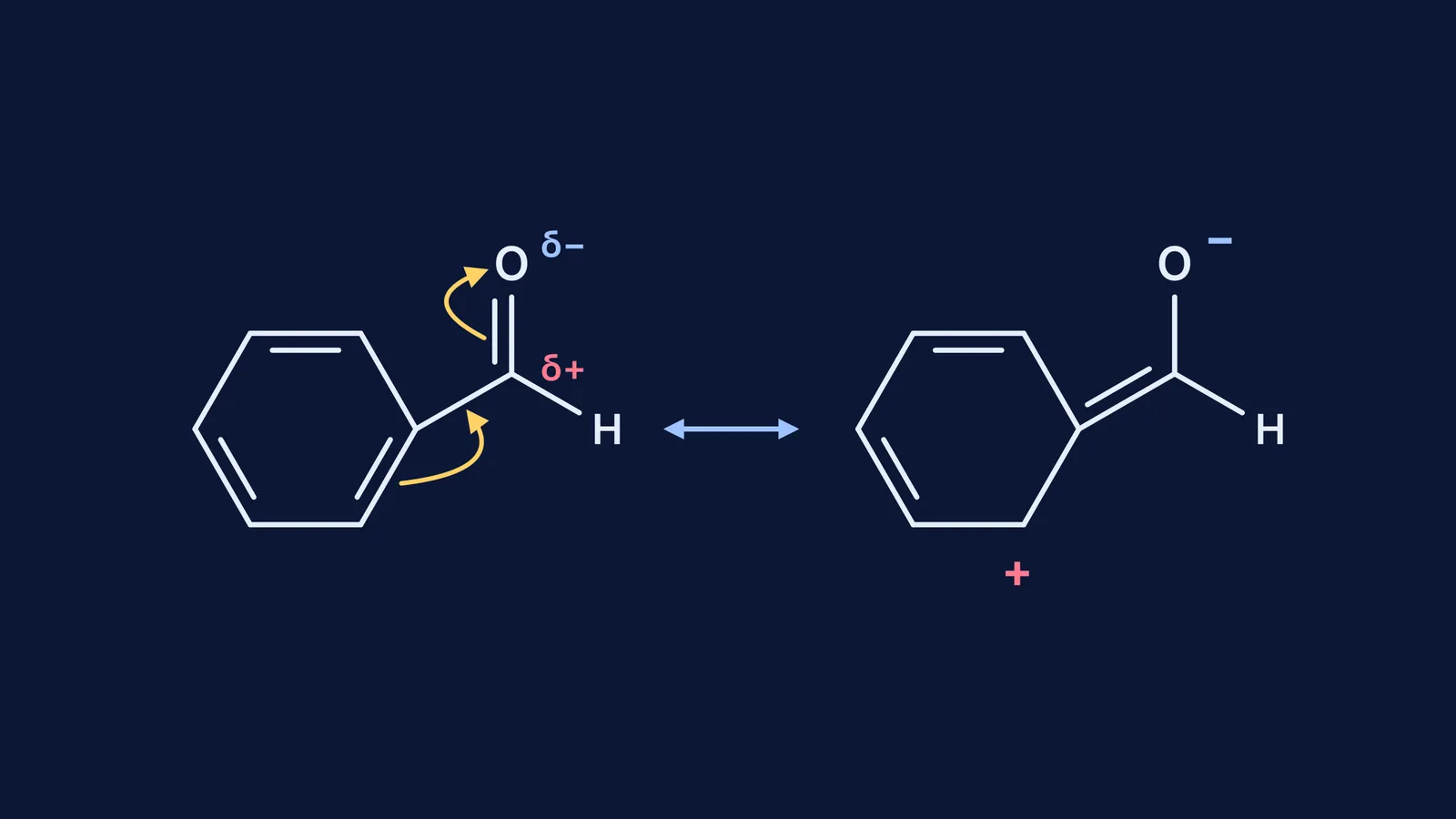
In benzaldehyde (C6H5CHO), the carbonyl group is attached directly to a benzene ring, and the ring's π electrons are conjugated with the C=O π bond. The ring can push electron density into the carbonyl group. In the second resonance structure, the C=O π electrons move onto oxygen, which becomes O−. A ring π bond shifts out to form a C=C bond with the old carbonyl carbon. A positive charge appears on a ring carbon ortho or para to the CHO group.
NCERT's solution says the carbonyl carbon of benzaldehyde is less electrophilic than that of propanal because "the polarity of the carbonyl group is reduced in benzaldehyde due to resonance" (NCERT Class 12 Chemistry, Example 8.3). Some of the positive charge that would sit on the carbonyl carbon is spread over the ring instead. For more on how ring delocalisation is measured, see how to calculate the resonance energy of benzene.
How big is the difference?
Hydration is one of the simplest nucleophilic additions: water adds across C=O to give a gem-diol, and the hydration equilibrium constant K_H tells you how far the reaction goes. Matthew Elrod and colleagues at Oberlin College measured K_H for several carbonyl compounds by NMR and built a calibrated computer model to predict others (ACS Earth and Space Chemistry, 2021).
Propanal: measured K_H = 1.26 at 298 K, so a little over half the propanal in water is hydrated at equilibrium.
Benzaldehyde: not measured in the study. The model predicts log K_H of −1.9 to −2.4, which is a K_H of roughly 0.004 to 0.013, so only about 0.4% to 1.2% would be hydrated.
So propanal's equilibrium constant is roughly 100 to 300 times larger than the value predicted for benzaldehyde. The same study lists measured values of log K_H = 3.4 for formaldehyde, 0.1 for acetaldehyde and −2.7 for acetone, which puts benzaldehyde's prediction between the simple aldehydes and acetone (Elrod et al., 2021). They also found that electronegative neighbouring groups increase hydration, most likely by pulling electron density from the carbonyl carbon.
How do you write this in an exam?
A four-line answer that covers the key points:
Claim: benzaldehyde is less reactive than propanal towards nucleophilic addition.
Reason: the benzene ring is conjugated with the C=O group and releases electrons into it by resonance.
Evidence: draw both resonance structures with curly arrows, showing O− on oxygen and + on an ortho or para ring carbon.
Conclusion: the carbonyl carbon carries less positive charge, so it is less electrophilic and the nucleophile attacks more slowly.
Two common slips: writing only about the inductive effect, and putting the + charge on a meta carbon instead of ortho or para.
How do you rank other carbonyl compounds?
Run these four checks on each compound:
Is a group that can donate electrons by resonance (such as a benzene ring) attached to the C=O? Reactivity goes down.
Is an electron-withdrawing group near the carbonyl? Reactivity goes up.
Is it a ketone? Reactivity goes down for steric and electronic reasons.
Are the groups bulky? Reactivity goes down. Our post on cyanohydrin formation and steric hindrance shows this with HCN.
Try it on HCHO, CH3CHO, C6H5CHO and CH3COCH3. The checks put C6H5CHO and CH3COCH3 below the simple aldehydes; the hydration values above order those two, giving HCHO > CH3CHO > C6H5CHO > CH3COCH3, though benzaldehyde's place rests on a predicted rather than a measured value.
If you want to practise ranking problems with every step explained, the Fermi Problem Library has worked problems with a step-by-step solver that explains the reasoning rather than printing an answer. If resonance itself feels shaky, the Fermi Concept Library covers every concept in chemistry, each with its own lesson.
See a benzene ring next to C=O? Draw the resonance structures first.


