

On this page
When you study organic chemistry for university entrance exams, the carbonyl group (C=O) is everywhere. Both aldehydes and ketones contain this group, making them prone to nucleophilic addition. But if you put them in a race under identical conditions, aldehydes almost always win.
Why does this happen? The answer lies in the environment around the carbonyl carbon.
Why are aldehydes more reactive than ketones towards nucleophilic addition?
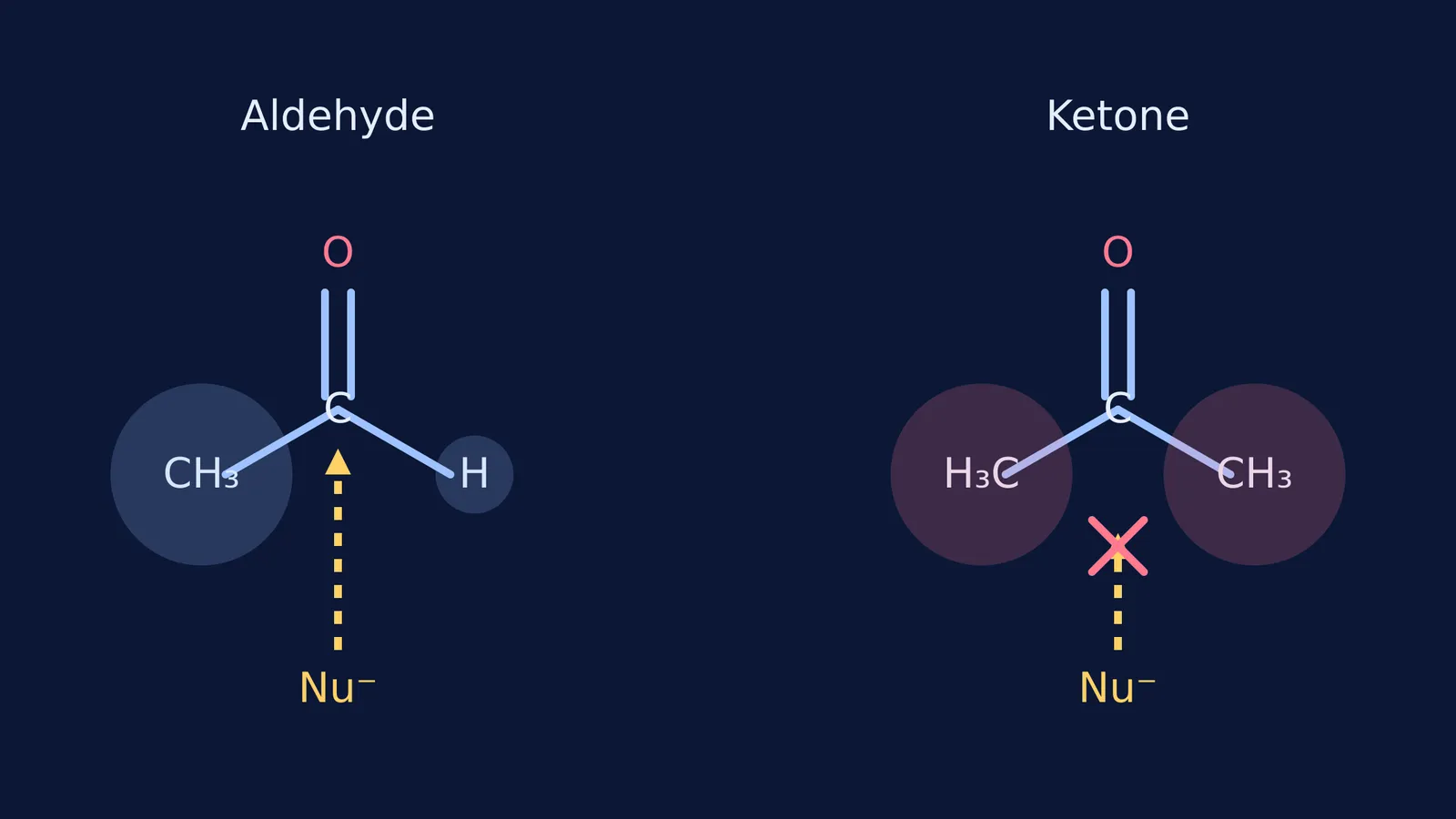
Nucleophilic addition happens when an electron-rich nucleophile attacks the electron-poor carbon of the carbonyl group. Standard chemistry texts outline that aldehydes react faster because of two main reasons: less steric hindrance and fewer electronic stabilising effects (LibreTexts/19%3A_Aldehydes_and_Ketones-_Nucleophilic_Addition_Reactions/19.04%3A_Nucleophilic_Addition_Reactions_of_Aldehydes_and_Ketones)).
1. Less steric crowding In an aldehyde, the carbonyl carbon is attached to at least one small hydrogen atom. In a ketone, it is sandwiched between two bulky alkyl groups (like methyl or ethyl). As the nucleophile attacks, the carbon's bond angles must compress from 120° to about 109.5°. Two bulky groups in a ketone create a cramped transition state, requiring more activation energy to push them together. The tiny hydrogen in an aldehyde simply stays out of the way.
This difference in spatial crowding makes the transition state for ketone addition much higher in energy, drastically slowing down the rate of the reaction compared to aldehydes.
2. Weaker electronic stabilisation Alkyl groups are electron-donating. Through a process called the inductive effect (+I effect), they push some of their electron density toward the carbonyl carbon.
How does the inductive effect change the partial positive charge?
Because oxygen is more electronegative than carbon, it pulls the double bond's electrons toward itself, leaving the carbon with a partial positive charge (δ+). This δ+ is the primary target for the incoming nucleophile.
In a ketone, two alkyl groups push electron density toward the carbon, partially neutralising that δ+. This extra electron density makes the carbonyl carbon less attractive to nucleophiles. An aldehyde only has one alkyl group (or none, in the case of formaldehyde), leaving its δ+ much stronger and more exposed to attack.
When these concepts get confusing, checking the Fermi Concept Library gives you a structured way to review the mechanisms in chemistry.
How does this reactivity difference show up in the lab?
This fundamental difference in reactivity has major practical consequences for how we run chemical reactions in the lab. Consider the formation of acetals and ketals. When reacting an aldehyde with an alcohol under acidic conditions, the reaction proceeds smoothly to form an acetal. However, attempting to form a ketal from a ketone using the same simple setup often results in very poor yields because the equilibrium strongly favours the starting materials. Chemists must use specialised techniques, like continuous removal of water, to drive the reaction forward.
Similarly, in reactions with Grignard reagents, aldehydes (other than formaldehyde) yield secondary alcohols, while ketones yield tertiary alcohols. The bulky intermediate formed when a Grignard reagent attacks a ketone is more crowded, making the pathway energetically steeper.
The trend even appears in reactions like cyanohydrin formation, where hydrogen cyanide adds across the C=O bond. Because ketones are more stable and more crowded, their equilibrium constants for addition are generally much smaller than those for aldehydes.
Practical framework: Ranking reactivity
If an exam question asks you to rank molecules by reactivity towards nucleophiles, use this simple checklist:
Count the alkyl groups: Zero (formaldehyde) > one (aldehydes) > two (ketones).
Check group size: Larger alkyl groups (like tert-butyl) create more steric hindrance than small ones (like methyl).
Look for electron-withdrawing groups: If halogens or other withdrawing groups are attached to the alkyl chain, they pull electron density away, increasing the δ+ and making the molecule more reactive.
For example, formaldehyde (HCHO) is more reactive than ethanal (CH3CHO), which is more reactive than propanone (CH3COCH3).
You can see this pattern repeated when comparing other reactions. For instance, whether you are looking at Aldehydes and ketones: nucleophilic addition and named reactions or exploring Carbonyls with ammonia derivatives: oximes, hydrazones, 2,4-DNP, the aldehyde will generally react more readily. And if you are trying to remove the oxygen entirely, as detailed in Clemmensen vs Wolff-Kishner: reducing a C=O group to CH2, the local environment of the carbonyl carbon still dictates the reaction conditions.
If you struggle to piece these trends together across different chapters, Fermi's AI tutor can help. It notices where a student is stuck and decides whether to explain, ask, or show the reaction steps on a digital board.


