

On this page
Coordination isomerism is one of the structural isomer types you meet in Class 12 coordination compounds, and it is one of the easier ones to spot. One thing must be true before you even start: the compound must be a salt in which both parts are complex ions.
What is coordination isomerism?
Chemistry LibreTexts defines it this way: coordination isomerism "occurs in compounds containing complex anionic and cationic parts and can be viewed as the interchange of one or more ligands between the cationic complex ion and the anionic complex ion" (Chemistry LibreTexts/Coordination_Chemistry/Structure_and_Nomenclature_of_Coordination_Compounds/Isomers/Structural_Isomers%3A_Coordination_Isomerism_in_Transition_Metal_Complexes)).
Put another way, the total ratio of ligands to metals stays the same, but which ligands are attached to which metal changes (Wikipedia summary). The molecular formula of the whole salt does not change. What changes is the formula of each complex ion inside it.
What is the standard example of coordination isomerism?
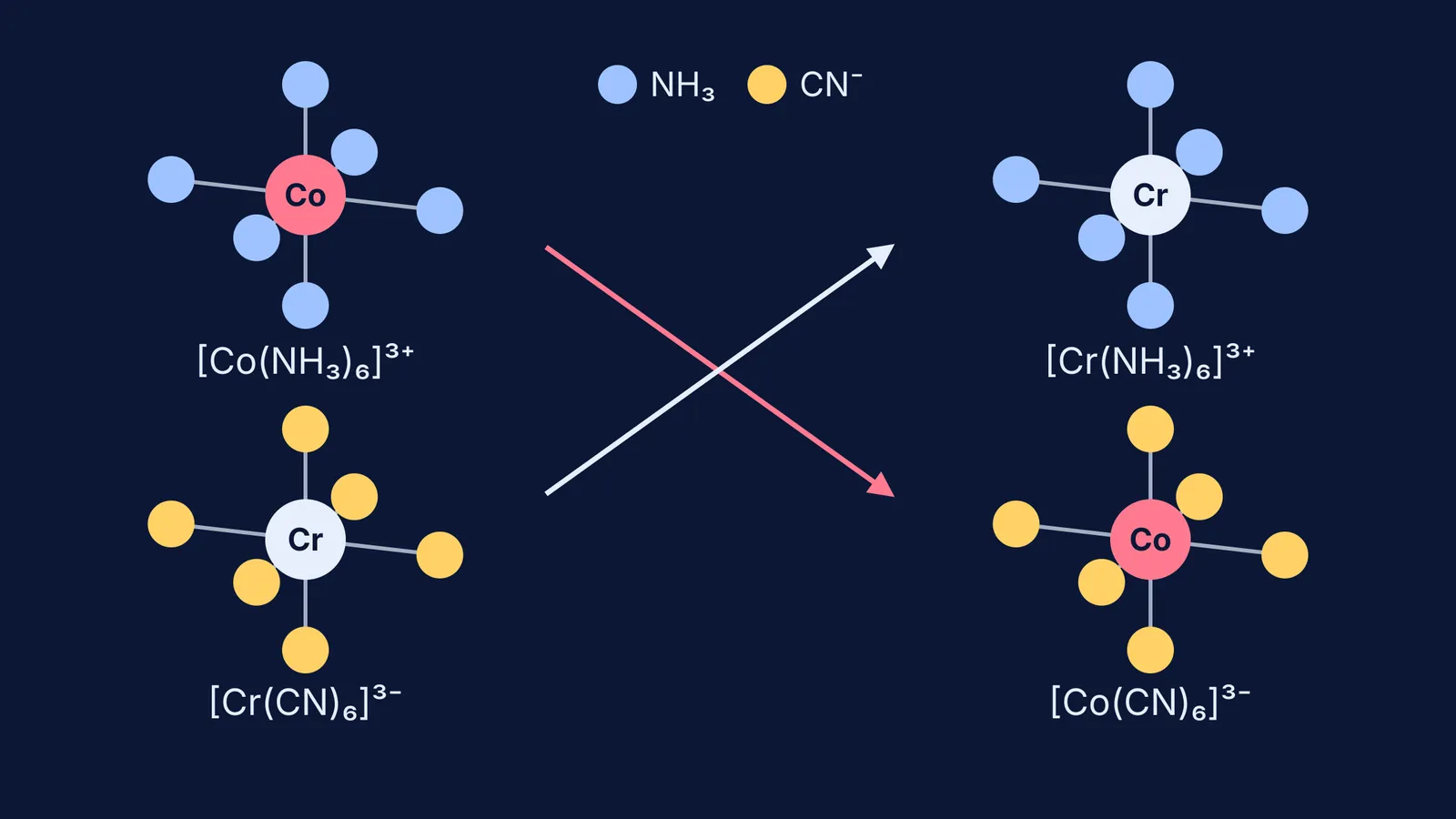
The usual example is the pair [Co(NH3)6][Cr(CN)6] and [Cr(NH3)6][Co(CN)6] (Chemistry LibreTexts/Coordination_Chemistry/Structure_and_Nomenclature_of_Coordination_Compounds/Isomers/Structural_Isomers%3A_Coordination_Isomerism_in_Transition_Metal_Complexes)).
Read it in pieces:
In the first salt, cobalt carries six NH3 and forms the cation [Co(NH3)6]3+; chromium carries six CN- and forms the anion [Cr(CN)6]3-.
In the second salt, the ligand sets have traded metals: chromium now carries the six NH3 as [Cr(NH3)6]3+, and cobalt carries the six CN- as [Co(CN)6]3-.
Count the atoms: one Co, one Cr, six NH3 and six CN- in both. Same formula, different arrangement, so they are isomers.
Both metals are +3 here, which is why the charges come out neatly as 3+ and 3- each time. A second example on the same LibreTexts page swaps metals between [Zn(NH3)4][CuCl4] and [Cu(NH3)4][ZnCl4], and the page also gives [Cu(NH3)4][PtCl4] and [Pt(NH3)4][CuCl4] as coordination isomers.
How do you check if a compound shows coordination isomerism?
Use this four-step check in an exam.
Split the formula at the square brackets. Write the cation and the anion separately.
Confirm both are complex ions, each with a metal and its own ligands inside a bracket. If one part is a simple ion like Cl- or K+, stop: the answer is no.
Work out each metal's oxidation state from the ligand charges and the ion's charge.
Move one or more ligands from one metal to the other, keeping each metal's coordination number the same, then recheck that the new cation and anion charges still balance. Every rearrangement that passes both checks is a coordination isomer.
Step 4 is the easy one to get wrong. It is tempting to move a single ligand and forget that a neutral NH3 and a charged CN- or Cl- change the ion charges by different amounts, or that a bidentate ligand such as oxalate fills two coordination sites.
Worked example: how many coordination isomers can a salt have?
Take [Co(NH3)6][Cr(C2O4)3], with oxalate (C2O4 2-) as the charged ligand. LibreTexts lists the full swap, [Cr(NH3)6][Co(C2O4)3], plus partial swaps such as [Co(NH3)4(C2O4)][Cr(NH3)2(C2O4)2] and [Cr(NH3)4(C2O4)][Co(NH3)2(C2O4)2] (Chemistry LibreTexts/Coordination_Chemistry/Structure_and_Nomenclature_of_Coordination_Compounds/Isomers/Structural_Isomers%3A_Coordination_Isomerism_in_Transition_Metal_Complexes)). Formulas here are written cation first.
Check the first partial swap with step 3 and step 4. Both metals are +3, and each oxalate is 2-.
[Co(NH3)4(C2O4)]: +3 + 0 - 2 = +1, a cation.
[Cr(NH3)2(C2O4)2]: +3 + 0 - 4 = -1, an anion.
+1 and -1 balance in a 1:1 salt, and the totals (one Co, one Cr, six NH3, three oxalates) are unchanged. It is a valid isomer.
Notice what happened: the ion charges changed from 3+ and 3- to 1+ and 1-. That is allowed. The rule is that the whole salt stays neutral with the same atoms, not that each ion keeps its old charge.
So how many are there? Each oxalate takes two sites on an octahedral metal, so one oxalate can only trade places with two NH3. Cobalt can hold zero, one, two or three oxalates, and chromium takes the rest. That gives four arrangements in all: the original salt plus three coordination isomers, exactly the set LibreTexts lists.
If you want the other three structural types side by side, our explainer on ionisation, hydrate and linkage isomers covers them. Naming both halves of these salts correctly is its own skill, practised in how to name salts with a complex cation and complex anion. And once you move on to stereoisomers, see how to count geometrical and optical isomers of complexes.
How should you practise this before an exam?
Write five salts with a complex cation and a complex anion, then generate every coordination isomer for each using the four steps. Check charges and coordination numbers out loud as you go. If oxidation states or ligand charges keep tripping you up, the gap is usually earlier in the chapter. The Fermi Concept Library covers every concept in chemistry, each with its own lesson and its place in the map. When your method feels right but answers still come out wrong, the Fermi Problem Library has worked problems with a step-by-step solver that explains the reasoning, so you can see where your charge count slipped.


