

On this page
You are given [Co(NH₃)₄Cl₂]⁺ and four options for the number of isomers. A memorised list works until the question changes one ligand. A method keeps working: put the ligands on an octahedron, name what sits opposite what, then check each structure for a mirror plane.
If you are preparing for CBSE Class 12, JEE Main or NEET-UG, this belongs to the coordination compounds chapter. Here is a way to answer it without guessing.
How many geometrical isomers does an octahedral complex have?
The count depends on the pattern of ligands, not on the metal. So first rewrite the formula as a type. [Co(NH₃)₄Cl₂]⁺ is MA₄B₂. [Co(en)₂Cl₂]⁺ is M(AA)₂B₂, where AA is a bidentate ligand such as ethylenediamine (en).
Here are the counts for the common types:
MA₅B has only one structure, because every drawing can be rotated onto every other (LibreTexts, UC Davis Chem 124A).
MA₄B₂ has two isomers, with the two B ligands either cis or trans (same LibreTexts page).
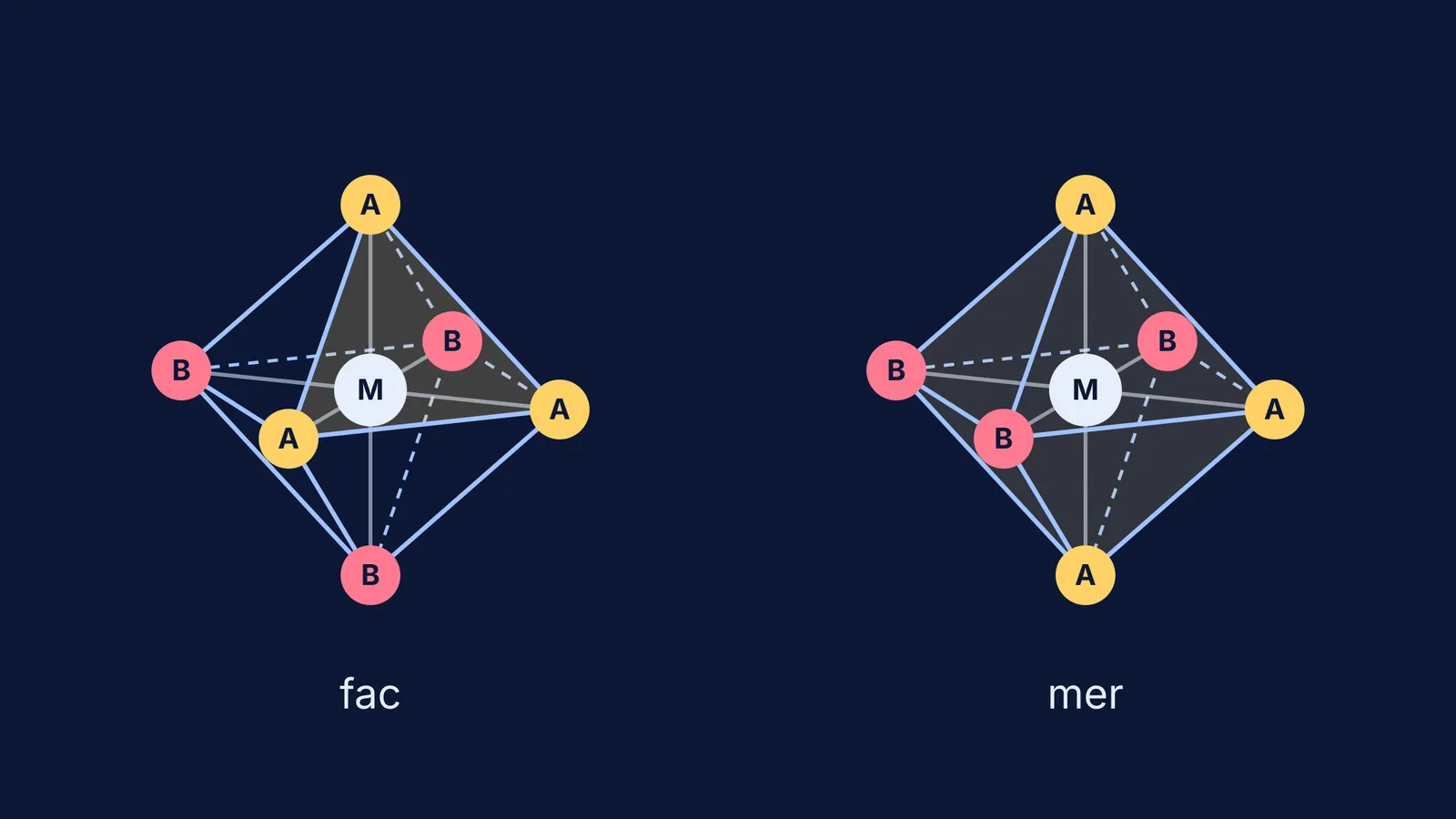
MA₃B₃ has two isomers: fac, where each set of three sits on one triangular face, and mer, where each set lies along a meridian (same page).
MA₂B₂C₂ has five geometrical isomers (LibreTexts isomerism worksheet/Geometry_and_Isomerism_in_Coordination_Compounds_(Worksheet))) and six stereoisomers once you count one enantiomeric pair (Wikipedia, octahedral molecular geometry).
MABCDEF has 15 diastereomers, and all 15 are chiral, which makes 30 stereoisomers (Wikipedia, octahedral molecular geometry).
How do you count them without missing one?
Use what we call the trace-the-trans method. An octahedron has six positions in three opposite pairs: top and bottom, left and right, front and back. Two structures are the same isomer exactly when they have the same set of trans pairs.
Rewrite the formula as a type (MA₄B₂, M(AA)₂B₂ and so on).
Place chelates first. A bidentate ligand like oxalate can only take two adjacent (cis) positions (LibreTexts/Coordination_Chemistry/Structure_and_Nomenclature_of_Coordination_Compounds/Isomers/Stereoisomers%3A_Geometric_Isomers_in_Transition_Metal_Complexes)), so an AA ligand never spans a trans pair.
List every possible answer to the question "what sits trans to what?" Each different answer is one geometrical isomer.
Test each isomer for a mirror plane, as in the next section.
Worked example: MA₂B₂C₂. Ask how many of the like pairs are trans.
All three pairs trans (A opposite A, B opposite B, C opposite C): 1 isomer.
Exactly one pair trans: if A is opposite A, the B and C ligands must alternate around the middle, so each B is opposite a C. You can choose A, B or C as the trans pair: 3 isomers.
No pair trans: every A is opposite a B or a C. Only one arrangement does this: 1 isomer.
That gives 1 + 3 + 1 = 5, which matches the sourced count above.
Which isomers are optically active?
The test is one line: if a structure has a plane of symmetry, it has no optical isomers, and if it has none, it does (LibreTexts, optical isomers in inorganic complexes/Coordination_Chemistry/Structure_and_Nomenclature_of_Coordination_Compounds/Isomers/Optical_Isomers_in_Inorganic_Complexes)). Apply it to each type:
MA₄B₂ and MA₃B₃: in MA₄B₂, the plane through the metal and both B ligands is a mirror. In fac-MA₃B₃, a plane through the metal, one A and one B is a mirror; in mer, the meridian plane is. Neither type has an enantiomeric pair (Wikipedia table).
MA₂B₂C₂: in each of the four isomers with a trans pair, a mirror plane passes through that pair. The all-cis isomer has no such plane, so it exists as one enantiomeric pair (Wikipedia).
M(AA)₂B₂: in the trans isomer, both chelate rings lie in one plane, and that plane is a mirror. The cis isomer has no plane, so it splits into Λ and Δ forms. The real salt [CoCl₂(en)₂]Cl shows both behaviours. The cis form has been resolved into its Λ and Δ enantiomers, and a separate trans isomer exists (Wikipediacobalt(III)_chloride)). That makes 2 geometrical isomers and 3 stereoisomers.
M(AA)₃: [Co(en)₃]³⁺ has left-handed (Λ) and right-handed (Δ) optical isomers (LibreTexts/Coordination_Chemistry/Structure_and_Nomenclature_of_Coordination_Compounds/Isomers/Optical_Isomers_in_Inorganic_Complexes)). It has one geometrical form and two stereoisomers.
What should you check before marking an answer?
Did you reduce the formula to a type before counting?
Did every chelate span a cis edge?
Did you count by trans pairs, not by how the drawing looks?
Did you run the mirror-plane test on every isomer?
Did you answer the number the question asked for?
If your count keeps coming out one short, the Fermi Problem Library has worked problems with a step-by-step solver that explains the reasoning rather than printing an answer. If cis, trans or chirality still feels shaky, the Fermi Concept Library gives each concept its own lesson.
To see where the octahedron itself came from, read how Alfred Werner worked out the shape of coordination compounds. To predict which complexes are octahedral, see valence bond theory for complexes and hybridisation. The same mirror logic is used for organic molecules in counting stereoisomers from chiral centres.


