

On this page
Isomers are molecules that share the exact same chemical formula but have different arrangements of atoms. In coordination chemistry, structural isomers occur when the actual bonds between the central metal ion and its ligands are different (Wikipedia).
There are four primary types of structural isomerism to know for exams like JEE Main and NEET-UG: ionisation, hydrate, linkage and coordination isomerism. Here is how to spot the difference between them from their chemical formulas.
What is ionisation isomerism?
Ionisation isomerism happens when a ligand inside the coordination sphere swaps places with a counter ion from outside the sphere. When these isomers dissolve in water, they release different ions, which you can test for using precipitation reactions.
Take the formula Co(NH₃)₅BrSO₄. It can form two different ionisation isomers:
[Co(NH₃)₅Br]SO₄: The bromide ion is a ligand bonded to the cobalt, and the sulphate ion is outside. It releases SO₄²⁻ in water, which forms a white precipitate with barium chloride.
[Co(NH₃)₅SO₄]Br: The sulphate ion is bonded to the cobalt, and the bromide ion is outside. It releases Br⁻ in water, which forms a pale yellow precipitate with silver nitrate.
If you are struggling to predict the products of these precipitation tests, the Fermi Concept Library contains a lesson for every concept in chemistry, where Fermi's AI tutor works out what you already know and checks your understanding as it goes.
What is hydrate isomerism?
Hydrate isomerism (sometimes called solvate isomerism) is a special case of ionisation isomerism. It occurs when a water molecule swaps places with another ion, changing whether the water acts as a direct ligand to the metal or as "free" water of crystallisation in the crystal lattice.
The classic example is chromium(III) chloride hexahydrate, CrCl₃·6H₂O, which exists in three forms:
[Cr(H₂O)₆]Cl₃: All six water molecules are ligands. It is violet and releases three ionisable chloride ions.
[Cr(H₂O)₅Cl]Cl₂·H₂O: Five waters are ligands, one is in the lattice. It is blue-green and releases two ionisable chloride ions.
[Cr(H₂O)₄Cl₂]Cl·2H₂O: Four waters are ligands, two are in the lattice. It is dark green and releases one ionisable chloride ion.
You can learn more about finding the number of free ions in our guide to counting ionisable chlorides in complexes with AgNO3 and conductivity.
What is linkage isomerism?
Linkage isomerism occurs when a complex contains an ambidentate ligand: a ligand that has more than one donor atom but can only bond through one of them at a time.
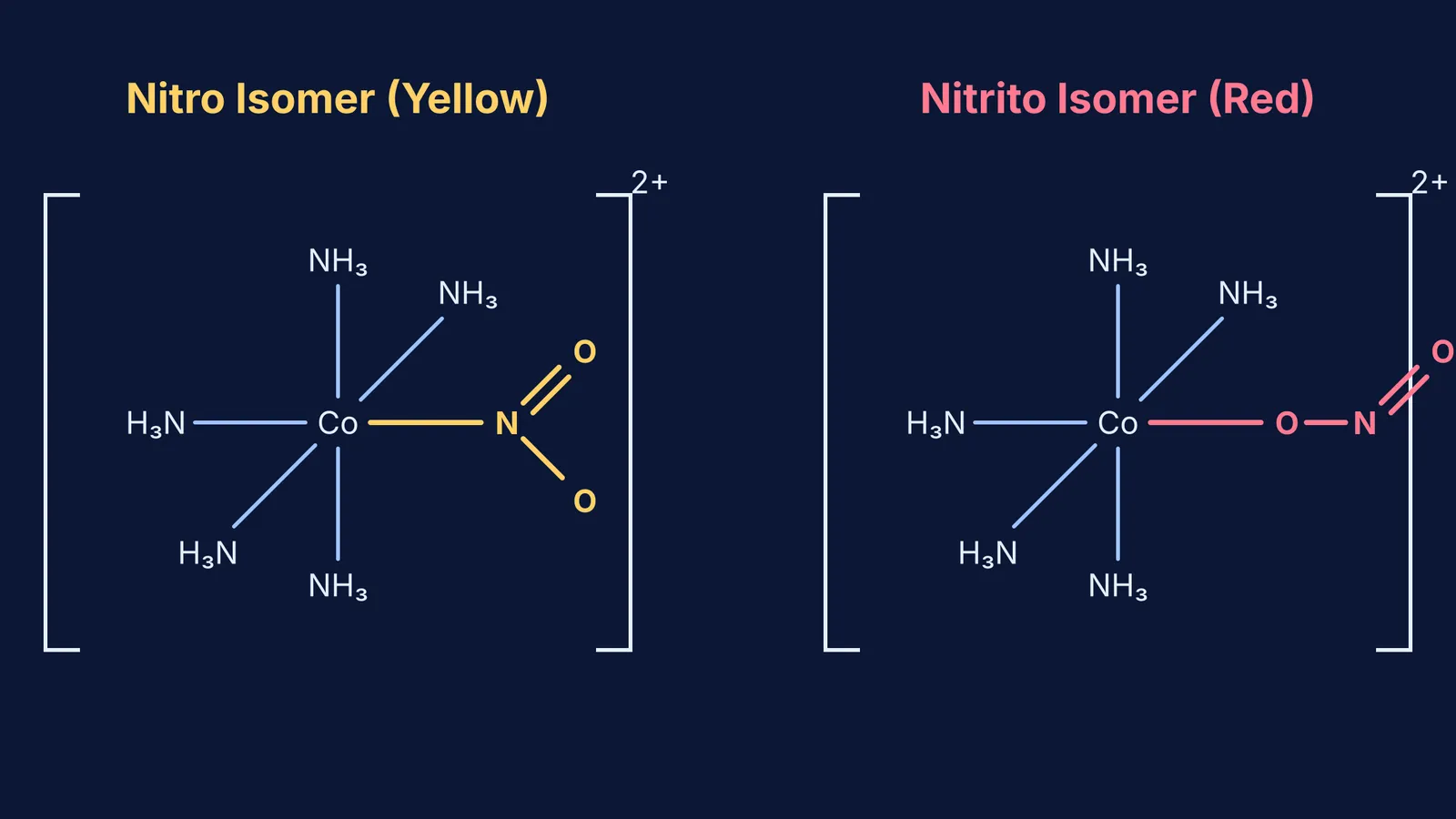
The nitrite ion (NO₂⁻) is a common ambidentate ligand. It can bond to a metal through its nitrogen atom or through an oxygen atom, producing two distinct linkage isomers with very different colours:
[Co(NH₃)₅(NO₂)]²⁺: The NO₂⁻ is bonded through the nitrogen atom (the nitro group). This isomer is a yellow-orange colour.
[Co(NH₃)₅(ONO)]²⁺: The NO₂⁻ is bonded through an oxygen atom (the nitrito group). This isomer is red.
Other common ambidentate ligands to watch out for include the thiocyanate ion (SCN⁻), which can bond through sulphur or nitrogen, and the cyanide ion (CN⁻), which can bond through carbon or nitrogen.
What is coordination isomerism?
Coordination isomerism only happens in salts where both the cation and the anion are complex ions. The isomerism arises when the two central metal atoms completely swap their sets of ligands.
For example, consider a salt made of a cobalt complex and a chromium complex:
[Co(NH₃)₆][Cr(CN)₆]: Here, the six ammonia ligands are bound to the cobalt, and the six cyanide ligands are bound to the chromium.
[Cr(NH₃)₆][Co(CN)₆]: In this isomer, the metals have swapped ligands. The ammonia is now with the chromium, and the cyanide is with the cobalt.
Telling these four types apart is a pattern-recognition task. When a question asks you to identify the isomerism, look at the brackets first. If the ions outside the brackets change, it is ionisation (or hydrate, if water moves). If the atom connecting a ligand changes, it is linkage. If there are two sets of brackets swapping ligands, it is coordination.
For more on unpicking the structures of inorganic compounds, see our guide to oxidation numbers from structure: Fe3O4, S4O6²⁻ and CrO5.


