

On this page
When you encounter a coordination salt such as [Pt(NH₃)₄][PtCl₄] or [Co(NH₃)₆][Cr(CN)₆], both ions sit inside coordination brackets. In CBSE Class 12 exams, JEE Main, and NEET-UG, examiners use these dual-complex compounds to test whether you know which sphere comes first, how to deduce oxidation numbers, and where the suffix -ate belongs. Following the International Union of Pure and Applied Chemistry (IUPAC) rules makes the process methodical and reliable.
Which coordination sphere comes first in the IUPAC name?
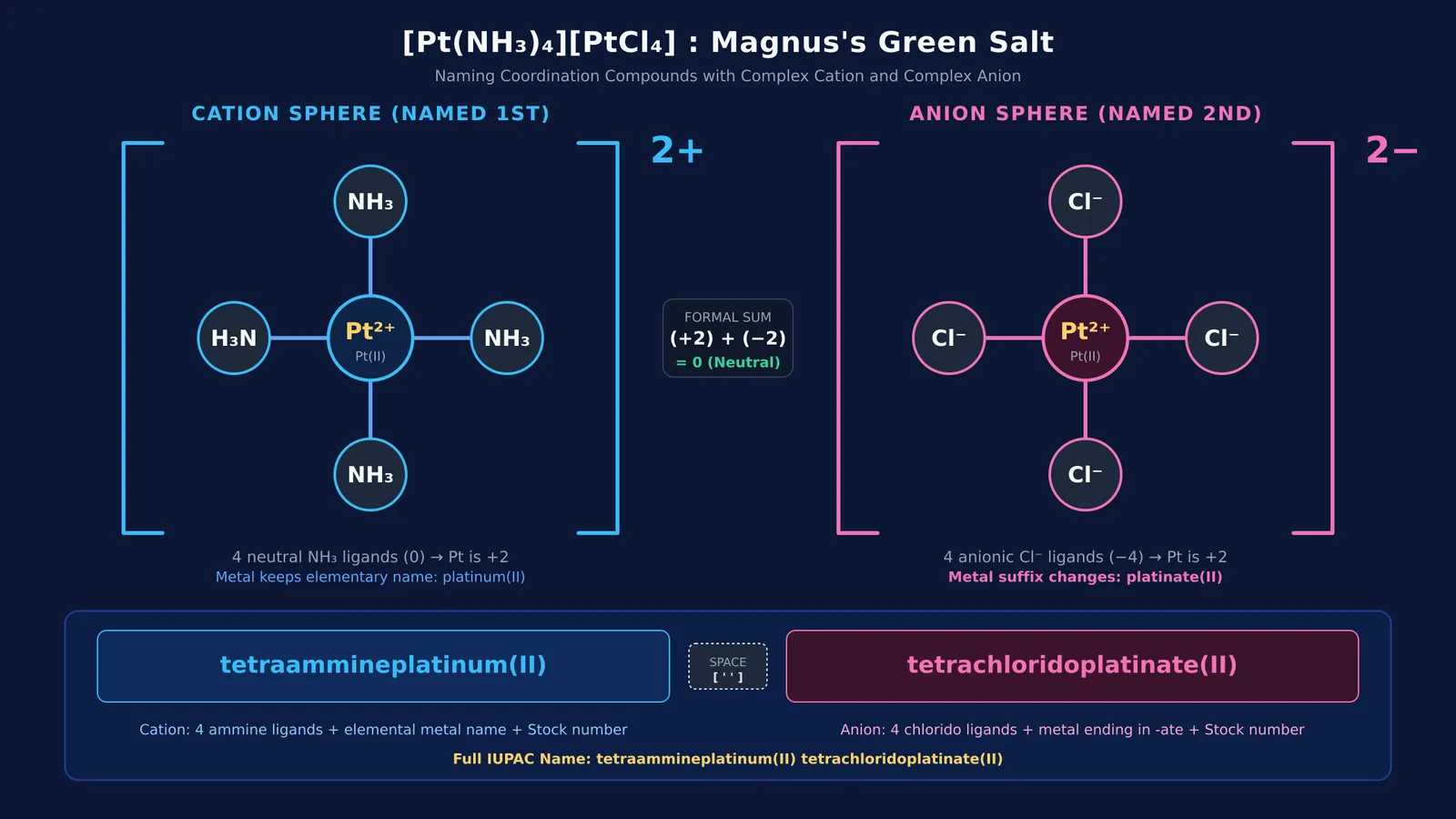
Just like simple sodium chloride, any coordination salt is named with the cation first and the anion second, separated by a space. According to the IUPAC Recommendations 2005 (Chapter IR-9), this order holds regardless of ion complexity. In the formula [Pt(NH₃)₄][PtCl₄], the cation [Pt(NH₃)₄]²⁺ is named first and the anion [PtCl₄]²⁻ second.
Within each coordination sphere, the naming sequence follows clear rules:
Name ligands first in alphabetical order, ignoring multiplying prefixes (di-, tri-, tetra-).
Use updated IUPAC ligand names: "chlorido" for Cl⁻, "cyanido" for CN⁻, "ammine" for NH₃, and "aqua" for H₂O.
Follow the ligands with the metal name and its oxidation state in parentheses, with no internal space.
For single-sphere fundamentals, review our guide to coordination compounds naming and isomerism.
How do you find the oxidation states of both metal centers?
Determining oxidation states is the trickiest step because neither sphere has an elementary counter-ion to give away the charge. You resolve this by combining ligand charges with known metal coordination geometries:
Sum ligand charges: neutral ligands (NH₃, H₂O) contribute 0, while anionic ligands (Cl⁻, CN⁻) contribute −1.
Formulate the charge balance equation: for [Pt(NH₃)₄][PtCl₄], let the metal oxidation states be x and y. Then (x + 0) + (y − 4) = 0, meaning x + y = 4.
Match coordination numbers to stable oxidation states: platinum exhibits +2 (4-coordinate, square planar) and +4 (6-coordinate, octahedral). Since both platinum atoms are 4-coordinate, both must be Pt(II). Thus x = +2 and y = +2, yielding [Pt(NH₃)₄]²⁺ and [PtCl₄]²⁻.
In contrast, [Pt(NH₃)₄Cl₂][PtCl₄] has a 6-coordinate Pt(IV) cation and a 4-coordinate Pt(II) anion, satisfying (x − 2) + (y − 4) = 0 with x = +4 and y = +2. This structural logic parallels counting ionisable chlorides in Werner complexes.
Why does the metal name in the anion end in -ate?
The key difference between the two spheres is the suffix on the central metal. As outlined in the peer-reviewed IUPAC Brief Guide in Pure and Applied Chemistry, an anionic coordination entity requires the suffix "-ate".
In the cation, the metal keeps its normal element name: platinum, cobalt, chromium, or silver.
In the anion, the metal adds "-ate": platinate, cobaltate, or chromate.
Elements with Latin-derived symbols use their Latin roots: iron becomes ferrate, copper becomes cuprate, and silver becomes argentate.
How do you name [Pt(NH3)4][PtCl4] and [Co(NH3)6][Cr(CN)6] step by step?
Here is how the rules apply to standard exam compounds:
[Pt(NH₃)₄][PtCl₄]:
Cation [Pt(NH₃)₄]²⁺: four ammonia ligands give "tetraammine", followed by platinum(II). Cation: tetraammineplatinum(II).
Anion [PtCl₄]²⁻: four chloride ligands give "tetrachlorido", followed by platinate(II). Anion: tetrachloridoplatinate(II).
Full IUPAC name: tetraammineplatinum(II) tetrachloridoplatinate(II). In 1828, Heinrich Gustav Magnus discovered this salt, now known as Magnus's green salt.
[Co(NH₃)₆][Cr(CN)₆]:
Both cobalt and chromium are 6-coordinate octahedral centers. Cobalt(III) pairs with ammonia and chromium(III) with cyanide, so (x + 0) + (y − 6) = 0 gives x = +3 and y = +3.
Cation [Co(NH₃)₆]³⁺: hexaamminecobalt(III).
Anion [Cr(CN)₆]³⁻: hexacyanidochromate(III).
Full IUPAC name: hexaamminecobalt(III) hexacyanidochromate(III). Its coordination isomer [Cr(NH₃)₆][Co(CN)₆] is hexaamminechromium(III) hexacyanidocobaltate(III). Geometry and orbital splitting for these ions are explored in valence bond theory for complexes.
[Ag(NH₃)₂][Ag(CN)₂]:
Silver(I) forms linear 2-coordinate complexes, with x = +1 and y = +1.
Full IUPAC name: diamminesilver(I) dicyanidoargentate(I).
What is the quick exam checklist for dual complexes?
When solving these under exam conditions:
Split the formula into cation and anion brackets.
Sum ligand charges and use coordination numbers to assign metal oxidation states.
Name each sphere: ligands alphabetically, followed by the metal (with -ate strictly on the anion).
Separate the two names with a single space and verify Roman numerals.
To practice with guided feedback, the Fermi Problem Library has worked problems with a step-by-step solver that explains the reasoning rather than printing an answer. If you need to revise coordination geometries or crystal fields, the Fermi Concept Library covers every concept in chemistry, each with its own lesson and its place in the map. When you get stuck on charge balance, Fermi's AI tutor notices where a student is stuck and holds a line of reasoning across a session to build your confidence.


