On this page
In 1889 the chemist Bohuslav Brauner published "Experimental Researches on the Periodic Law. Part I. Tellurium" in the Journal of the Chemical Society, Transactions, volume 55, pages 382 to 411 (DOI). The scan is free on the Internet Archive. He spent "the greater part of my spare time during the past six years" trying to show that tellurium is lighter than iodine, as Mendeleev's table seemed to need. The answer went the other way. All quotations below are from that paper. Its header gives only "Bohuslav Brauner, Ph.D., F.C.S., late Berkeley Fellow of Owens College", so we leave out the rest of his life.
Why did Mendeleev expect tellurium to be about 125?
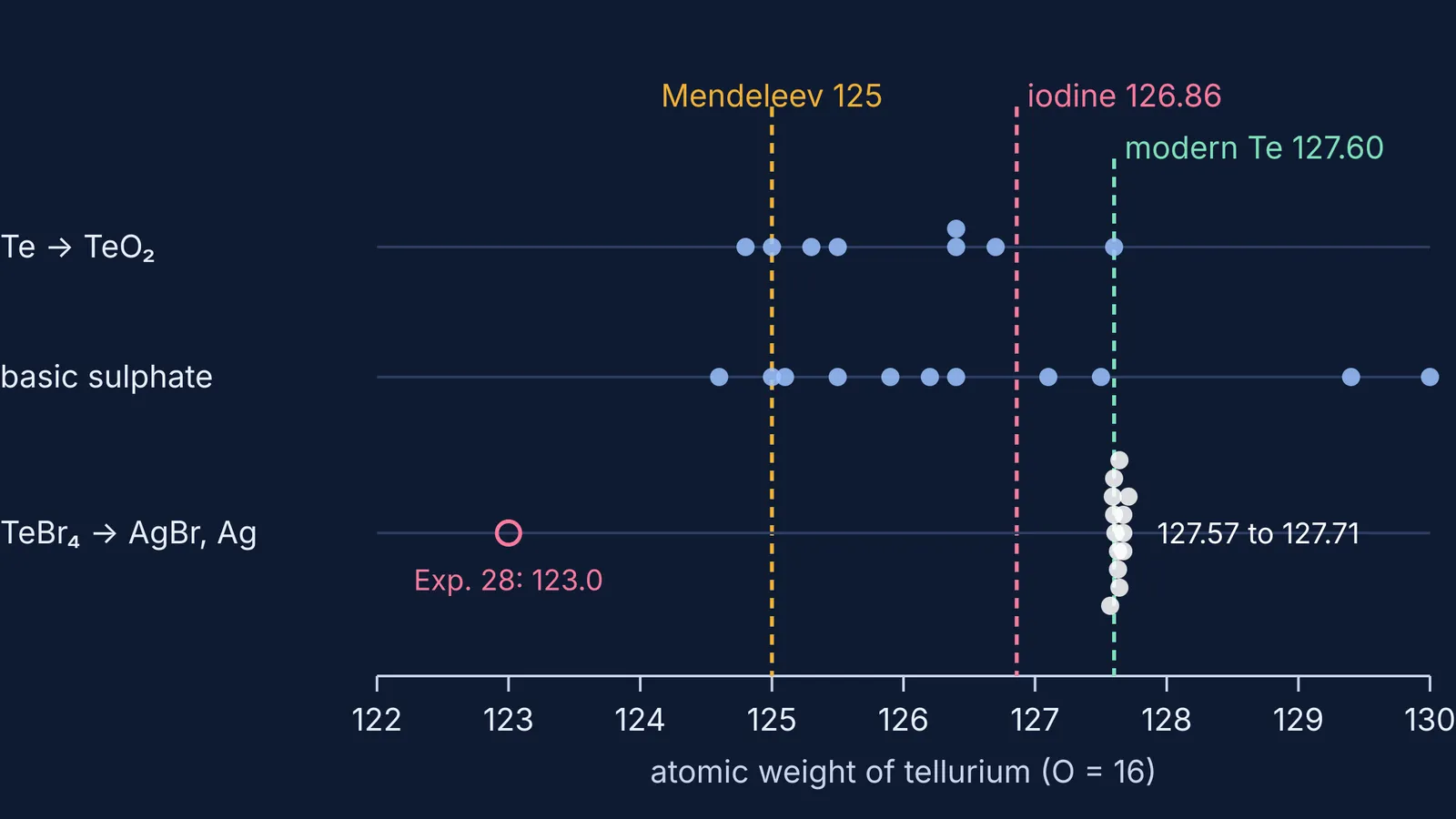
Tellurium behaves like sulphur and selenium, and iodine like chlorine and bromine, so tellurium must come first. If atomic weights rise along a row, it must also weigh less. Brauner prints Mendeleev's guess as Sb = 122, Te = 125, I = 127. With the newer values Sb = 119.96 and I = 126.86 (Stas), he expected tellurium to be "about 123·5".
The measured values said otherwise. Berzelius got 128.9 (1812 and 1818) and 128.3 (1832), and v. Hauer got 127.9 in 1857. In 1879 Wills concluded that iodine "must, therefore, precede tellurium". Brauner did not trust that. Wills's numbers spread over 3.27 units, and 21.4 per cent were below iodine.
Brauner listed 24 elements, among them Be, In, Cs and U, that once failed to fit the system. Each time "these atomic weights are at fault, and not the system". You can read how Mendeleev used that idea to predict missing elements in Mendeleev's periodic table and the gaps he left.
Which methods first gave tellurium about 125?
Brauner tried several routes. The first ones he describes are:
Oxidising weighed tellurium to the dioxide, TeO₂, and weighing it. Eight runs gave 124.8 to 127.6.
Turning the dioxide or the metal into a basic sulphate. The results ran from 124.6 to 136.4.
Heating weighed silver or copper with tellurium vapour to make Ag₂Te or Cu₂Te. These also scattered.
They sat near the expected 125, and he admits he took that value for a while, "as the author actually did for some time". But they never agreed with each other. One clue stood out. When his "tellurium dioxide" was treated with hydrochloric acid, "a white residue was always left, and this would not dissolve in the acid even on continued boiling!"
How did tellurium tetrabromide give 127.61?
Stas had found the estimation of combined bromine with silver to be "the most exact of all quantitative determinations", so Brauner turned to tellurium tetrabromide. He purified it by subliming it in a vacuum, dissolved it, and precipitated all the bromine as AgBr:
Br⁻ + Ag⁺ → AgBr
Every TeBr₄ gives four AgBr, so you only need to track bromine. Brauner worked with O = 16, Ag = 107.938 and Br = 79.963.
Worked example: Experiment 31
3.82048 g of TeBr₄ gave 6.41734 g of AgBr.
Molar mass of AgBr. 107.938 + 79.963 = 187.901 g mol⁻¹.
Moles of AgBr. 6.41734 ÷ 187.901 = 0.034153 mol. This is also the moles of Br.
Mass of bromine. 0.034153 × 79.963 = 2.73096 g. That is 71.482% of the sample, as printed.
Mass of tellurium. 3.82048 − 2.73096 = 1.08952 g.
Moles of TeBr₄. 0.034153 ÷ 4 = 0.0085382 mol. One Te per TeBr₄, so this is also the moles of Te.
Atomic mass of Te. 1.08952 ÷ 0.0085382 = 127.61.
Brauner's printed value is 127.61, "larger by 0·75 than the atomic weight of iodine!" Redo it with today's Ag = 107.868 and Br = 79.904 and the same weighings give 127.53, still well above iodine's 126.90.
He then weighed out the exact silver needed for the bromine and titrated the small excess. Across twelve such experiments, 34.59027 g of TeBr₄ needed 33.37355 g of silver. That gives 127.64, with single runs from 127.57 to 127.71. The modern value is 127.60.
Why did the dioxide method give the wrong answer?
Take his first aqua regia run. 2.3092 g of tellurium gave 2.9001 g of "TeO₂".
Oxygen gained: 2.9001 − 2.3092 = 0.5909 g.
Moles of TeO₂: 0.5909 ÷ 32 = 0.018466 mol.
Te = 2.3092 ÷ 0.018466 = 125.05.
If Te is really 127.6, that tellurium should give 2.8883 g of oxide. His product was 11.8 mg too heavy, only 0.41% of its mass, but the atomic mass came out 2.0% low. The answer depends on the small difference, the 0.59 g of oxygen, and 11.8 mg is 2% of that.
The bromide method had the same trap. In a first trial, Experiment 28, the AgBr was too heavy by 0.0552 g, which gave Te = 123.0, close to what Mendeleev wanted. Brauner traced it to a silver tellurium tartrate and to tellurium carried down with the AgBr. Only after removing both did 127.6 appear.
What did Brauner think was going on?
He listed three possible explanations and tested each one.
A bad measurement. Ruled out. Getting 123.6 instead of 127.6 would need an error "200 times as large as the largest deviation from the mean".
Oxygen in the bromide. An oxybromide would raise the result. A full analysis found 28.55% Te in TeBr₄. TeBr₄ with Te = 127.60 should contain 28.53%. There was no oxygen.
Tellurium is not one substance. He suggested it might contain a heavier, unknown element of the same group, perhaps Mendeleev's predicted "dwitellurium = 214". He tried to split tellurium by fractional sublimation and fractional precipitation. Every fraction gave the same 127.6.
Trusting both his number and the periodic law pushed him toward a hidden impurity. He noted that the bromine equivalent, 127.6 ÷ 4 = 31.9, "ought to be about = 31".
How was the tellurium–iodine puzzle finally solved?
In 1913 Moseley showed that elements line up by atomic number, the charge on the nucleus, not by atomic weight. Tellurium is 52 and iodine is 53, so tellurium comes first even though it is heavier. Ar and K, and Co and Ni, are the same kind of pair, covered in Henry Moseley and fixing the periodic table.
The reason tellurium is heavier is its isotopes. Iodine in nature is a single isotope, iodine-127. Most tellurium atoms are tellurium-128 or tellurium-130, so the average mass ends up above iodine's. Brauner was half right: tellurium is a mixture, but of isotopes, not of elements.
His silver method came from Stas, whose own silver was later questioned, as told in Theodore Richards and the impure silver behind Stas's chlorine.
For more atomic mass problems from gravimetric data, the Fermi Problem Library has a step-by-step solver that explains the reasoning. For the modern periodic law, see the Concept Library.
Quick checklist
Mendeleev's table put Te before I and expected Te to be about 125.
His oxide, sulphate and telluride results scattered near 125.
TeBr₄ → AgBr, Experiment 31: 3.82048 g gave 6.41734 g, so Br = 71.482% and Te = 127.61.
Twelve silver experiments: 127.57 to 127.71. Modern value: 127.60. Iodine: 126.90.
A small error in a mass difference becomes a large error in the atomic mass.
Atomic number (Te 52, I 53) decides the order, not atomic mass.
Tellurium is heavier because most of its atoms are tellurium-128 or tellurium-130.