

On this page
In 1869, Dmitri Mendeleev organised the known elements by their atomic weight, but his system had a few nagging flaws. For the chemistry to make sense, certain heavier elements had to be placed before lighter ones. For decades, the "atomic number" of an element was just its place in the queue, with no proven physical meaning. In 1913, an English physicist named Henry Moseley changed that. He gave the atomic number its modern definition and cemented the structure of the periodic table we use today.
How did Henry Moseley measure atomic number?
Moseley built a vacuum tube to fire high-energy electrons at targets made of different metals. He systematically measured the characteristic X-rays emitted by a range of elements, from aluminium to gold. To separate the X-rays by their wavelengths, he used the newly discovered technique of X-ray diffraction, reflecting the rays off the regular spacing of atoms in a crystal.
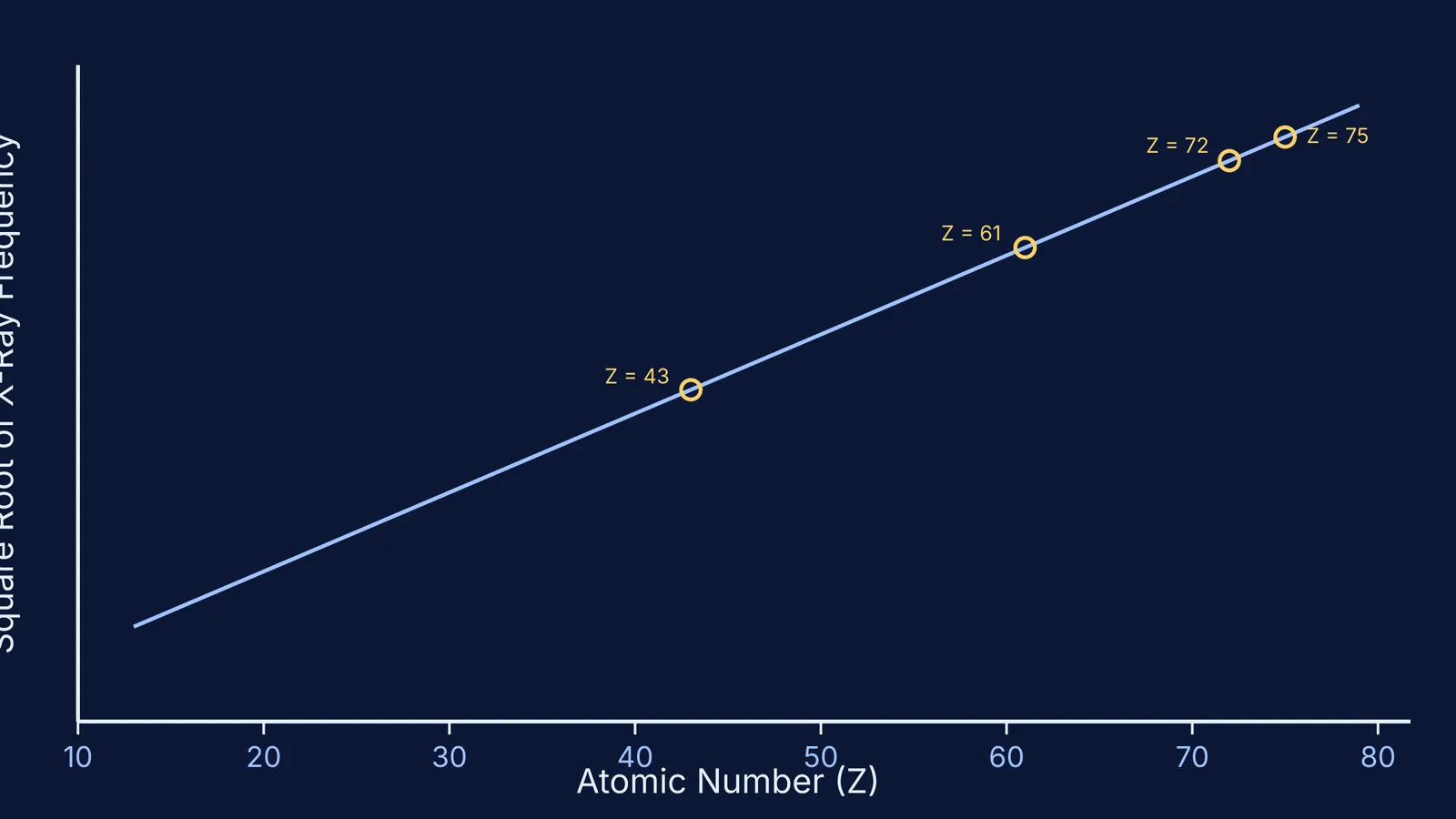
When he plotted his results, he found a clear mathematical pattern. The square root of the emitted X-ray frequency was directly proportional to the element's atomic number. This finding proved that the atomic number was not an arbitrary sequence, but a fundamental physical property: the total positive charge of the atomic nucleus, which we now know as the number of protons. Niels Bohr later remarked that this was the turning point in science's acceptance of the nuclear atom, and Robert Millikan called it one of the most brilliant conceptions in history.
What is Moseley's law?
Moseley's discovery was formalised into what is now called Moseley's law. In plain text, it states that the square root of the X-ray frequency (√ν) equals a constant multiplied by the atomic number minus a screening constant (Z − b).
For the most intense X-rays, known as the K-alpha line, this screening constant is approximately 1. Because this relationship produces a straight line when graphed, it became incredibly easy to see if an element was missing or out of place. It also provided strong experimental support for the Bohr model of the atom, which relied on a central nucleus with a specific positive charge surrounded by electrons in defined orbits.
How did Moseley fix the periodic table?
Moseley's X-ray data immediately resolved the anomalies in Mendeleev's table. Instead of guessing based on chemical behaviour, chemists now had an objective physical measurement to sort the elements.
Pair reversals: Cobalt has a slightly higher atomic weight than nickel, but Moseley showed that cobalt (Z=27) correctly precedes nickel (Z=28) based on its nuclear charge. He proved the same reversal for argon (Z=18) and potassium (Z=19).
Missing elements: The straight-line graph had obvious gaps where an atomic number was skipped. Moseley predicted the existence of four missing elements at atomic numbers 43, 61, 72 and 75. These were later discovered and named technetium, promethium, hafnium and rhenium.
The rare earths: He also determined that the lanthanide series must contain exactly 15 members, clearing up decades of confusion about how many rare earth metals existed and where they fit in the table.
How to learn the periodic table for exams?
Moseley's work is a cornerstone of modern chemistry and atomic physics. Understanding why the table is ordered by atomic number makes it much easier to predict how elements will behave and interact in chemical reactions.
To master the modern periodic table and its trends, you can explore the Fermi Concept Library, which breaks down atomic radius, ionisation enthalpy and electronegativity with their physical causes. If you get stuck on the mathematics of atomic structure or X-ray spectra, you can use the Fermi Problem Library, which features a step-by-step solver that explains the reasoning rather than printing an answer.
For more on the history of atomic physics and the periodic table, read about Charles Barkla and the characteristic X-rays of elements or Lothar Meyer and the atomic volume curve of the elements.


