On this page
On 20 June 1872 William Crookes read a long paper to the Royal Society, "Researches on the Atomic Weight of Thallium". It was printed in Philosophical Transactions, volume 163, pages 277 to 330 (DOI), and the scan is free on the Internet Archive. The whole paper is about one number, 203.642, and to get it Crookes weighed everything as if there were no air in the room. All quotations are from that paper. His discharge-tube work is in William Crookes and the glowing tubes that revealed cathode rays, so here we stay with thallium.
Why did Crookes spend eight years on one atomic weight?
He calls the work "experiments which have engrossed much of my spare time during the last eight years". The reason was thallium's size. For a metal "that stands so high in the scale as thallium", he wrote, small errors "are magnified to serious proportions". Most of the mass of a thallium compound is thallium, so a tiny weighing error lands almost entirely on the unknown.
His model was the Belgian chemist Jean Stas, whose memoirs he called "the most noteworthy chemical memoirs that have ever been written". How even Stas was later caught out by impure silver is told in Theodore Richards and the impure silver behind Stas's chlorine.
How did Crookes turn thallium into its nitrate?
He chose synthesis over analysis: "a weighed quantity of the metal itself is taken and converted into one of its salts". The steps were:
Seal pure thallium in evacuated glass, melt it and run the clean metal away from its oxide. Weigh glass and metal.
Dissolve the metal in pure nitric acid and evaporate the excess acid under reduced pressure.
Melt the dry nitrate (he gives 394 °F) and weigh again, repeating until "the weights are constant".
Wash out the nitrate and weigh the empty glass.
With concentrated acid the main reaction can be written Tl + 2HNO₃ → TlNO₃ + NO₂ + H₂O. Check: 1 Tl, 2 H, 2 N and 6 O on each side. A footnote adds a warning. Too much hot acid formed a little "pernitrate of thallium", which left "a brown powder of peroxide of thallium". In modern terms that is a trace of thallium(III). He added oxalic acid to destroy it, so the product stayed pure thallium(I) nitrate.
He used 183.79 to 497.97 grains of metal per run, when "in ordinary analysis chemists are satisfied to take 5 or 10 grains". A grain is 64.80 mg, but you never need to convert, because only the ratio of two masses matters.
His richest source was the flue dust of pyrites burners in sulphuric acid works. Thallium and its salts are highly toxic, so treat all this as history, not a method.
How do you find an atomic mass from two weighings?
Crookes worked one run, Determination E, through in full. These are his vacuum weights.
Thallium taken: 183.790232 grains.
Thallium nitrate formed: 239.646066 grains.
Mass of NO₃ gained: 239.646066 − 183.790232 = 55.855834 grains.
Mole ratio: in TlNO₃, one Tl goes with one NO₃. So Tl ÷ NO₃ = 183.790232 ÷ 55.855834 = 3.29044.
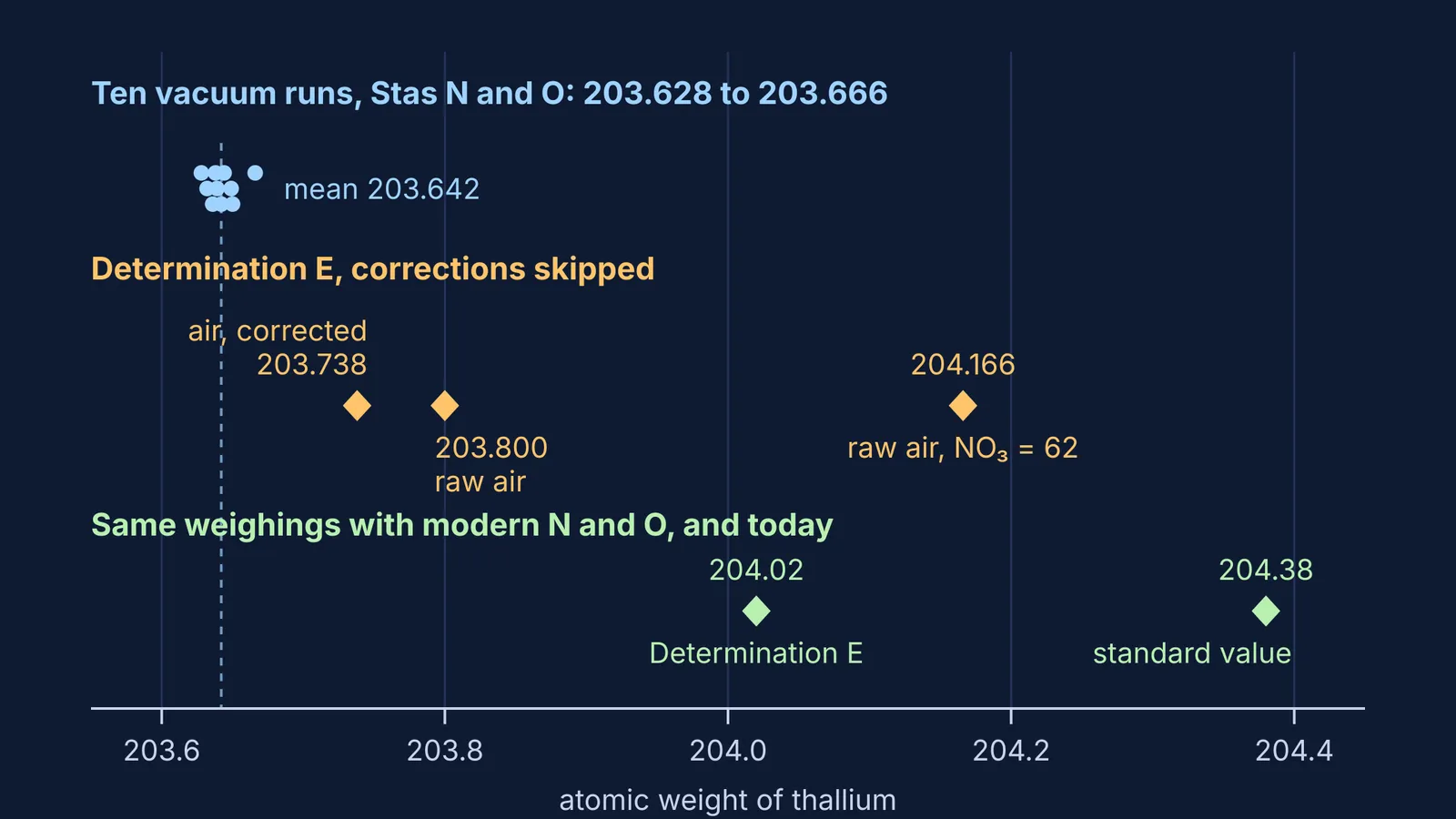
Crookes's answer: he used Stas's N = 14.009 and O = 15.960, so NO₃ = 61.889. Then Tl = 3.29044 × 61.889 = 203.642.
With today's values: N = 14.007 and O = 15.999 give NO₃ = 62.004, and Tl = 3.29044 × 62.004 = 204.02.
Step 5 reproduces eight of his ten printed rows to within 0.001. Rows E and H do not: the table's glass-plus-nitrate figure for E repeats an intermediate number from his text, and H recomputes to 203.825, not 203.650. The page scan prints them that way, so quote his results for those two.
How much did air change the answer?
Crookes used a second balance inside an iron case connected to an air pump. He weighed each object once in ordinary air and once in thin air, then calculated its weight in a vacuum. His air balance would "clearly indicate a difference of 0·0001 of a grain when loaded with 1000 grains in each pan", which is one part in ten million.
Air pushes up on everything you weigh, more on bulky objects than on compact metal weights. For Determination E:
The thallium gained 0.006311 grain when corrected to vacuum.
The nitrate gained 0.034707 grain, more than five times as much, because it is heavier and far less dense than the metal.
That difference goes straight into the NO₃ mass. His own results for the same run, with each shortcut taken:
Vacuum weights with NO₃ = 61.889: 203.642.
His corrected weighings in ordinary air: 203.738.
Raw air weights: 203.800.
Raw air weights with the old NO₃ = 62: 204.166.
His ten vacuum runs all lie between 203.628 and 203.666, a spread of 0.038. Skipping the vacuum correction alone moves the answer by 0.096, two and a half times that spread. Of the last line he wrote: "The error of the last deduction, +·524, is sufficiently large to show the necessity of neglecting no precaution in chemical manipulation." That is 0.26 per cent.
His simpler example: glass and water reading 1000 grains displace 1.9736 grains of air, the 1000-grain brass weight only 0.1462 grain. The true mass is 1001.8274 grains, 0.18 per cent above the reading.
For more atomic mass problems from weighing data, the Fermi Problem Library has a step-by-step solver that explains the reasoning.
What does a 1 : 1 nitrate say about thallium's valency?
Read the same weighings as Tl(NO₃)₃ and thallium comes out at 3 × 204.02 = 612. That is impossible next to lead and mercury, so the nitrate is TlNO₃.
His second method, finding how much barium nitrate precipitates the sulphate from thallium sulphate, fits too: Tl₂SO₄ + Ba(NO₃)₂ → BaSO₄ + 2TlNO₃. Check: 2 Tl, 1 S, 1 Ba, 2 N and 10 O on each side. In the occurrence section he calls the same salt "sulphate of the protoxide of thallium".
This is the inert pair effect in a weighing. Aluminium and gallium are +3 in their nitrates. Thallium, at the foot of group 13, is +1, and its +3 compounds are strong oxidising agents. For the reasons, read the inert pair effect: why heavy p-block elements prefer lower states.
How close was 203.642 to the modern value?
Today's standard atomic weight of thallium is 204.38. Recomputed with modern N and O, Determination E gives 204.02, about 0.18 per cent low. The paper does not explain that gap, so we will not guess a cause.
What he did conclude was about Prout's idea that atomic weights are whole multiples of hydrogen's: "the number 203·642 cannot, within the limit of what has been shown to be the probable error, by any liberty be made to follow the hypothesis."
Quick checklist
Method: weigh Tl, convert it all to TlNO₃, weigh again. The gain is NO₃.
M(Tl) = M(NO₃) × mass of Tl ÷ mass of NO₃, because the formula is 1 : 1.
Determination E: 183.790232 grains gave 239.646066 grains, so Tl = 203.642 with Stas's values and 204.02 with today's.
Correcting to vacuum moved the answer by 0.096, more than the spread of all ten runs.
TlNO₃ and Tl₂SO₄ show Tl⁺, the inert pair effect at work.