On this page
In 1892 Professor A. Crum Brown and Dr. John Gibson published a three-page paper in the Journal of the Chemical Society, Transactions (volume 61, pages 367 to 369). It asks the question you still meet in every benzene chapter: will the group already on the ring send the next group to meta, or to ortho and para? Their answer was a sorting rule that fitted every case they knew. In the same three pages they explained why a rule that always works is still not an explanation. The scan is free on the Internet Archive (DOI 10.1039/CT8926100367). Quotations below are from that paper.
What problem were Crum Brown and Gibson trying to solve?
Chemists knew that when C₆H₅X gives C₆H₄XY, the product is "either (a) exclusively, or nearly so, a meta-compound, or (b) a mixture of ortho- and para- with none or very little meta-". The choice "depends on the nature of the radicle X, and not at all, or only very slightly, on the nature of Y". NCERT calls this the directive influence of a group.
An earlier chemist, Nölting, had sorted groups into a meta class and an ortho-para class. Crum Brown and Gibson complained that "when the rule seems to fail, it is always possible to find an excuse for it". They wanted a test so sharp that "if in any case it should be found to fail, no excuse could be found for it".
For how ortho, meta and para were first told apart, see Wilhelm Körner's isomer count that fixed ortho, meta and para.
What does the Crum Brown–Gibson rule say?
Attach a hydrogen to the group X, giving HX. Then ask: can HX be turned into HOX by a single step of oxidation?
No: C₆H₅X gives ortho + para products.
Yes: C₆H₅X gives meta products.
They were strict about "one step": "no doubt H·CH₃ can be converted into HO·CH₃, but not by one step of oxidation; whereas H·CO·CH₃ can, by one step of oxidation, be converted into HO·CO·CH₃." So −CH₃ is ortho-para and −COCH₃ is meta.
Which groups did they test, and did the rule work?
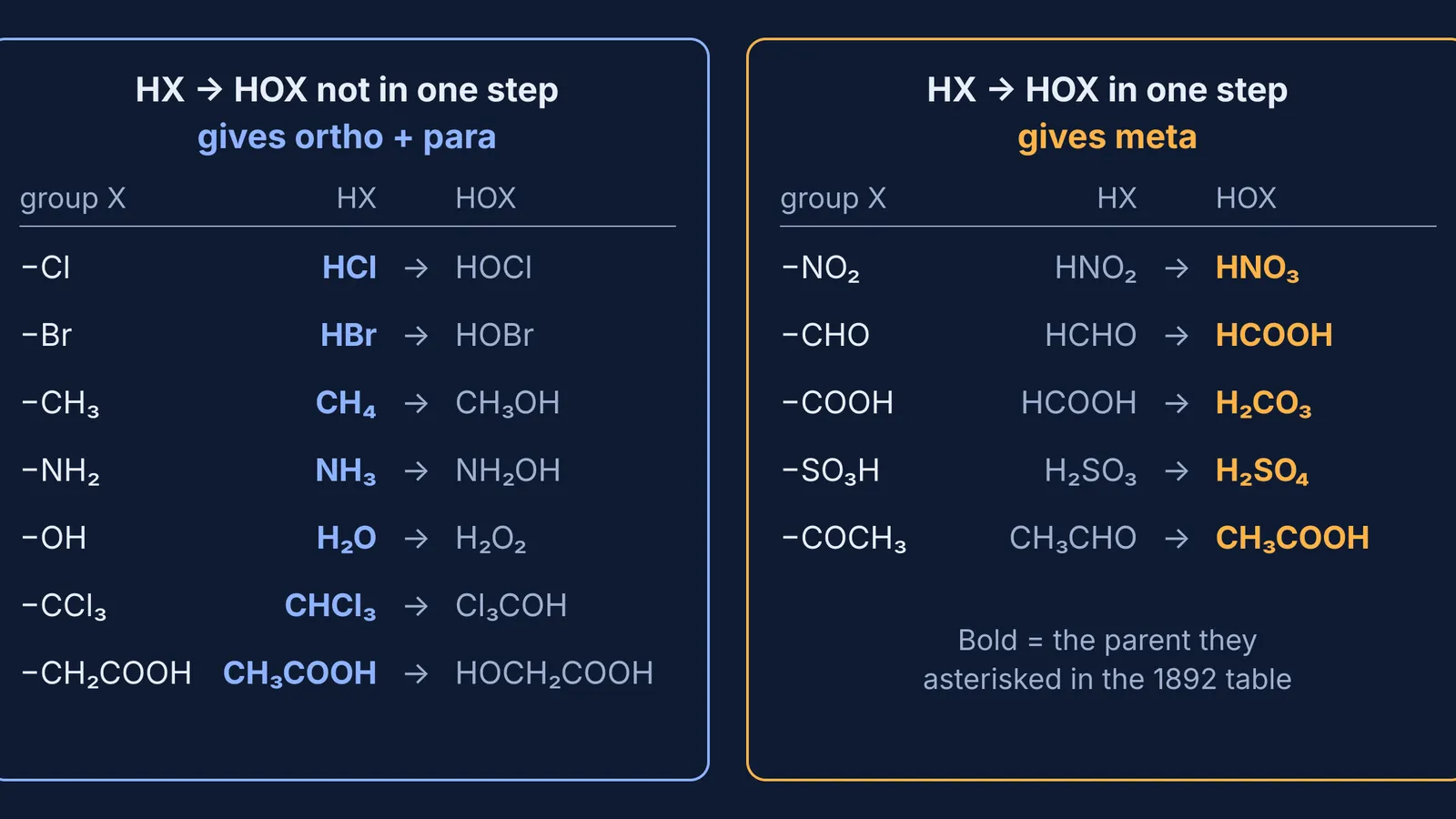
Their table on page 369 has twelve rows. We checked each against the page scan. Written as HX → HOX:
−Cl: HCl → HOCl, not one step. Ortho-para.
−Br: HBr → HOBr, not one step. Ortho-para.
−CH₃: CH₄ → CH₃OH, not one step. Ortho-para.
−NH₂: NH₃ → NH₂OH, not one step. Ortho-para.
−OH: H₂O → H₂O₂, not one step. Ortho-para.
−NO₂: HNO₂ → HNO₃, one step. Meta.
−CCl₃: CHCl₃ → Cl₃C−OH, not one step. Ortho-para.
−CHO: HCHO → HCOOH, one step. Meta.
−COOH: HCOOH → HO−CO−OH (carbonic acid), one step. Meta.
−SO₃H: H₂SO₃ → H₂SO₄, one step. Meta.
−COCH₃: CH₃CHO → CH₃COOH, one step. Meta.
−CH₂COOH: CH₃COOH → HOCH₂COOH, not one step. Ortho-para.
That is seven ortho-para groups and five meta. In row 11 the printed HOX entry repeats the HX formula, "H·CO·CH₃"; the text above the table gives HO·CO·CH₃, so it is a misprint.
Row 7 needed a defence. Nitrating C₆H₅CCl₃ can give m-nitrobenzoic acid, but "we have no means of knowing whether the conversion of ·CCl₃ into CO·OH takes place before or after" nitration. In chlorination, where the test is clean, "we obtain o and p C₆H₄Cl·CCl₃".
Why did they say their rule "is not a law"?
"The rule given above is not a law, because it has no visible relation to any mechanism by which the substitution is carried out in one way rather than in another way." If it kept working, "it must be related in some way to a law", and might help in "guiding us to the cause".
A rule that sorts data is a pattern. A law, in their sense, needs a reason tied to how the reaction happens, and in 1892 nobody could draw electrons moving around a benzene ring.
How does resonance explain the same groups today?
Today you sort groups by what the atom attached to the ring does with its electrons. The full argument with resonance structures is in ortho, para or meta? Predict the product on phenol and nitrobenzene. Applied to the 1892 list:
−OH, −NH₂: the attached atom shares a lone pair with the ring (+R). Ortho or para attack gives an arenium ion with an extra resonance form, positive charge on O or N. Activating, ortho-para.
−CH₃, −CH₂COOH: an sp³ carbon donates weakly by +I and hyperconjugation. Ortho-para. The CH₂ keeps the COOH away from the ring.
−Cl, −Br: −I slows the ring, but +R still favours ortho and para. See why chlorine is deactivating but ortho-para directing.
−NO₂, −CHO, −COOH, −SO₃H, −COCH₃: the attached atom is in a polar multiple bond to oxygen (−I, −R). Ortho or para attack would put positive charge on the carbon carrying the group, so meta wins. Deactivating.
Why did the old rule work so often? Its meta groups are the ones whose attached atom is already bonded to oxygen at a higher oxidation level. Oxidation state was standing in for electron withdrawal. For −CCl₃ we follow the paper and give no modern verdict, because we did not check modern data for it.
Worked example: does the rule survive four groups they did not list?
These four cases are our own working, not from the paper.
−OCH₃. HX = CH₃OH, HOX = CH₃O−OH. Methanol is oxidised at carbon (to HCHO), not to a hydroperoxide. Not one step, so ortho-para. Modern view: O lone pair, +R, ortho-para. Rule works.
−CN. HX = HCN, HOX = HOCN (cyanic acid). Cyanide goes to cyanate in one step, for example with hypochlorite in alkali: CN⁻ + OCl⁻ → OCN⁻ + Cl⁻ (atoms and charge balance). So meta. Modern view: −I and −R, meta. Rule works, but only if you know that reaction.
−N(CH₃)₃⁺. HX = H−N(CH₃)₃⁺, HOX = HO−N(CH₃)₃⁺, the protonated N-oxide. Tertiary amine to N-oxide is one oxidation, so meta. Modern view: positive N, no lone pair, meta. Rule works.
−NH₃⁺ (anilinium ion). HX = NH₄⁺, HOX = NH₃OH⁺. If NH₃ → NH₂OH is not one step (row 4), neither is this. The rule says ortho-para. NCERT's amines chapter says the anilinium ion, formed when aniline is nitrated in strong acid, is meta-directing. Rule fails.
Case 4 is the failure with "no excuse" that the authors invited. Case 2 shows another weakness: the verdict depends on which oxidations you know. Resonance has neither problem.
To revise the electronic effects behind these answers, the Concept Library covers every concept in chemistry, one at a time.
If you are practising this for JEE, Fermi Test Prep is JEE Main and Advanced preparation with an AI tutor.
Quick checklist
If HX → HOX is one oxidation step, X is meta-directing; if not, ortho-para.
Twelve rows: seven ortho-para, five meta.
They called it "not a law" because it had no link to a mechanism.
Modern reason: lone-pair donors and alkyl groups go ortho-para; positive or partially positive attached atoms go meta; halogens deactivate but go ortho-para.
−NH₃⁺ breaks the rule; charge and resonance get it right.