

On this page
Chlorine is the odd one out in the substituent table, which is why NCERT sets it as a worked example in the Class 12 chemistry book. Most groups that slow a benzene ring down also push new groups to meta. Chlorine slows the ring yet sends new groups to ortho and para. Two separate effects answer two separate questions.
Why is chlorine deactivating if it has lone pairs?
Chlorine is more electronegative than carbon, so the C–Cl bond pulls electron density out of the ring through the sigma bonds. This is the -I (negative inductive) effect. Electrophilic substitution passes through a positively charged intermediate, the arenium ion, and draining electrons from the ring makes that cation harder to form.
The NCERT Class 12 chemistry textbook, Unit 6 Haloalkanes and Haloarenes answers this in Example 6.9: through its inductive effect chlorine destabilises the intermediate carbocation, and because the inductive effect is stronger than resonance, the net result is deactivation. OpenStax Organic Chemistry, section 16.4 agrees: halogens are deactivating because their stronger electron-withdrawing inductive effect outweighs their weaker electron-donating resonance effect.
Why is chlorine ortho-para directing, then?
Direction is decided by comparing the intermediates formed when the electrophile attacks each position. Draw the arenium ion for each case:
Ortho attack: one resonance structure puts the positive charge on C1, the carbon carrying chlorine. Chlorine's lone pair can share that charge.
Para attack: the same thing happens. Again one structure has the charge on C1, next to chlorine's lone pair.
Meta attack: the charge lands on C2, C4 and C6, never on C1. Chlorine's lone pair cannot reach it, so the meta intermediate pays the -I penalty and gets no resonance help.
OpenStax notes that the weak resonance donation is felt only at the ortho and para positions, not at meta, so the meta intermediate forms more slowly. Ortho and para are not fast; they are simply less slow. NCERT's closing line in Example 6.9 is worth memorising: reactivity is controlled by the stronger inductive effect, and orientation is controlled by the resonance effect.
What does the real data show?
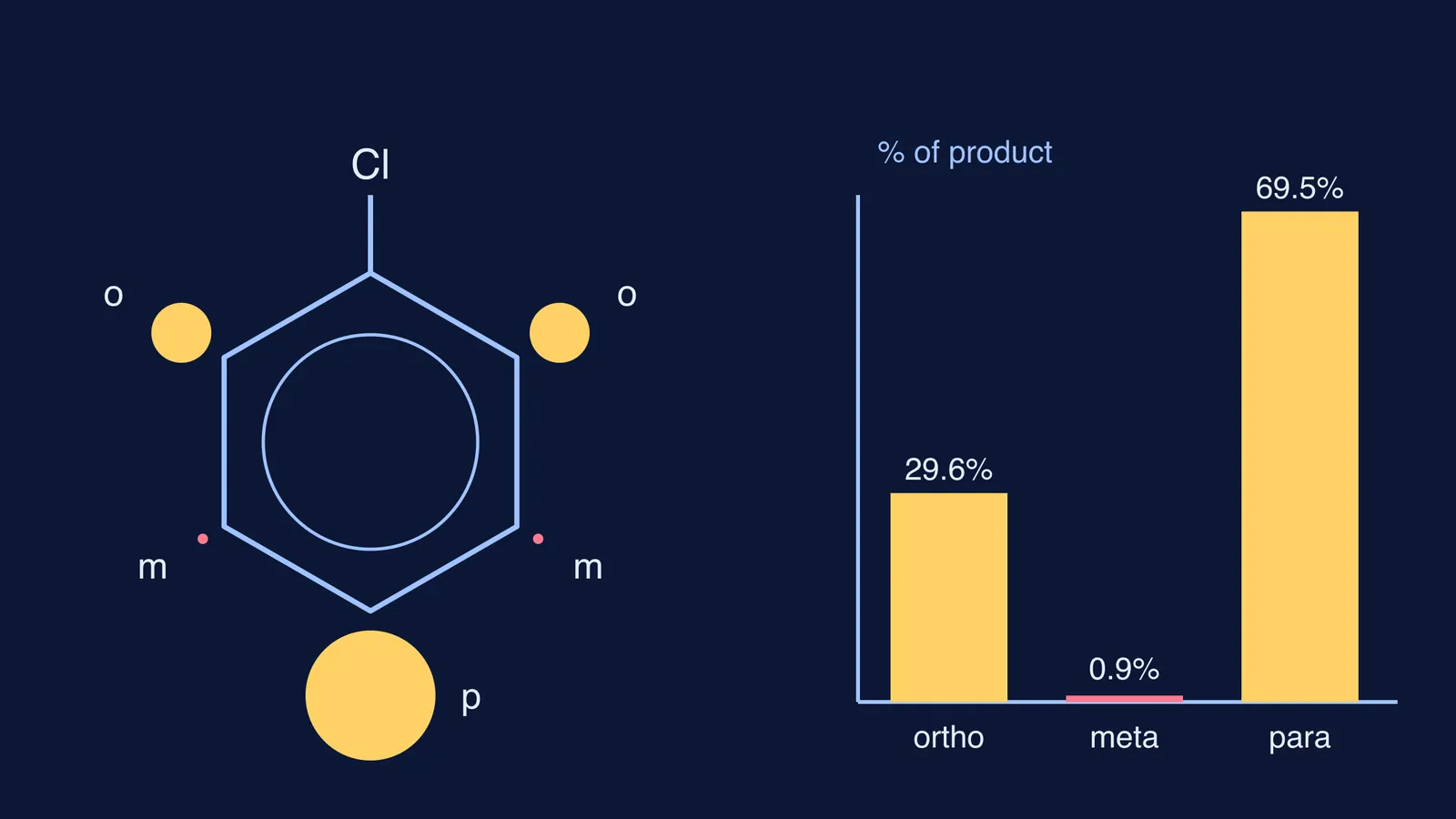
In a 1954 paper in the Journal of the American Chemical Society, John D. Roberts and colleagues nitrated chlorobenzene at 25 °C and measured 29.6% ortho, 0.9% meta and 69.5% para product (DOI 10.1021/ja01647a005). The OpenStax table for nitration with nitric and sulfuric acid at 25 °C lists 35% ortho, 1% meta and 64% para for chlorobenzene. The split shifts with conditions, but meta stays near 1% in both.
Worked example: compare one position with another. A ring has two ortho positions, two meta positions and only one para position, so divide before you compare. Using the Roberts figures above:
Each ortho position: 29.6 ÷ 2 = 14.8% of the product
Each meta position: 0.9 ÷ 2 = 0.45% of the product
The para position: 69.5% of the product
So the para carbon gives about 154 times as much product as one meta carbon (69.5 ÷ 0.45), and each ortho carbon about 33 times as much (14.8 ÷ 0.45). This compares positions within chlorobenzene only, not chlorobenzene against benzene.
Why does para beat ortho even per position? A common textbook explanation is that ortho sits beside the chlorine, where crowding and the -I pull are strongest, since the inductive effect fades with distance. Para gets the same resonance help from farther away.
How do you write this answer in an exam?
A four-step answer that covers the main points:
Cl is more electronegative than C, so its -I effect withdraws electron density and destabilises the arenium ion. The ring is deactivated.
Cl's lone pair donates by +R. This stabilises the intermediates from ortho and para attack, where the positive charge reaches C1.
In meta attack the charge never sits on C1, so there is no resonance help.
Hence -I controls the rate and +R controls the orientation: products are mainly ortho and para, with para major.
Three traps to avoid:
Do not say chlorine activates the ortho and para positions. As NCERT puts it, resonance only makes the deactivation less for ortho and para attack.
Do not lump chlorine with -NO2, which deactivates and directs meta; OpenStax notes that in nitration -NO2 makes the ring more than 10 million times less reactive than benzene.
Do not lump it with -OH, where +R wins; the same OpenStax section says -OH makes the ring 1000 times more reactive than benzene.
The same reasoning appears in conversions such as chlorobenzene to p-nitrophenol, and in questions where a substituent changes the outcome entirely, like why aniline does not undergo Friedel-Crafts reaction.
If -I and +R still feel like memorised labels, the Fermi Concept Library gives each chemistry concept its own lesson and its place in the map. To test yourself, the Fermi Problem Library has worked problems with a step-by-step solver that explains the reasoning rather than printing an answer.
Next time you see a halogen on a ring, ask two questions: how fast, and where.


