

On this page
You have just learnt that –NH2 is one of the strongest activating groups a benzene ring can carry. Then a "Give reason" question tells you that aniline does not undergo the Friedel-Crafts reaction at all. Both statements are true. The link between them is the catalyst.
Why does aniline not undergo Friedel-Crafts reaction?
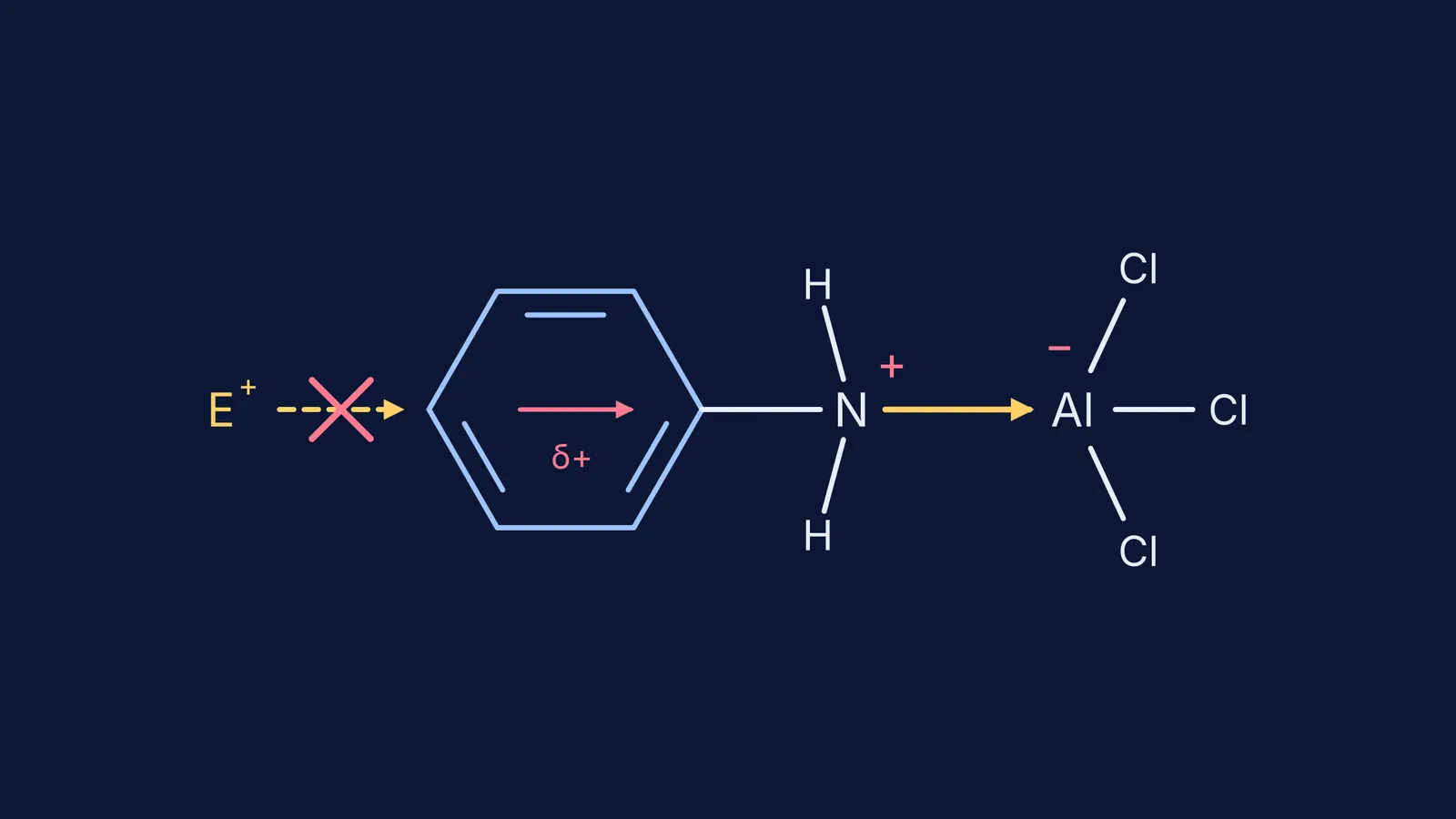
The NCERT Class 12 chemistry textbook (Unit 9, Amines) gives the reason in one sentence: aniline does not undergo Friedel-Crafts reaction (alkylation and acetylation) due to salt formation with aluminium chloride, the Lewis acid used as the catalyst. The same page adds that the nitrogen of aniline then "acquires positive charge and hence acts as a strong deactivating group for further reaction."
In plain terms, an acid-base reaction gets in the way of the substitution you wanted. Nitrogen has a lone pair to give. The aluminium in AlCl3 is short of electrons and wants one. The OpenStax *Organic Chemistry* textbook puts it this way: the amino group forms an acid–base complex with the AlCl3 catalyst, which prevents further reaction.
What happens when aniline meets AlCl3, step by step?
Nitrogen donates its lone pair to aluminium. The product is a salt-like complex, C6H5–NH2(+)–AlCl3(−).
Nitrogen now carries a formal positive charge. Its lone pair is used up in the bond to aluminium, so it can no longer push electron density into the ring.
A positive charge sitting right next to the ring pulls electron density out of it. The ring becomes electron-poor, or deactivated.
A deactivated ring will not attack the carbocation or acylium ion. OpenStax notes that Friedel-Crafts reactions don't succeed on rings carrying a strongly electron-withdrawing group or a basic amino group.
The catalyst is also tied up. AlCl3 bound to nitrogen is no longer free to help make the electrophile.
So the reaction fails for two reasons at once: the ring is switched off and the catalyst is used up.
Isn't –NH2 supposed to activate the ring?
It does, but only while the lone pair is free. NCERT explains that the ortho and para positions of aniline carry high electron density, which makes –NH2 an ortho- and para-directing, powerful activating group. That is why aniline reacts with bromine water at room temperature and gives 2,4,6-tribromoaniline.
Nitration shows what happens when the lone pair is taken away. In strongly acidic conditions, aniline is protonated to the anilinium ion, which is meta-directing. NCERT reports that direct nitration of aniline gives 51% para, 47% meta and 2% ortho nitroaniline. The large meta share is the fingerprint of a positive nitrogen next to the ring, the same thing AlCl3 creates. Sulphonation works the same way, as you can see in how sulphonation of aniline gives sulphanilic acid as a zwitterion.
How do chemists get around it?
They protect the amine first by turning it into an amide. NCERT shows aniline being acetylated with acetic anhydride to give acetanilide. In acetanilide the nitrogen lone pair is shared with the C=O group by resonance, so –NHCOCH3 activates the ring less than –NH2 does. OpenStax adds that amido groups are less basic than amino groups, so they do not tie up the Lewis acid the way –NH2 does.
OpenStax states that Friedel–Crafts alkylations and acylations of N-arylamides proceed normally. It gives an example: benzoylation of acetanilide, followed by hydrolysis, gives 4-aminobenzophenone in 80% yield. The route is protect, substitute, then remove the protecting group. Once the ring has two groups, working out where a third group goes on a disubstituted benzene becomes the next skill to learn.
How should you write this in a CBSE board or JEE Main answer?
A short "Account for" answer needs three ideas in order:
The Friedel-Crafts reaction uses anhydrous AlCl3, a Lewis acid, as the catalyst.
Aniline is a Lewis base. The lone pair on nitrogen forms a salt with AlCl3: C6H5NH2 + AlCl3 → C6H5NH2(+)–AlCl3(−).
Nitrogen gets a positive charge and becomes strongly electron-withdrawing, so the ring is deactivated and electrophilic substitution does not take place.
Check your answer against these common slips:
Writing "–NH2 is deactivating". It is activating. The complex is what deactivates the ring.
Calling AlCl3 just "the catalyst" without saying it is a Lewis acid.
Saying aniline is "too reactive". That is the problem with bromination, not with this reaction.
Drawing the complex without the + on nitrogen.
If you can recite this answer but can't yet explain why the same lone pair matters in bromination and nitration, the Fermi Concept Library gives every chemistry concept its own lesson and shows its place in the map. That way you can study amines, Lewis acids and electrophilic substitution side by side. For practice, the Fermi Problem Library has worked problems with a step-by-step solver that explains the reasoning rather than printing an answer.
Next, for an activated ring whose lone pair doesn't get tied up in the same way, read about electrophilic substitution reactions of anisole.


