

On this page
How does the sulphonation of aniline work?
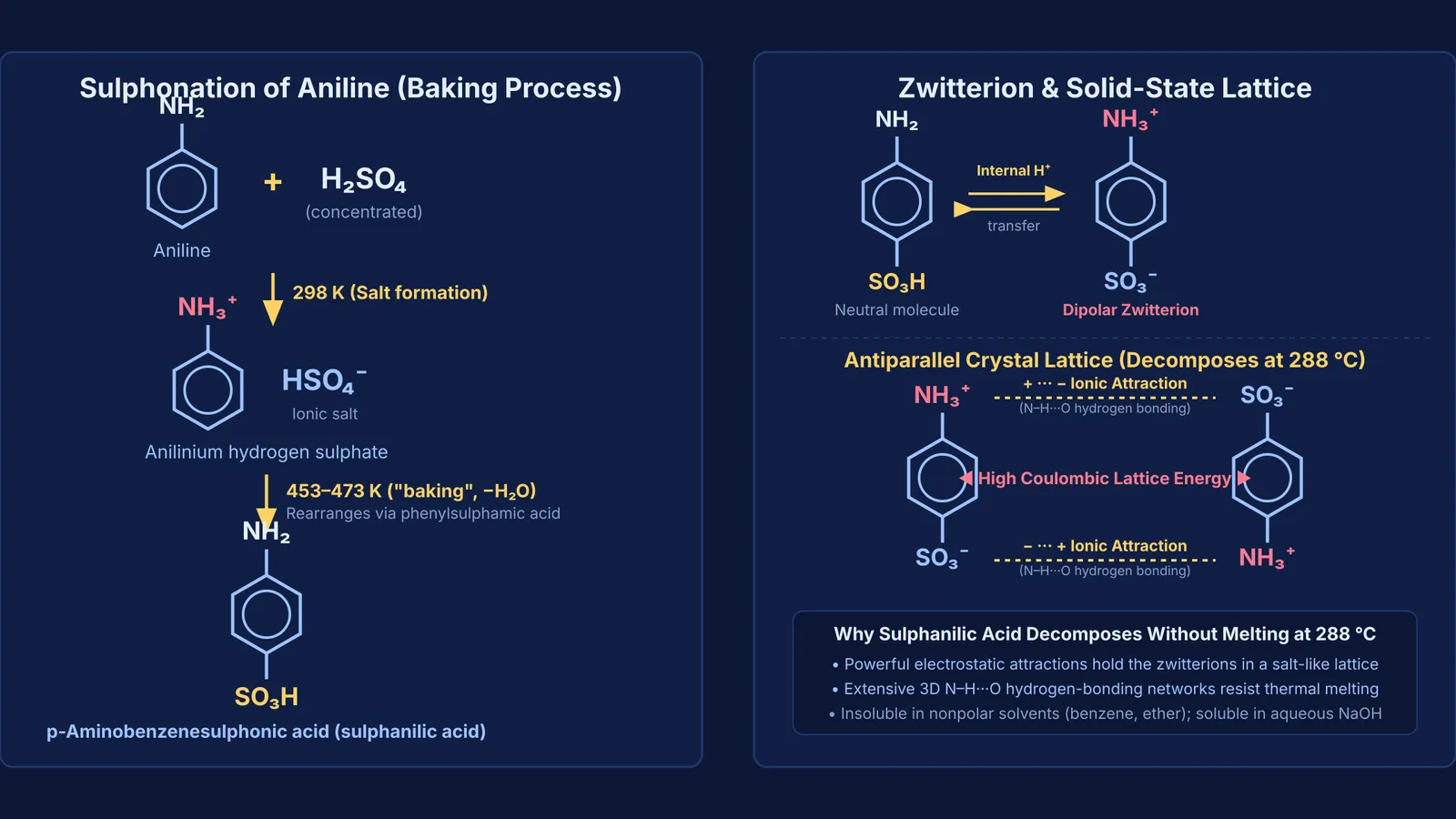
Mixing aniline with concentrated sulphuric acid at room temperature does not substitute the ring directly. Instead, an acid-base neutralization occurs immediately: aniline's basic amino group accepts a proton to form anilinium hydrogen sulphate (C₆H₅NH₃⁺ HSO₄⁻).
To achieve ring substitution, the dry salt is heated at 453–473 K (180–200 °C) in an industrial process known as "baking". Under sustained heat, the salt loses water to form phenylsulphamic acid (C₆H₅NHSO₃H). Mechanistic investigations by Gabriello Illuminati in the Journal of the American Chemical Society and tracer experiments by W. J. Spillane and F. L. Scott in Tetrahedron Letters90678-6) showed that phenylsulphamic acid rearranges: the sulfonic acid group transfers to the ortho position to yield orthanilic acid and then migrates rapidly to the sterically unhindered para position.
Because the reaction operates at elevated temperatures, thermodynamic control dictates the outcome: the bulky sulfonic acid group settles at the position furthest from the amino group, forming p-aminobenzenesulphonic acid (sulphanilic acid). Unlike nitration, which requires protecting the amine with an acetyl group to prevent oxidation, sulphonation proceeds cleanly through this salt-baking route.
Why does sulphanilic acid exist as a zwitterion?
Sulphanilic acid holds both a strongly acidic sulfonic group (–SO₃H) and a basic amino group (–NH₂). Sulfonic acids are strong proton donors; according to dissociation data in the PubChem compound summary, sulphanilic acid has an aqueous pKa of 3.23. The amino group, conversely, behaves as a base.
An internal acid-base transfer takes place spontaneously. The acidic –SO₃H group loses its proton to the basic –NH₂ group on the same molecule:
⁺H₃N–C₆H₄–SO₃⁻
This dipolar species is a zwitterion. Single-crystal X-ray analysis by A. I. M. Rae and E. N. Maslen in Acta Crystallographica confirmed that solid sulphanilic acid exists entirely in this dipolar state, held in extensive networks of N–H···O hydrogen bonds.
Why is the melting point of sulphanilic acid so high?
Most substituted benzenes of comparable size are liquids or low-melting solids. Aniline is a liquid at room temperature (melting at −6 °C), and benzenesulphonic acid melts at 50–51 °C. Sulphanilic acid behaves instead like an inorganic salt: data from the PubChem compound record indicates that it decomposes without melting at 288 °C (550 °F).
This thermal stability reflects its zwitterionic lattice:
Ionic lattice energy: The crystal lattice consists of alternating positive (–NH₃⁺) and negative (–SO₃⁻) ends. Overcoming these strong Coulombic attractions requires far more thermal energy than separating neutral molecular solids.
Hydrogen-bonded networks: Each ammonium group forms multiple hydrogen bonds with neighbouring sulfonate oxygen atoms, locking molecules into a rigid network.
Solvent selectivity: Breaking this ionic lattice demands polar interactions. Sulphanilic acid is insoluble in nonpolar organic solvents such as benzene or ether and only sparingly soluble in cold water. It dissolves readily in aqueous sodium hydroxide, which deprotonates the –NH₃⁺ group to yield the soluble sodium salt (H₂N–C₆H₄–SO₃⁻ Na⁺).
Why does sulphanilic acid fail to undergo Friedel-Crafts reactions?
Entrance examination questions frequently ask whether aniline or sulphanilic acid undergoes Friedel-Crafts alkylation or acylation. Neither does.
Friedel-Crafts reactions require anhydrous aluminium chloride (AlCl₃) as a Lewis acid catalyst. When aniline or sulphanilic acid is mixed with AlCl₃, the basic amino lone pair coordinates immediately to the electron-deficient aluminium centre, generating a positive formal charge on nitrogen. As outlined in our guide on directing groups in benzene, an ammonium substituent strongly deactivates the ring purely through its inductive (−I) effect. Because nitrogen has a complete octet without empty orbitals, it cannot withdraw electrons through resonance (−M); instead, its concentrated positive charge pulls electron density through the sigma framework. This severe electron depletion prevents attack by carbocation or acylium electrophiles.
How do you solve sulphonation questions in exams?
When answering questions on aniline sulphonation and zwitterionic behavior in CBSE boards, JEE Main, or NEET, apply this checklist:
Verify reaction temperature: Mixing aniline with sulphuric acid at room temperature produces anilinium hydrogen sulphate. Sustained heating at elevated temperatures (the "baking" process) is required to obtain sulphanilic acid.
Identify the major isomer: High temperatures favor thermodynamic control, placing the bulky sulfonic group in the para position.
Write the zwitterionic formula: Represent solid sulphanilic acid as ⁺H₃N–C₆H₄–SO₃⁻ to explain why it decomposes at high temperatures without melting.
Evaluate solubility: Expect solubility in aqueous sodium hydroxide (forming sodium sulfanilate) and concentrated hydrochloric acid, but insolubility in nonpolar organic solvents.
Connect to azo dyes: Sulphanilic acid is diazotized to form a diazonium zwitterion used in diazonium salt coupling reactions to synthesize indicators like methyl orange.
When mapping how functional groups transform across organic chemistry, the Fermi Concept Library covers every concept in chemistry, each with its own lesson and its place in the map. When practicing reaction pathways, the Fermi Problem Library provides worked problems with a step-by-step solver that explains the reasoning rather than printing an answer.


