

On this page
When you add a third group to a benzene ring that already has two substituents, the ring does not just offer up random carbons for the new reaction. The incoming electrophile is steered by the electronic and physical presence of the groups already there.
The rules for predicting where a third substituent goes on a disubstituted benzene ring come down to three competing factors: reinforcing effects, the strength of the activators, and physical crowding.
When do directing effects reinforce each other?
Sometimes, the two existing substituents work perfectly together. If they both direct the incoming group to the very same carbon atoms on the ring, predicting the major product is straightforward.
For instance, consider *p*-nitrotoluene, where a methyl group and a nitro group sit opposite each other on the ring. The methyl group is an *ortho/para* director, pushing any new electrophile to the positions immediately next to it (since the *para* position is already taken). The nitro group is a *meta* director, which also points the incoming group to those exact same positions. Because the two groups reinforce each other, they act cooperatively, and the electrophile reliably attacks the spot they both agree on. You do not have to worry about competing influences here.
What happens when directing effects oppose?
Usually, the two groups will disagree on where the next substituent should go. When directing effects oppose each other, the stronger activating group wins the competition/16%3A_Chemistry_of_Benzene_-_Electrophilic_Aromatic_Substitution/16.06%3A_Trisubstituted_Benzenes_-_Additivity_of_Effects).
Activating groups push electron density into the benzene ring, making it more attractive to incoming electrophiles. The group that pushes the hardest controls the entire reaction. The general hierarchy of directing strength is:
Strong activators: Groups with lone pairs that can donate directly into the ring via resonance, such as –OH, –NH₂, and –OR.
Weak activators: Groups that donate electron density through induction or hyperconjugation, like alkyl groups (–CH₃, –CH₂CH₃).
Weak deactivators: Halogens (–Cl, –Br, –I), which withdraw electrons inductively but still direct *ortho/para* via resonance.
Strong deactivators: Groups that withdraw electron density heavily, such as –NO₂, –COOH, –CN, and –SO₃H.
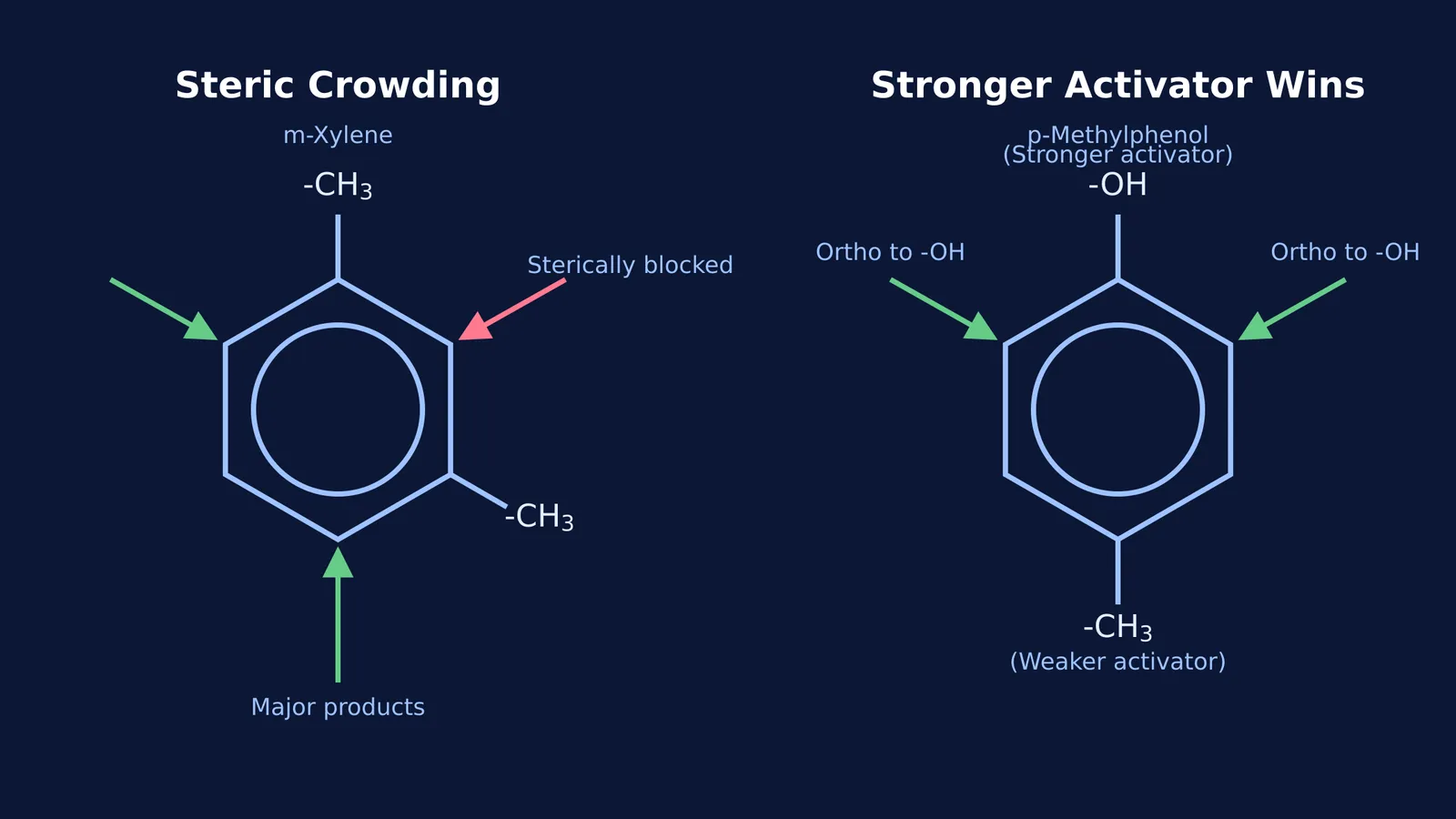
If you try to nitrate *p*-methylphenol (a ring with a –CH₃ and an –OH opposite each other), the methyl group wants to direct the incoming nitro group to its own *ortho* positions. However, the hydroxyl group wants to direct to *its* *ortho* positions. Because –OH is a much stronger activator than –CH₃, its resonance effect overwhelms the weak induction of the methyl group. The new group will attach *ortho* to the –OH. This dominance of the –OH group also explains why the bromination of phenol happens so aggressively at all its free *ortho* and *para* positions.
Why does steric crowding block the middle position?
Even if a position is electronically favoured by the activating groups, it might be physically impossible for a new molecule to reach. This spatial blocking is known as steric hindrance, and it overrides the electronic rules.
If you have a ring with two substituents separated by a single carbon atom (a 1,3-disubstituted or *meta* pattern), the carbon directly between them is technically *ortho* to both. Electronically, it might seem like a prime target. However, because atoms and functional groups take up physical three-dimensional space, the gap between the two existing groups is simply too crowded for a new electrophile to squeeze into.
Instead of fighting for space, the incoming group will attach to the less crowded positions on the outside of the ring. For example, in *m*-xylene, the position between the two methyl groups is almost never attacked, leaving the other available *ortho* and *para* positions to form the major products.
How do you predict the major product?
When you face a disubstituted benzene problem in your chemistry prep, use this sequence to find the right answer:
Find the strongest activator: Identify all the groups already on the ring and rank them. The strongest activator always dictates the preferred positions for the next attack.
Mark the targets: Draw arrows to the positions *ortho* and *para* to that strongest activator. (If your strongest group is a deactivator, mark its *meta* position).
Cross out the crowded spots: If one of your marked target positions sits directly between two existing *meta* substituents, cross it out.
Choose the most open path: The remaining position with the least steric hindrance will be your major product.
Applying these rules takes practice, especially when you have to balance them against named reaction conditions like those in the Reimer-Tiemann and Kolbe reactions of phenol. The Fermi Concept Library maps out every activating and deactivating group to help you memorise the hierarchy. If you are stuck on a specific synthesis problem, you can bring it to Fermi; the AI tutor will teach through it — drawing the ring on the board, helping you identify the stronger activator, and checking your reasoning as you predict the major product.


