

On this page
When you learn organic chemistry for JEE or NEET, the inductive effect explains why some acids are stronger than others. An electronegative atom like chlorine pulls electron density towards itself, which stabilises a negative charge and makes releasing a proton easier. But this electron pull is not infinite. It operates through the chain of sigma bonds, and each bond acts like a weak transmitter. The further away the substituent is from the reactive centre, the weaker its influence becomes.
Why does the inductive effect decrease with distance?
The inductive effect causes a permanent polarisation of bonds, but this polarisation weakens rapidly as you move away from the electron-withdrawing or electron-donating group. Because the electrons are firmly held in overlapping sigma bonds, each carbon atom in the chain resists the pull slightly. The electron cloud is not perfectly mobile, so the displacement is greatest at the bond closest to the electronegative atom.
The induced change in polarity is always less than the original polarity that caused it. This means the shift in electron density becomes significantly smaller at each successive bond down the carbon chain, acting like a chain of springs where each one absorbs some of the force.
How pKa data proves the effect fades
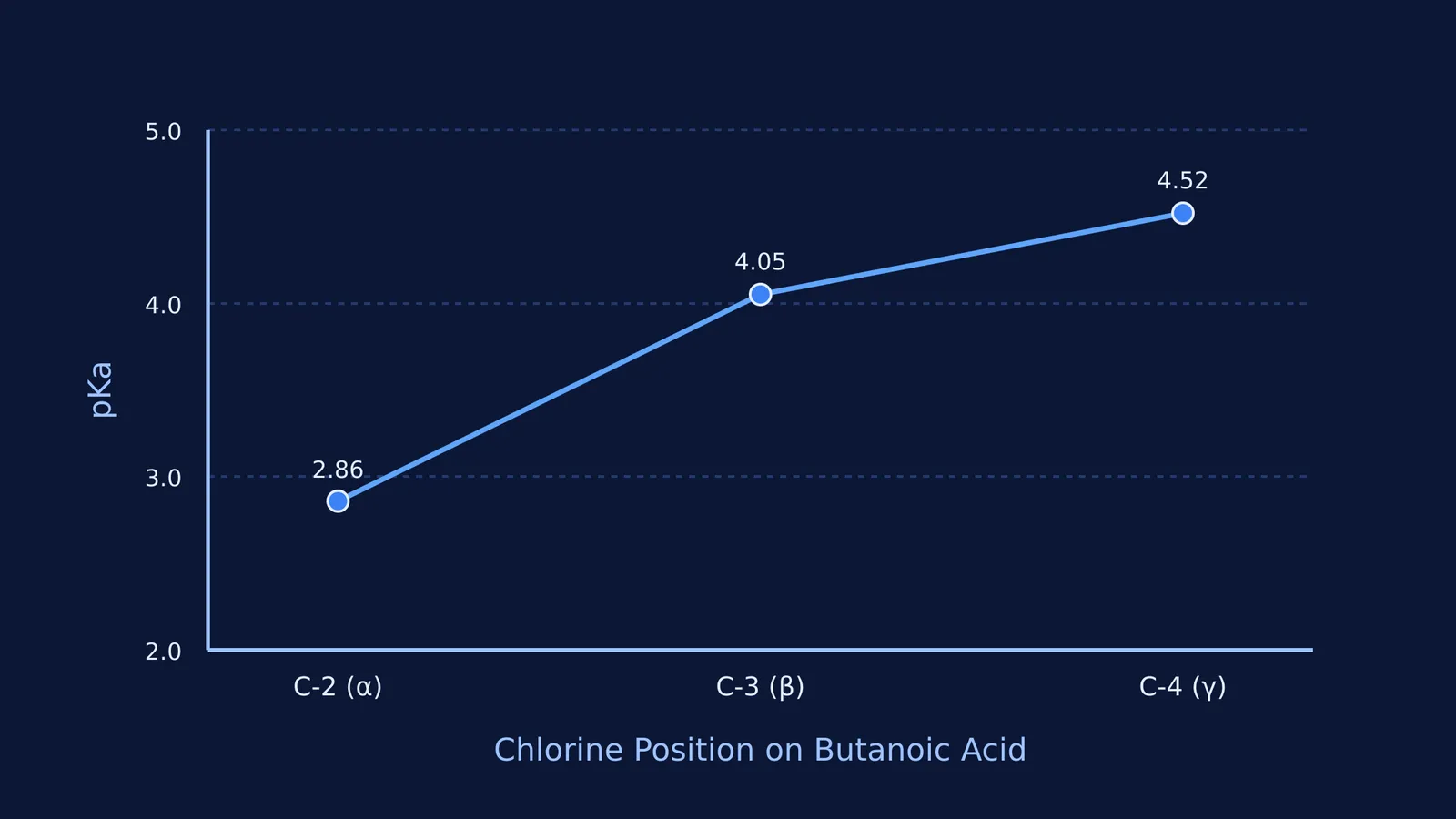
We can see exactly how fast this effect dies out by looking at the acidity of chlorobutanoic acid isomers. The pKa value measures acid strength; a lower number means a stronger acid. According to the Wikipedia entry on the inductive effect, placing the chlorine atom at different distances from the carboxyl group (–COOH) changes the acidity drastically.
2-Chlorobutanoic acid: When the chlorine is on the adjacent α-carbon, the pKa is 2.86. The strong pull heavily stabilises the carboxylate ion.
3-Chlorobutanoic acid: Moving the chlorine one carbon further away (the β-carbon) weakens the effect, raising the pKa to 4.05.
4-Chlorobutanoic acid: When the chlorine is on the γ-carbon, three bonds away, the pKa rises to 4.52.
For comparison, unsubstituted butanoic acid has a pKa of 4.82. The data clearly shows the inductive pull losing its grip on the distant carboxyl group.
Does the inductive effect stop after 3 carbons?
It does not mathematically hit zero, but for practical chemistry purposes, it becomes negligible after the third or fourth carbon atom. The pKa difference between 4-chlorobutanoic acid and butanoic acid is only 0.3 units (source). This small difference is often ignored when comparing major structural features in exam questions. If a substituent is more than three carbons away from the reactive centre, you can usually treat its inductive influence as insignificant.
If you have concept gaps on which effects matter most in a complex molecule, the Fermi Concept Library covers every concept in physics, chemistry, biology, mathematics and computing, each with its own lesson and its place in the map.
A framework for ranking acidity
When you face a question asking you to rank molecules by acidity, use this simple checklist:
Nature of the group: Is the substituent electron-withdrawing (–I) or electron-donating (+I)? A –I group increases acidity, while a +I group decreases it.
Distance: Count the number of bonds between the substituent and the acidic hydrogen. The closer the group, the stronger the effect. Distance trumps the number of groups in most cases.
Number: If distances are equal, two identical groups exert a stronger effect than one. For example, two chlorines at the same distance will pull more electron density than a single chlorine.
Power: If distance and number are equal, compare the electronegativity of the groups (e.g., fluorine has a stronger –I effect than chlorine, so a fluoro-substituted acid will be stronger than a chloro-substituted one).
If you make a mistake in applying these rules and pick the wrong order, the Fermi Problem Library has worked problems with a step-by-step solver that explains the reasoning rather than printing an answer, helping you see exactly where your logic broke down.
For more practice with molecule stability, you can review our guides on Heat of hydrogenation: ranking alkene stability with real data and the Diborane structure: banana bonds and B–H lengths explained.


