

On this page
Diborane, B₂H₆, is the boron hydride you meet in the p-block chapter, and it breaks the first rule of covalent bonding you learned: one bond is one pair of electrons shared by two atoms. Four of its hydrogens are bonded the ordinary way. The other two sit between the boron atoms, and each is held by a single electron pair spread over three atoms. So exam questions ask you to count its bonds, compare their lengths and explain how it holds together.
Why does diborane have two kinds of B–H bonds?
Start by counting electrons. Each boron brings 3 valence electrons and each hydrogen brings 1, so B₂H₆ has 2 × 3 + 6 × 1 = 12 valence electrons. Ethane, C₂H₆, has the same formula shape and uses 14 electrons for its seven ordinary bonds. Diborane is two electrons short, which is why it is traditionally called electron-deficient.
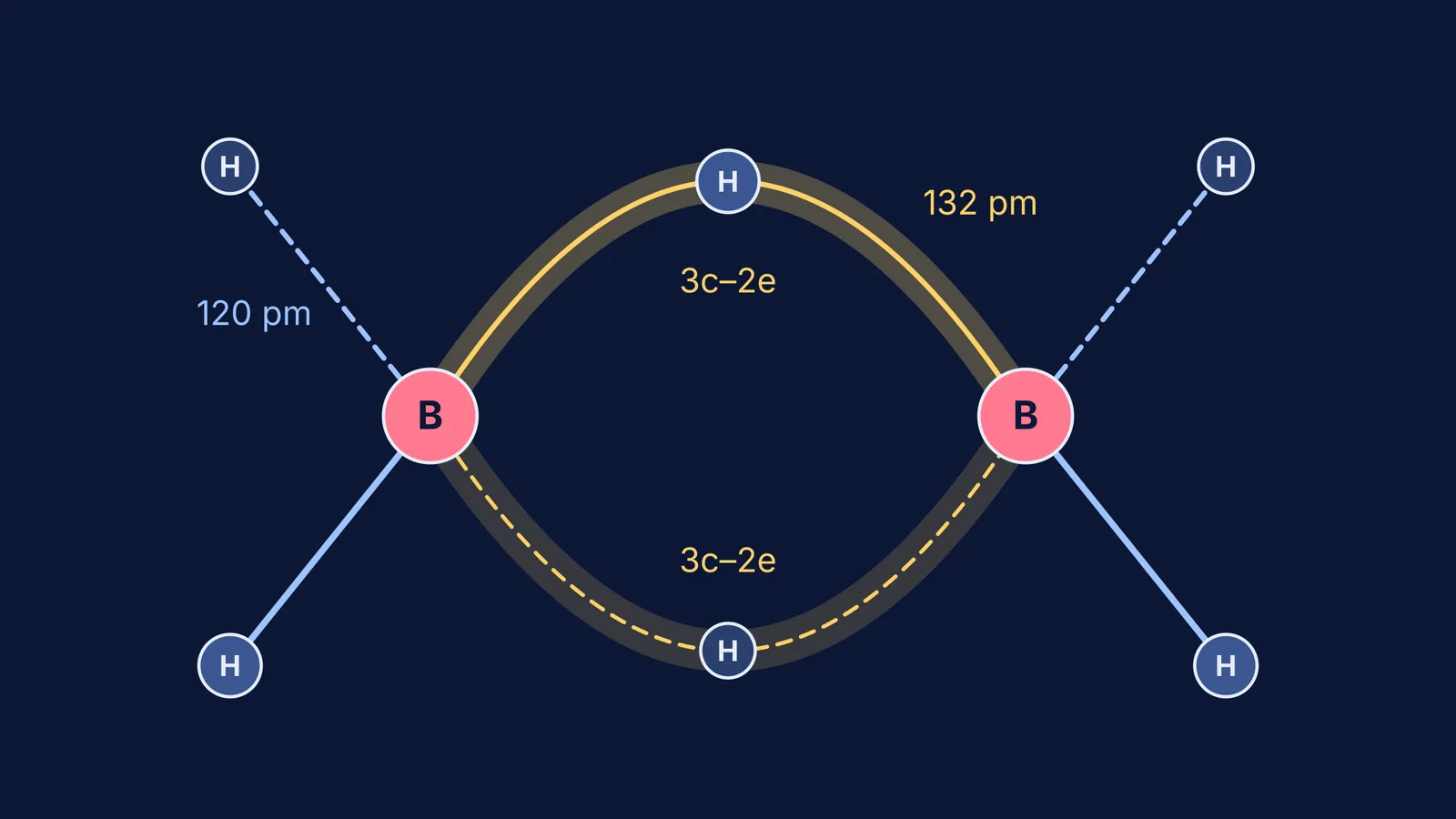
Here is how it copes. Eight electrons make four normal two-centre two-electron (2c–2e) bonds to the terminal hydrogens. The remaining four electrons form two three-centre two-electron (3c–2e) bonds, one through each bridging hydrogen, as the Wikipedia article on diborane sets out.
H. C. Longuet-Higgins and R. P. Bell explained the structure and bonding of the boron hydrides in a 1943 paper, The structure of the boron hydrides, in the Journal of the Chemical Society. William Lipscomb later received the 1976 Nobel Prize in Chemistry "for his studies on the structure of boranes illuminating problems of chemical bonding".
How does a three-centre two-electron bond form?
Picture one bridge: B, H, B. Each boron offers one orbital (in the school model, a hybrid orbital; our guide to hybridisation and orbitals covers how those form), and the hydrogen offers its 1s orbital. Three atomic orbitals combine into three molecular orbitals. Only the lowest, bonding orbital is filled, and it holds the one pair of electrons that holds all three atoms together.
Because the bond is drawn as a curve from one boron, through the hydrogen, to the other boron, it is sometimes called a banana bond, as the Wikipedia article notes. If combining orbitals is new to you, our explainer on molecular orbital theory builds it up from H₂.
One pair serving two B–H links gives each bridging link roughly half a bond. Half a bond is weaker, and weaker bonds are longer.
Which B–H bond is longer in diborane?
The bridging one. The NIST Computational Chemistry Comparison and Benchmark Database lists the experimental geometry of diborane:
Terminal B–H bond length: 1.20 Å (120 pm).
Bridging B–H bond length: 1.32 Å (132 pm).
Terminal H–B–H angle: 121°.
Bridging H–B–H angle: 96.2°, and B–H–B angle: 83.8°.
Boron-to-boron distance: 1.763 Å.
Other references round a little differently; Wikipedia gives 1.19 Å and 1.33 Å. Either way, the bridging bond is about 0.12–0.14 Å longer. Its infrared stretch is also lower, about 2100 cm⁻¹ against 2500 cm⁻¹ for terminal B–H, as a weaker bond's should be.
NIST assigns the molecule D₂h symmetry: the two borons and two bridging hydrogens lie in one plane, and the four terminal hydrogens lie in a second plane at right angles to it.
What reactions of diborane come up in exams?
The Wikipedia article on diborane lists the reactions questions usually draw on:
With water: B₂H₆ + 6H₂O → 2B(OH)₃ + 6H₂, releasing about 466 kJ per mole of diborane.
Burning in oxygen: B₂H₆ + 3O₂ → B₂O₃ + 3H₂O, releasing about 2035 kJ per mole of diborane.
With Lewis bases: it forms adducts with bases such as tetrahydrofuran and carbon monoxide, and its adduct with dimethyl sulfide is a common reagent in organic synthesis. Our post on Lewis acidity of boron trihalides explains why boron accepts electron pairs.
With ammonia: it forms the diammoniate of diborane, with a little ammonia borane as a by-product.
With alkenes: it gives trialkylboranes (hydroboration), which can then be converted to alcohols.
A worked example: answering a diborane question in four steps
Take a typical question: how many 3c–2e bonds does diborane have, and why is the bridging B–H bond longer than the terminal one?
Count valence electrons: 2 × 3 + 6 × 1 = 12.
Give each terminal hydrogen an ordinary bond: 4 bonds use 8 electrons.
Place the 4 leftover electrons in the bridges: 2 bonds, each 3c–2e.
Explain the length: one pair spread over two B–H links means about half a bond each, so the bridge is weaker and longer (1.32 Å against 1.20 Å in NIST's data).
Watch for three slips: calling the molecule planar, counting the bridges as four separate bonds, and swapping the two H–B–H angles.
If your count is right but your written reasoning loses marks, try bonding questions in the Fermi Problem Library, where the step-by-step solver explains the reasoning rather than printing an answer. To fill a gap in the background ideas, the Fermi Concept Library gives each chemistry concept its own lesson.
Next time you see B₂H₆, count to 12 first; the structure follows from that number.


