

On this page
If a question asks you to rank alkenes by stability, the cleanest evidence is how much heat each one gives out when hydrogen adds across its double bond. Less heat out means the alkene started lower in energy, so it was more stable. Below you will find the measured numbers, the three effects behind them, and a four-step method for exam questions.
What does heat of hydrogenation tell you about alkene stability?
Heat of hydrogenation is the enthalpy change when an alkene adds hydrogen to give an alkane, and the difference between two isomers' values tells you their relative stability (LibreTexts, Stability of Alkenes/07:_Alkenes-_Structure_and_Reactivity/7.07:_Stability_of_Alkenes)).
Think of two balls rolling down to the same floor. If 1-butene, cis-2-butene and trans-2-butene all become butane, the one that releases the least energy must have started lowest. That is why the comparison is strictly fair only when the alkenes give the same alkane.
The classic gas-phase measurements were published by G. B. Kistiakowsky and colleagues in the Journal of the American Chemical Society in 1935 and 1936 (Kistiakowsky et al., 1935). The NIST Chemistry WebBook lists their values, several of them as reanalysed by Cox and Pilcher in 1970, and the WebBook's listed values are the numbers used here.
How do substitution and cis-trans geometry change the numbers?
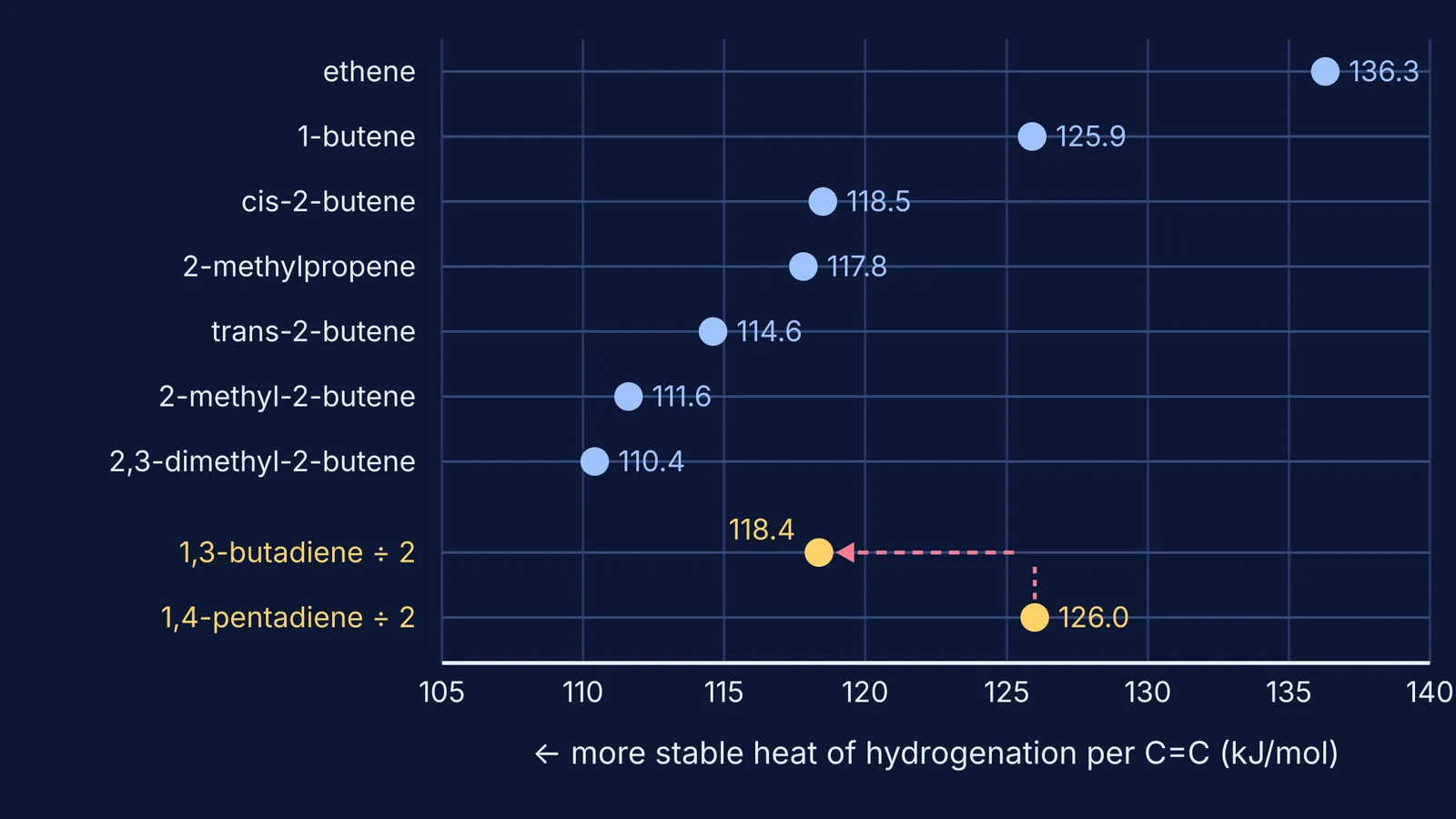
All of these reactions release heat, so ΔH is negative; the list gives the size of the heat released, in kJ/mol, from the NIST Chemistry WebBook:
Ethene: 136.3 (NIST, ethylene)
1-butene: 125.9 (NIST, 1-butene)
cis-2-butene: 118.5 (NIST, cis-2-butene)
2-methylpropene: 117.8 (NIST, isobutene)
trans-2-butene: 114.6 (NIST, trans-2-butene)
2-methyl-2-butene: 111.6 (NIST, 2-methyl-2-butene)
2,3-dimethyl-2-butene: 110.4 (NIST, 2,3-dimethyl-2-butene)
The first pattern: more alkyl groups on the double-bond carbons, less heat released. The usual explanation is hyperconjugation, a stabilising interaction between the C=C π orbital and neighbouring C–H σ bonds that grows with each extra substituent (LibreTexts, Stability of Alkenes/07:_Alkenes-_Structure_and_Reactivity/7.07:_Stability_of_Alkenes)). Our post on inductive, resonance and hyperconjugation effects uses the same idea to rank acids and bases.
The second pattern: trans beats cis. Both 2-butenes give butane, yet cis-2-butene releases 3.9 kJ/mol more than trans-2-butene. In the cis isomer the two methyl groups sit on the same side and crowd each other, which LibreTexts describes as steric strain.
Why is a conjugated diene more stable than two separate double bonds?
Take 1,4-pentadiene, whose two double bonds are separated by a CH2 group. Adding two moles of hydrogen releases 252.0 kJ/mol (NIST, 1,4-pentadiene), almost exactly twice the 125.9 kJ/mol of 1-butene (NIST, 1-butene). Isolated double bonds behave like two independent alkenes.
Now take 1,3-butadiene, where the double bonds alternate with a single bond. It releases 236.7 kJ/mol (NIST, 1,3-butadiene), which is 15.1 kJ/mol less than the 251.8 kJ/mol you would predict from two 1-butene units. That shortfall is the stabilisation from conjugation.
There are two ways to explain it. In the molecular-orbital picture, the π electrons are delocalised over all four carbons; in the valence-bond picture, the central single bond is made from sp² orbitals, which form shorter, stronger bonds than sp³ orbitals (LibreTexts, Stability of Conjugated Dienes/14:_Conjugated_Compounds_and_Ultraviolet_Spectroscopy/14.01:_Stability_of_Conjugated_Dienes-_Molecular_Orbital_Theory)).
How do you rank alkenes by stability in an exam question?
Check the products. If every alkene gives the same alkane, lower heat of hydrogenation means more stable.
Count the alkyl groups on the two double-bond carbons: tetrasubstituted beats trisubstituted, then disubstituted, then monosubstituted, then ethene.
Among disubstituted alkenes, trans is usually more stable than cis.
Look for conjugation. Alternating double bonds release less heat than the same number of isolated ones.
Worked example. Rank 1-butene, cis-2-butene and trans-2-butene by heat of hydrogenation, highest first. All three give butane, so step 1 passes. 1-butene is monosubstituted, so it releases the most. Both 2-butenes are disubstituted, and cis has the methyl clash, so it comes next. Order: 1-butene > cis-2-butene > trans-2-butene, which matches the measured 125.9, 118.5 and 114.6 kJ/mol (NIST, 1-butene; NIST, cis-2-butene; NIST, trans-2-butene). Stability runs the opposite way.
The most common slip is reversing the logic: "more heat released, so more stable". Write "less heat out, lower start, more stable" at the top of your notes. The same stability order explains why alcohol dehydration usually gives the more substituted alkene, and the energy bookkeeping is the same kind you do with Hess's law cycles.
If the four steps make sense but you still mix up the direction under time pressure, the Fermi Problem Library has worked problems with a step-by-step solver that explains the reasoning rather than printing an answer. If hyperconjugation itself feels hazy, the Fermi Concept Library gives each concept its own lesson and its place in the map.
Try the worked example again tomorrow, then use step 2 to predict whether 2-methyl-2-butene or 2,3-dimethyl-2-butene releases less heat, and check against the list above.


