

On this page
Conversions in organic chemistry often feel like a puzzle. When you are asked to convert chlorobenzene to p-nitrophenol, the order of your steps is everything. You cannot simply pull the chlorine atom off and replace it with a hydroxyl (OH) group in one go. The secret lies in adding a helper group first to change the reactivity of the molecule.
Why can't you just add hydroxide to chlorobenzene?
Halobenzenes are stubbornly unreactive towards nucleophilic substitution. In chlorobenzene, the lone electron pairs on the chlorine atom interact with the pi-electron system of the benzene ring through resonance. This interaction gives the carbon-chlorine bond a partial double-bond character. It becomes much stronger and shorter than a standard single bond, holding the chlorine atom tightly to the ring.
Because of this stability, directly replacing the chlorine atom with an OH group requires extreme industrial conditions. In the classic Dow process, this direct conversion needs aqueous sodium hydroxide, a blistering temperature of 623 K, and a crushing pressure of 300 atm (Source). This resonance stability explains Why Chlorobenzene Cannot Be Made from Phenol and HCl under standard conditions, and why going the other way is equally difficult.
To make this conversion work in a normal school or university laboratory setup, we cannot rely on raw heat and pressure. We have to activate the ring chemically first.
How do you nitrate chlorobenzene?
The solution is to add a functional group that pulls electron density away from the ring, making the carbon attached to the chlorine more susceptible to attack. We do this through an electrophilic aromatic substitution reaction.
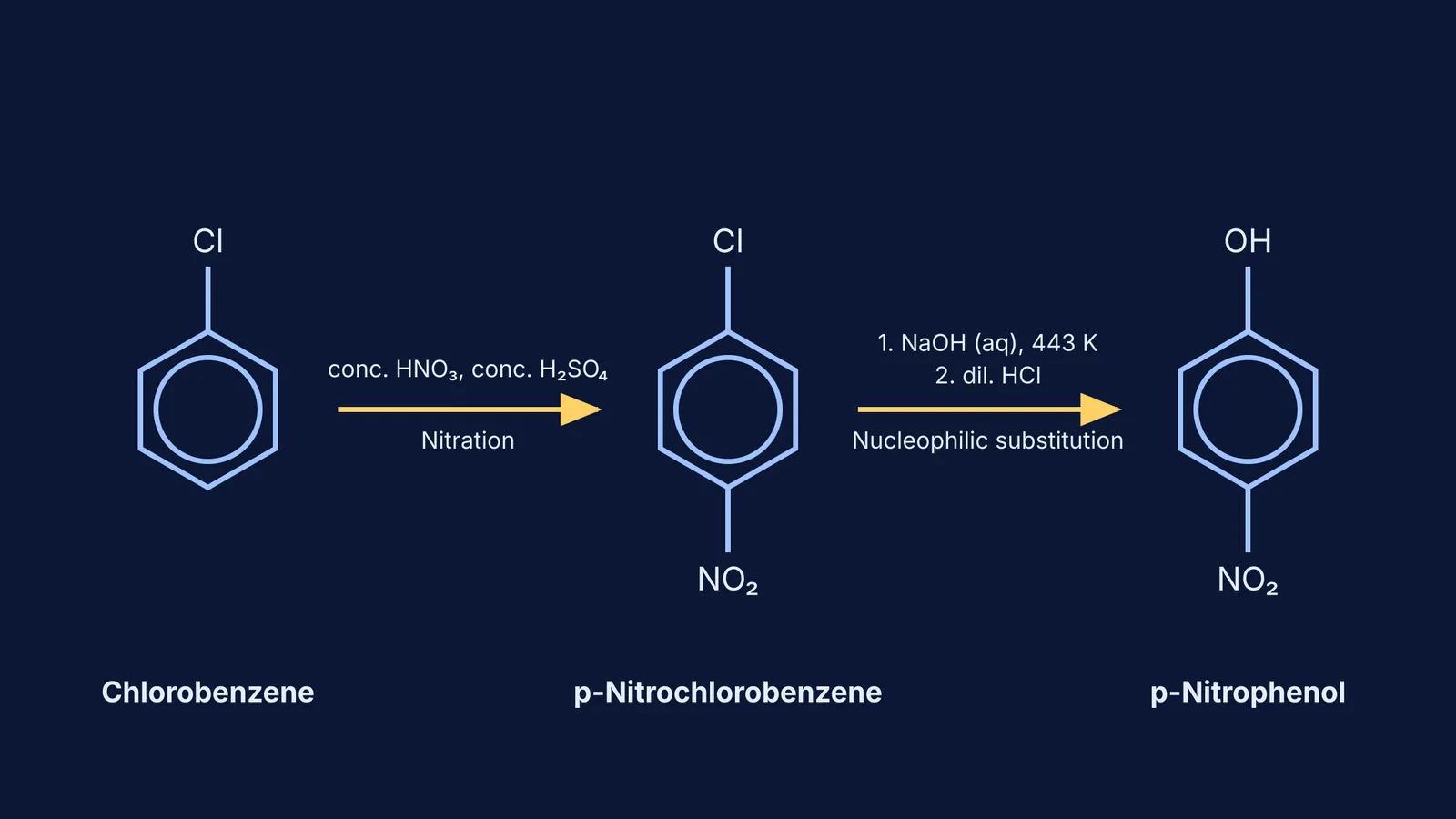
When you treat chlorobenzene with a nitrating mixture—a blend of concentrated nitric acid (HNO₃) and concentrated sulfuric acid (H₂SO₄)—a nitro (NO₂) group attaches to the ring. In this reaction, sulfuric acid acts as a catalyst to generate the highly reactive nitronium ion (NO₂⁺).
The chlorine atom already on the ring is an ortho/para directing group. This means the incoming nitro group will attach to either the position right next to the chlorine (ortho) or exactly opposite it (para). Because the chlorine atom is relatively large, it creates steric hindrance at the ortho position. As a result, the major product of this reaction is p-nitrochlorobenzene. You can separate the minor ortho product from the major para product using fractional distillation. A similar directing effect is seen during phenol nitration for making nitrophenols and picric acid.
If you are unsure why certain groups direct incoming electrophiles to specific positions, the Fermi Concept Library breaks down the inductive and resonance effects visually.
How does the nitro group help replace chlorine?
With the nitro group now sitting securely at the para position, the chemistry of the molecule changes entirely. The NO₂ group is strongly electron-withdrawing. It acts like an electron sink, pulling electron density out of the aromatic ring.
When a hydroxide ion (OH⁻) from the sodium hydroxide attacks the carbon holding the chlorine, it forms a negatively charged intermediate known as the Meisenheimer complex. The electron-withdrawing nitro group stabilizes this negative charge through resonance. Because the intermediate is more stable, the activation energy for the reaction drops significantly.
The ring is now "activated" towards nucleophilic substitution, and the stubborn chlorine atom is much easier to dislodge. Instead of needing 623 K and 300 atm, you can heat the p-nitrochlorobenzene with aqueous sodium hydroxide at a much milder 443 K (Source).
This heating step replaces the chlorine, but it does not immediately yield p-nitrophenol. Because the reaction occurs in a basic medium, the acidic phenol instantly reacts to produce the sodium salt of p-nitrophenol. Finally, a simple acidification step using dilute hydrochloric acid (H⁺) is required to protonate the salt, yielding your final product: p-nitrophenol. You can review the general conditions for these types of reactions in our substitution or elimination decision chart.
When practicing organic conversions, if you get stuck on why a mechanism requires a specific temperature or reagent, Fermi's AI tutor can work out what you already know and build a plan for the session, so you sit down to a clear next step instead of staring at a blank page.


