

On this page
Why does dilute nitric acid yield two mononitrophenols?
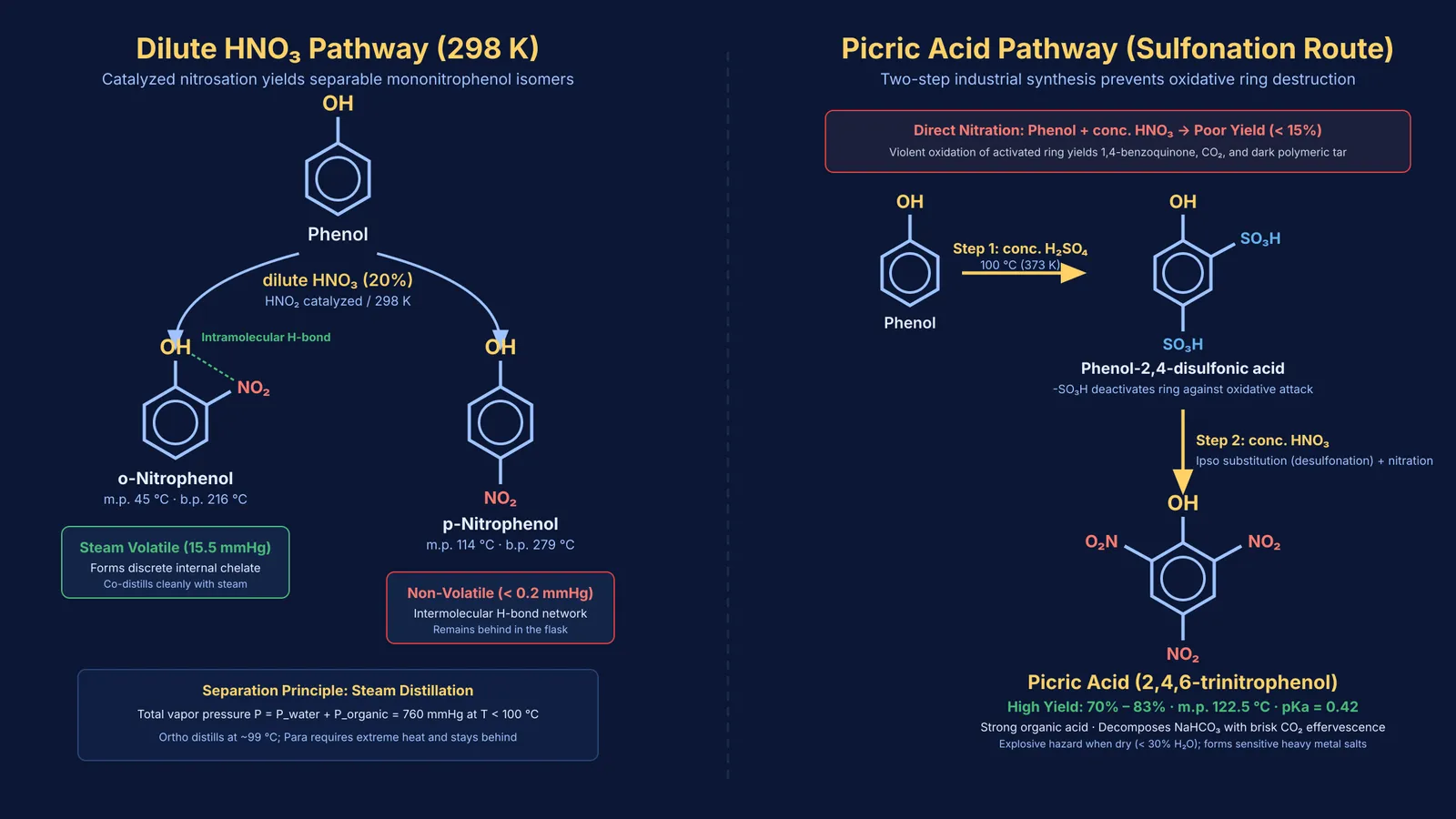
Phenol undergoes electrophilic aromatic substitution much faster than benzene because its hydroxyl (-OH) group strongly activates the ring through resonance (+M effect), directing incoming electrophiles to the ortho and para positions. As detailed in the Journal of the Chemical Society, while benzene requires concentrated nitric and sulfuric acids to generate nitronium ions (NO₂⁺), phenol reacts readily with dilute nitric acid (~20% concentration) at room temperature (298 K).
In that landmark 1950 investigation, C. A. Bunton, E. D. Hughes, C. K. Ingold, and co-workers showed that dilute nitric acid nitrates phenol through a catalyzed nitrosation pathway. Trace nitrous acid in the mixture generates nitrosonium ions (NO⁺), which attack the ring to form nitrosophenols that nitric acid rapidly oxidizes to nitrophenols. At 298 K, this yields a mixture of ortho-nitrophenol (2-nitrophenol) and para-nitrophenol (4-nitrophenol). Unlike the bromination of phenol, which forms 2,4,6-tribromophenol in aqueous solution, dilute nitric acid halts at mono-substitution because the newly introduced nitro group deactivates the ring against further electrophilic attack.
How does steam distillation separate ortho- and para-nitrophenol?
Separating ortho- and para-nitrophenol is a classic laboratory procedure. Both isomers share the molecular formula C₆H₅NO₃ (139.11 g/mol), yet their physical constants diverge substantially. PubChem's 2-nitrophenol record reports a melting point of 44 °C to 45 °C and a boiling point of 216 °C. In contrast, PubChem's 4-nitrophenol record shows para-nitrophenol melts at 113 °C to 114 °C and boils at 279 °C with decomposition.
This large physical gap stems from different hydrogen bonding modes:
Ortho-nitrophenol forms a stable, planar six-membered ring via intramolecular hydrogen bonding in o-nitrophenol. This internal chelation shields the polar hydroxyl and nitro groups, preventing molecules from associating strongly with one another.
Para-nitrophenol holds its functional groups 180° apart across the aromatic ring, making internal bonding geometrically impossible. Instead, it forms extensive intermolecular hydrogen bonds, creating an associated polymeric network in the liquid and solid states.
According to vapor pressure data compiled by Daniel R. Stull in Industrial & Engineering Chemistry, ortho-nitrophenol reaches a vapor pressure of 15.5 mmHg at 100 °C. When steam passes through the mixture, the sum of the partial pressures reaches atmospheric pressure (760 mmHg) below 100 °C, enabling ortho-nitrophenol to co-distill rapidly into the receiver. In contrast, para-nitrophenol has a vapor pressure under 0.2 mmHg at 100 °C and remains behind in the distillation flask.
Why does concentrated nitric acid give a poor yield of picric acid?
Treating phenol directly with concentrated nitric acid produces a very poor yield of picric acid (2,4,6-trinitrophenol), as documented by Ruth King in the Journal of the Chemical Society, Transactions. Concentrated nitric acid acts as a powerful oxidizing agent. Because the phenolic ring is highly activated by its hydroxyl substituent, the hot acid oxidizes the aromatic nucleus into 1,4-benzoquinone, oxalic acid, carbon dioxide, and insoluble dark polymeric tars.
Direct nitration also poses severe safety hazards because the oxidation of activated aromatics is violently exothermic and generates heavy volumes of toxic nitrogen dioxide gas. A similar balance between substitution and oxidation appears in the Reimer-Tiemann and Kolbe reactions of phenol, where experimental conditions are carefully moderated to prevent ring degradation.
How do chemists synthesize picric acid efficiently?
To avoid oxidative destruction and achieve high yields (70% to 83%), synthetic investigations published in the Journal of the Chemical Society, Transactions established an indirect two-step sulfonation-nitration pathway:
Sulfonation shield: Heating phenol with concentrated sulfuric acid (H₂SO₄) at 100 °C (373 K) introduces sulfonic acid groups at the ortho and para positions, forming phenol-2,4-disulfonic acid.
Ring deactivation: The strongly electron-withdrawing sulfonic acid groups (-SO₃H) reduce the electron density of the benzene ring through -I and -M effects, shielding it from oxidative cleavage by nitric acid.
Ipso substitution: Treating the disulfonic acid intermediate with concentrated nitric acid introduces a nitro group at the remaining open ortho position (C-6) and displaces both -SO₃H groups at positions 2 and 4 via electrophilic ipso substitution (nitrolysis), cleanly yielding 2,4,6-trinitrophenol.
According to PubChem's picric acid record, picric acid melts at 122 °C to 122.5 °C and has an aqueous pKa of 0.42 at 24 °C. The three strong electron-withdrawing nitro groups stabilize the resulting phenoxide conjugate base through extensive charge delocalization across six oxygen atoms. As a result, picric acid is far more acidic than acetic acid (pKa 4.76).
What is the exam decision protocol for phenol nitration?
For competitive exam problems, use this three-step decision framework:
Reagent and pathway: Dilute HNO₃ at room temperature yields mononitrophenols (ortho and para). Direct concentrated HNO₃ results in oxidative destruction and negligible yield. Concentrated H₂SO₄ followed by concentrated HNO₃ synthesizes picric acid in high yield.
Separation method: Separate the mononitrophenol isomers by steam distillation. Ortho-nitrophenol distills with steam due to intramolecular hydrogen bonding, whereas para-nitrophenol remains behind in the flask due to intermolecular association.
Acidity order: Rank relative acidities in order of increasing strength as phenol < ortho-nitrophenol ≈ para-nitrophenol < picric acid. As documented across PubChem's compound records, the three nitro groups on picric acid lower its pKa to 0.42, making it acidic enough to decompose aqueous sodium bicarbonate (NaHCO₃) with vigorous carbon dioxide effervescence. In contrast, phenol (pKa ≈ 10.0) and mononitrophenols (pKa ≈ 7.2) do not react with sodium bicarbonate.
When mastering organic reaction mechanisms, the Fermi Concept Library covers every concept in physics, chemistry, biology, mathematics and computing, each with its own lesson and its place in the map. When practicing synthesis problems, the Fermi Problem Library provides worked problems with a step-by-step solver that explains the reasoning rather than printing an answer.


